Valerie Taylor knew how to win with a spear gun.
In the early 1960s, she won the Australian spearfishing title three years in succession. Ron Taylor, whom she met through Sydney’s St George Spearfishing Club, became a world champion in 1965. Competition brought them underwater. Curiosity kept them there.
Fascination with marine life drew them away from competitive spearfishing and towards research and filmmaking. Their attention moved to the lives unfolding through reefs. Sharks became animals whose behaviour they watched, filmed and learned to understand.
The Taylors gave up competitive spearfishing and carried cameras into a world that most people would only ever see on a screen. Ron built acrylic housings for still and movie cameras because the equipment they needed did not yet exist. Valerie brought the nerve, presence and appetite for adventure that had already made her a champion. Together they learned how to stay close to animals that popular culture treated as monsters.
Their first underwater film was called Shark Hunter. Made in 1963, it sold to television networks in Australia and the United States. The title promised danger. The pictures began to reveal lives.
In 1967, Ron and Valerie joined a Belgian scientific expedition that surveyed 2,300 kilometres of the Great Barrier Reef over six months. Their cameras recorded the reef. Beyond the expedition, their practical knowledge helped scientists test equipment, spear tips and shark tags. Valerie kept detailed diaries. The scientific establishment sometimes regarded their work as too popular and too showy; decades later, researchers began using the Taylors’ footage to trace environmental change and species loss.
They had found the power that would define their lives. Their cameras brought audiences face to face with animals they feared. The story wrapped around those pictures determined what viewers saw.
That power reached its greatest scale with Jaws in 1975. Ron and Valerie filmed real great white sharks for Steven Spielberg’s production. The movie turned an unseen presence beneath the water into a global terror. When fear spilled into widespread shark killing, the Taylors were appalled. They went back before the cameras, this time on American television, to argue that sharks should be studied and understood.
Valerie turned persuasion into protection. She had been observing and filming grey nurse sharks since the 1960s. Their exposed teeth gave them a fearsome appearance, while their slow breeding left them vulnerable to sustained killing. Her campaigning helped secure protection for the grey nurse shark in New South Wales in 1984—the first protection order for a shark species anywhere in the world.
The change from hunter to advocate was built from close attention. The Taylors knew the thrill that drew people towards dangerous animals. They also knew how the camera could turn that thrill into spectacle. Years in the water taught them to recognise individual behaviour, the limits of popular myths and the damage human fear could do.
Their work kept returning to the same challenge: help people look for long enough to replace a symbol with an animal. Sharks remained powerful and demanded respect. They also belonged to ecosystems, moved through lives of their own and faced danger from people who imagined only the danger sharks posed to them.
Australian shark science now follows that movement with tools unavailable when the Taylors began. Acoustic and satellite tags trace journeys across thousands of kilometres. Genetics reveals relationships between juvenile sharks and allows researchers to estimate adult populations without seeing every adult. Film remains part of the work, and the animal now moves through the frame alive, carrying information back into the sea.
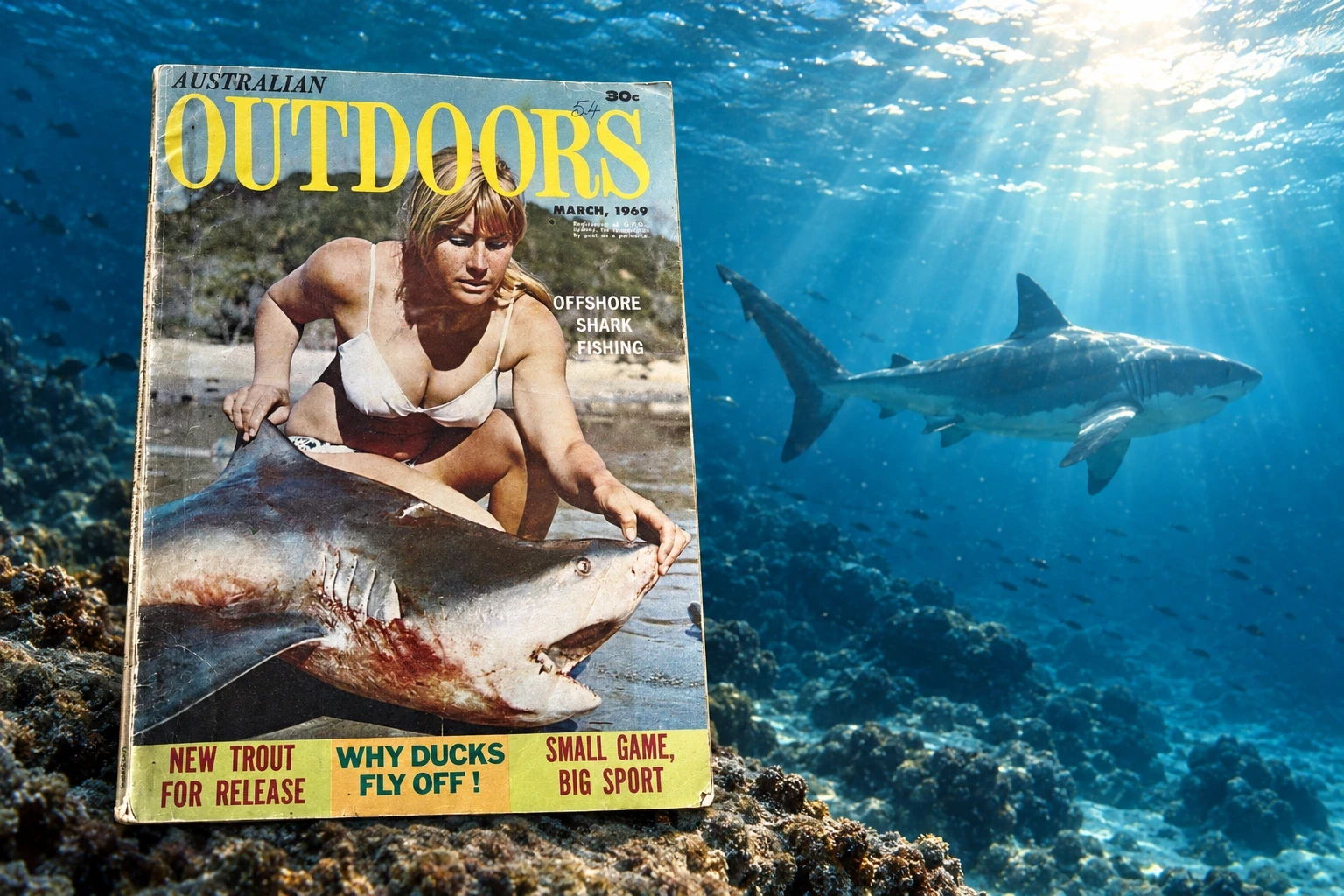
The old world remained visible while this new understanding grew. In March 1969, Australian Outdoors advertised “OFFSHORE SHARK FISHING” across its cover. The cover does not name the Taylors. It belongs to the world they were beginning to change: a world in which a large shark promised sport, danger and a story worth buying.
That magazine eventually reached the Sir John Monash Museum Free Book Swap. Found there more than half a century later, it opens a path into the Taylors’ much larger story. The magazine offers one way of seeing a shark. Their lives show how looking longer can transform the view.
This is the kind of journey an old object can begin. A visitor notices a cover, follows a question and meets two people who changed direction without surrendering their appetite for adventure. Their courage changed form: first getting close enough to compete, then staying close enough to understand and finally speaking loudly enough to protect.
This item was found through the Sir John Monash Museum Free Book Swap when this article was prepared. Items come and go, so it may no longer be on the shelf — but there is always something else waiting to be discovered.
Sources and further reading
- Ron and Valerie Taylor, Australian Museum
- Valerie Taylor—An underwater life, Australian National Maritime Museum
- Valerie Taylor: Saving the grey nurse shark, National Film and Sound Archive of Australia
- Valerie Taylor: *Playing with Sharks* excerpt, National Film and Sound Archive of Australia
- Sharks: management, conservation and white shark research, CSIRO
- Greynurse shark, NSW Department of Primary Industries and Regional Development