Rain closed around Derek Bell at Le Mans in 1995. Approaching the Porsche Curves at about 165 miles an hour, he could no longer see the edge of the track or the grass beyond it. He kept the McLaren moving through the darkness for two and a half hours.
Bell was 53. Sharing the car with his son Justin and Andy Wallace, he recovered the lead before a gear-selection problem disrupted their race. They finished third.
That night holds the qualities of Bell's long career in a single stint: speed sustained through uncertainty, a precise feel for the machinery and responsibility shared among three drivers and an entire team.
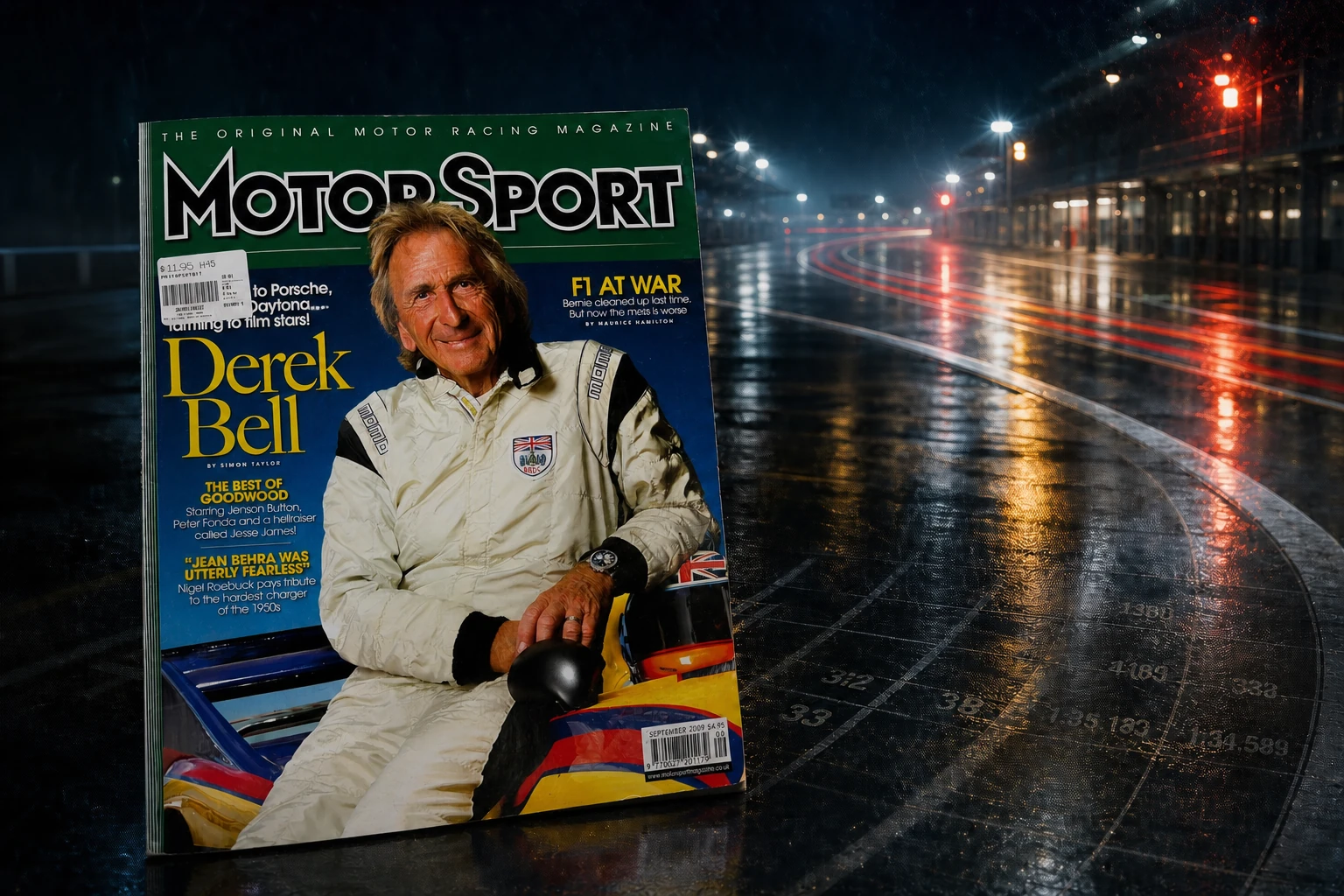
The September 2009 issue of Motor Sport, found through the Sir John Monash Museum Free Book Swap, carries Bell's face across its cover. Inside, Simon Taylor's feature, “Lunch with… Derek Bell”, follows the driver through the races, partnerships and decisions that shaped his life in endurance racing. The magazine is a doorway into a form of competition where victory belongs to a chain of people and every fast lap has consequences hours later.
Bell arrived there through single-seaters. After racing lessons with the Jim Russell school, he began competing in the mid-1960s and advanced through Formula Three. Ferrari brought him into Formula One, while a drive in a Ferrari 512S at Spa in 1970 opened the deeper direction of his career.
The car caught fire during the race. A mechanic broke a side window so Bell could keep going. The experience revealed the scale and intensity of sports-car racing: high speed carried across distance, machinery subjected to long punishment and a crew working to return a damaged car to the circuit.
His first start at the 24 Hours of Le Mans followed that year. In 1971 he shared a Porsche 917 with Jo Siffert and helped Porsche secure the World Championship for Makes. The foundations of an endurance career were taking shape.
The first Le Mans victory came in 1975. Bell and Jacky Ickx drove the Gulf-liveried Mirage GR8-Ford. A broken rear-suspension mounting forced Bell to nurse the car towards the finish. The winning drive depended on recognising what the car could still give and carrying it home.
Mechanical sympathy became one of the governing ideas of Bell's racing. It meant sensing the condition of the car through sound, movement and response, then matching pace to the distance still ahead. Bell admired the same quality in Ickx: great speed held within an understanding of risk, wear and the team's larger purpose.
The demands reached far beyond the cockpit. In the two-driver era, each driver could spend about 12 hours at the wheel over the course of Le Mans, with night stints lasting as long as four hours. Rest came in fragments. Traffic brought repeated closing speeds between cars of different classes. Weather changed the surface and visibility. The shared car carried the work of designers, engineers and mechanics, along with the prospects of the co-driver waiting for the next changeover.
Bell and Ickx won Le Mans together again in 1981 and 1982, this time for the Porsche works team. In 1983, Bell guided a Porsche 956 to second place with cracked brake discs. The result placed judgement at the centre of performance: preserve enough braking, maintain enough speed and deliver the car to the next lap.
The Porsche years gave Bell two further Le Mans victories. He shared the winning 962C with Hans-Joachim Stuck and Al Holbert in 1986 and 1987. The same period brought Bell world endurance championships in 1985 and 1986. He also won the 24 Hours of Daytona three times, in 1986, 1987 and 1989.
Those totals establish the scale of the career: five Le Mans victories, three at Daytona and two world endurance titles. The partnerships reveal how the success was made. Ickx, Stuck and Holbert each brought their own pace and judgement. Engineers prepared the car, mechanics kept it alive and each driver inherited the decisions made during the previous stint.
Bell distilled that responsibility in Taylor's 2009 feature: “temper your personal ambitions with the requirements of the team.” The sentence describes an ethic as much as a technique. Endurance racing asked a driver to remain extremely quick while protecting a shared effort that could unravel through one impatient choice.
The 1995 race brought that ethic into a new generation. Bell's son Justin had persuaded him to return to Le Mans, and their McLaren entry placed father and son in the same crew. Bell's rain-soaked night stint moved the car back into contention. The final third place became his last podium at the race and a demonstration of the craft he had accumulated over 25 years at Le Mans.
He made his final start there in 1996, his twenty-sixth appearance. By then, the victory list had become part of endurance-racing history. The sharper legacy lives in the way he described the work: speed joined to restraint, ambition placed inside a team and concentration renewed lap after lap.
The magazine on the shelf captures Bell in retirement, looking back. Pick it up and the cover opens onto motion: rain against a windscreen, failing brakes, a damaged suspension mounting and a co-driver waiting in the pits. Across all those hours, the essential achievement was to bring pace, car and people to the finish together.
This item was found through the Sir John Monash Museum Free Book Swap when this article was prepared. Items come and go, so it may no longer be on the shelf — but there is always something else waiting to be discovered.
Sources and further reading
- Lunch with… Derek Bell, Motor Sport Magazine
- Derek Bell, 2021 24 Hours of Le Mans Grand Marshal, Automobile Club de l'Ouest
- Derek Bell celebrates his 80th birthday, Porsche Newsroom
- Le Mans memories: Derek Bell and Mark Webber, Porsche Newsroom