On screen, each footfall appeared to carry weight. Bodies turned, fed, travelled and faced danger. The camera watched from animal height, giving every encounter the immediacy of a wildlife documentary.
How do you teach an animal that vanished millions of years ago to walk?
The creatures began as lumps of clay.
Before an animator could move a leg, somebody had to decide what that leg could do. Palaeontologists read the surviving clues: the proportions held in a skeleton, the fit of a joint, the scars where muscles once attached. Teeth suggested what entered an animal’s mouth. Trackways captured the spacing of steps made millions of years ago. Nests, eggs, skin impressions and other rare remains brought further pieces of a life into view.
Those pieces established the possibilities. A continuous animal still had to be built around them.
Under the guidance of palaeontologists, model makers shaped each creature in clay. Their hands gave volume to bones, stretched bodies across their frames and found the balance between muscle, skin and weight. Resin casts preserved the finished forms. Lasers then travelled over their surfaces, carrying the animals from the workbench into a computer.
The scans produced more than six million three-dimensional reference points. That abundance became its own obstacle. About 85 per cent of the data had to be stripped away before the creatures were light enough to move through the animation system.
Then the animators took over.
Every movement was built by hand through key poses. A foot met the earth. Weight travelled through a hip. A head turned towards movement beyond the frame. Each decision had to make anatomical sense, fit the timing of the scene and remain consistent with the animal that had appeared in the previous shot.
Close views demanded a different kind of presence. Practical-effects specialists at Crawley Creatures built animatronic heads and other physical elements that could occupy the same light and air as the camera. Digital bodies and practical effects became parts of the same animal.
The landscapes were already waiting.
Film crews had travelled to New Caledonia, Chile and Tanzania to photograph places capable of carrying the deep past. They filmed living forests, coastlines and open country with spaces reserved for animals that existed only in plans and models. A camera move through an empty landscape anticipated the height, speed and path of a creature that would arrive months later.
Every layer depended on the others. The palaeontologist’s judgement shaped the model. The model shaped the scan. The scan shaped the animator’s choices. The filmed landscape governed the light, angle and movement. Sound and editing finally drew the pieces into one living moment.
The first episode took about a year to complete. As the team found a way through each problem, the scale of the project grew. An early brief for 24 computer-generated creatures became 40. Nearly two and a half hours of photorealistic animation emerged from about two years of work.
The finished six-part series carried viewers through the Triassic, Jurassic and Cretaceous periods. Its natural-history approach gave prehistoric animals daily lives: movement across country, the search for food, encounters with rivals and the pressure to survive. The production received a Peabody Award, BAFTA’s 2000 Innovation prize and three Emmys. Its greatest feat happened in the viewer’s imagination. Dinosaurs became animals moving through a world.
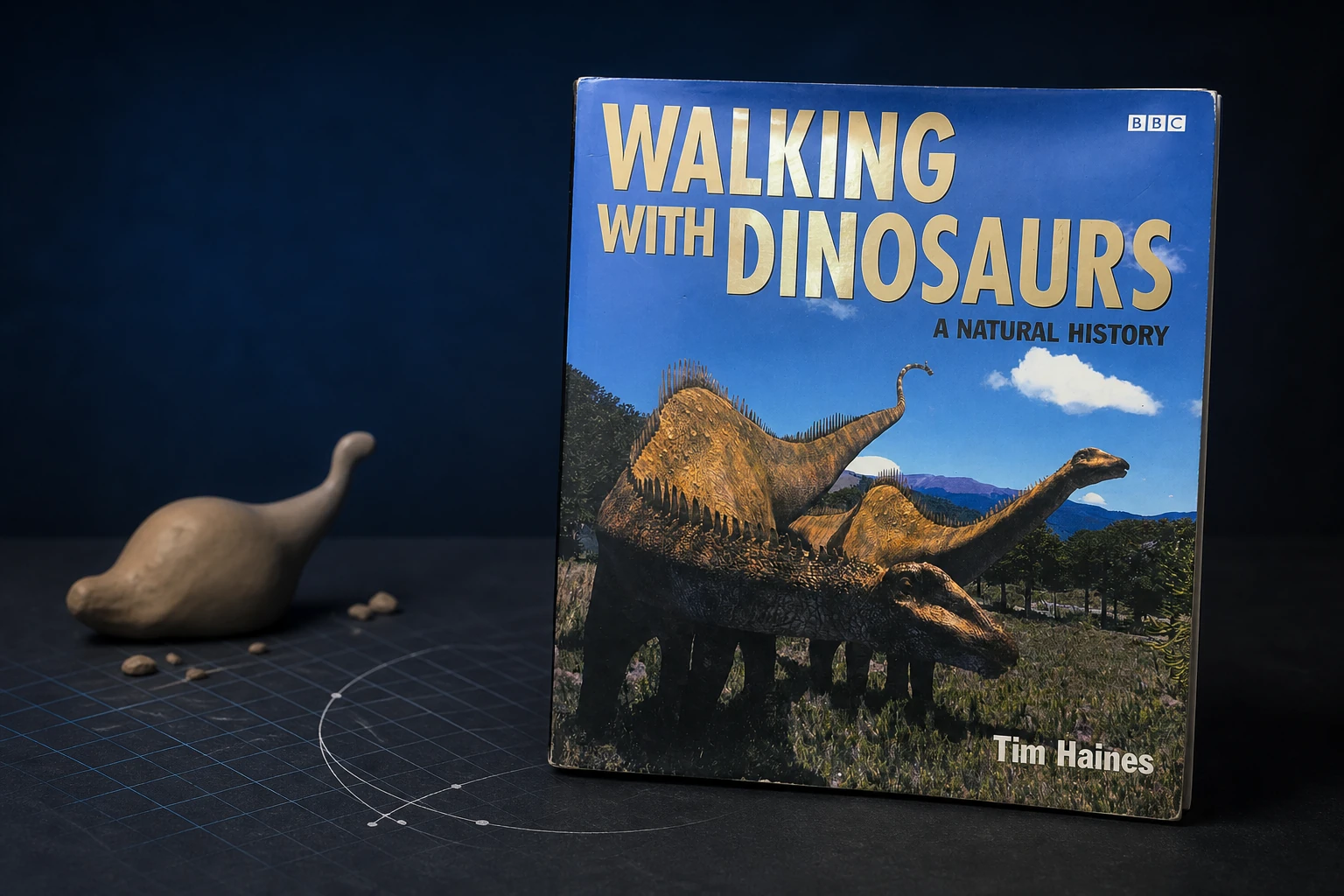
That world is held inside a blue book found through the Sir John Monash Museum Free Book Swap.
Tim Haines’s Walking with Dinosaurs: A Natural History appeared through BBC Worldwide in 1999 as a companion to the television series. The cover promises the experience at the heart of the project: a place beside animals separated from us by deep time. It also preserves the answer that one team created with the evidence and tools available at the end of the twentieth century.
The evidence has continued to grow.
Exceptionally preserved fossils have revealed traces of feathers and microscopic pigment-bearing structures. New technologies have allowed scientists to examine details that were once hidden. The range of defensible colours, surfaces, postures and movements has shifted as each discovery has entered the reconstruction.
The 1999 creatures remain fixed in their frames. Our picture of prehistory has continued to change.
In 2025, the BBC and PBS returned to Walking with Dinosaurs with a new six-part series. This time, individual dinosaurs were connected with fossils being unearthed by scientists in the present. The people recovering the evidence became visible alongside the lives they were trying to reconstruct.
The journey had come back to its beginning: a fragment in the ground, a question and a human being trying to understand what once moved there.
The blue book now holds one answer from 1999. Pick it up and the question returns. How would we teach these animals to walk today? Which movements would stay? Which colours, feathers or behaviours would change? What might the next fossil ask us to imagine again?
A community shelf can be a doorway into a world. Open this book and the clay model is still waiting on the workbench, ready to take its first step.
This item was found through the Sir John Monash Museum Free Book Swap when this article was prepared. Items come and go, so it may no longer be on the shelf — but there is always something else waiting to be discovered.
Sources and further reading
- Walking with Dinosaurs — 25th anniversary, Framestore
- Walking series, Framestore
- Walking with Dinosaurs, Peabody Awards
- Television Innovation in 2000, BAFTA
- Walking with Dinosaurs, Television Academy
- Walking with Dinosaurs by Tim Haines, Google Books
- What can scientists learn about dinosaurs and how?, Natural History Museum
- Walking with Dinosaurs, PBS