RoboCop arrived with the force of its own steel silhouette. It opened on 1,580 American screens in July 1987, earned $8 million in three days and reached $44.6 million within six weeks. Sequels, television versions, a 2014 remake and later games carried that image into new decades.
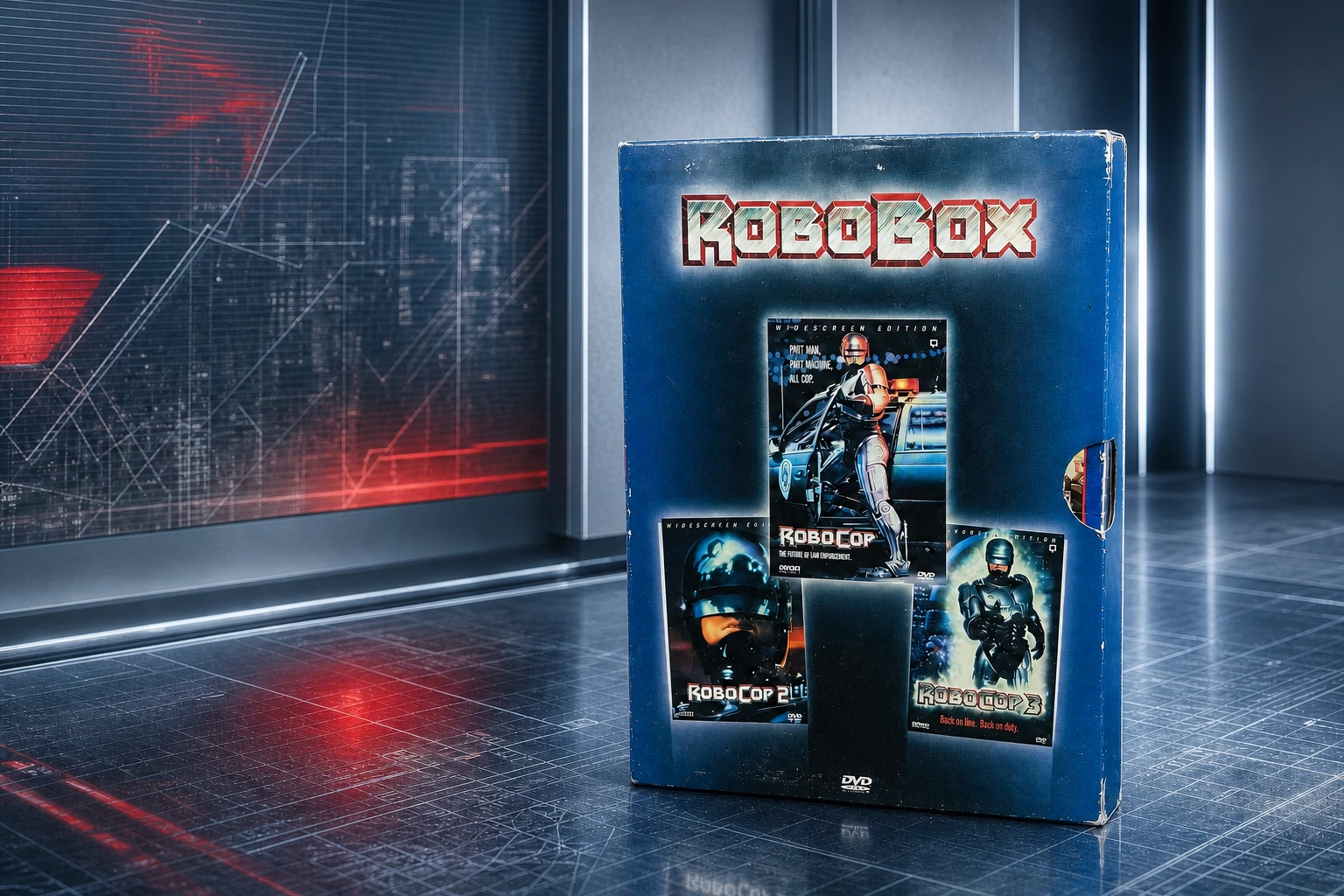
The worn blue box found through the Sir John Monash Museum Free Book Swap holds three of those early returns side by side. Across each cover, the armour promises certainty: polished, armoured, built to obey. The original film gives that image its lasting human charge through Alex Murphy’s returning history. Memory restores identity. Identity gives him a position from which to judge. Judgement makes choice possible again.
Orion Pictures gave RoboCop a modest promotional budget. The campaign relied on unusual ways of creating attention: critics saw an unfinished work print, costumed figures appeared at shopping centres and public events, and sneak previews played on 711 screens one week before the official opening.
The film entered cinemas on 17 July 1987 and found an audience immediately. Its success produced RoboCop 2 in 1990 and RoboCop 3 in 1993. Animated and live-action television series followed, along with a 2014 remake. In 2023, the Teyon-developed game RoboCop: Rogue City returned players to Old Detroit and the visual world of the original films.
That long afterlife begins with an exceptionally clear design. A person can recognise RoboCop from a helmet, a chest plate or the measured turn of a metal body. The silhouette is simple enough to survive changes of medium and generation. Its meaning comes from the man moving inside it.
Screenwriter Edward Neumeier began developing the idea in the early 1980s. His decisive step was to make the machine a man who had been used. That choice placed identity at the centre of the story from its earliest form.
Rob Bottin’s armour made the concept physical. Neumeier later recalled observing that its broad chest looked like the front of a truck. Bottin’s answer followed the story’s setting: Detroit. He had designed a car.
The result carries the visual language of a manufactured product. Broad panels cover the torso. Mechanical joints divide the limbs. The helmet reduces the face to a mouth and jaw. Silver-blue surfaces catch the light like metal travelling along an assembly line.
That manufactured body still needed a human way of moving.
The suit weighed 25 pounds. Peter Weller spent four months working with mime coach Moni Yakim, developing movement that could express the machine and the person confined within it. The finished performance has weight, restraint and rhythm. A foot plants before the body turns. A hand settles into position. The armour appears to govern every gesture, while small choices of timing allow Murphy to remain present.
The production itself placed Weller under severe pressure. The suit arrived late, and the movement he had prepared had to be reconsidered once he was inside it. Neumeier remembered the crisis and the way the character finally came alive through Weller’s physical work. The body looked manufactured. Its humanity depended on performance.
The future around RoboCop follows the same industrial logic.
The story is set in Detroit, where the corporation Omni Consumer Products has taken control of the police force and plans to replace Old Detroit with Delta City. Production designer William Sandell and the filmmaking team found much of that future in Dallas. Its modern skyline supplied the scale they needed, and Dallas City Hall became the exterior of OCP headquarters. The film’s climactic industrial landscape came from an abandoned steel mill outside Pittsburgh.
Government architecture, corporate offices, police operations and industrial ruin become parts of one administered city. OCP speaks about public order through products, contracts and market opportunities. Its executives compete over enforcement machines while the streets absorb the consequences of their decisions.
The film’s television interruptions extend that system into daily life. News, advertisements and violent entertainment arrive in the same bright broadcast voice. Neumeier has described the media breaks and comedy as deliberate parts of the screenplay. He also saw a connection between the enemies Murphy faces on the street and the people exercising power in the boardroom.
The satire gives the steel body a civic purpose. RoboCop is presented to the city as equipment: a corporate answer to crime, a public service turned into proprietary technology. OCP chooses his directives, controls his maintenance and expects obedience from its product.
Then Alex Murphy’s history begins to return.
Murphy enters the system as a police officer and emerges from it as an asset. OCP rebuilds his body, clears his memory and installs directives that define what he must do. His former life survives beyond the company’s design.
Fragments begin to surface. His partner Anne Lewis recognises the habits of the person inside the armour. A criminal recognises the officer he believed had been killed. Murphy returns to his former home, and memories of his wife, his son and his death re-enter his consciousness.
Remembered history gives those fragments continuity. The product has a past. The machine has a name. The assigned role becomes visible as something imposed upon a person whose life began before OCP claimed him.
That recovered identity changes what agency means inside the story. Murphy has immense physical power from the moment the system activates him. He can move through gunfire and overwhelm people who threaten the city. His most consequential strength develops when he can recognise the limits built into him and form judgements that belong to his recovered self.
The conflict becomes explicit when an undisclosed corporate directive prevents him from acting against a senior OCP executive. His body begins to shut down as he attempts to cross the boundary written into his programming. The company’s ownership reaches into his capacity to choose.
Memory creates a position from which that ownership can be understood. Identity allows him to distinguish his responsibilities from the corporation’s commands. By the end, when he identifies himself as Murphy, the name carries history, relationship and choice in a single word.
This is the resilience at the centre of RoboCop. The armour endures physical punishment. Murphy rebuilds continuity of self after an institution has renamed, repurposed and directed him. His history gives him somewhere human to stand.
Every continuation inherits the steel silhouette. The sequels on the Museum’s DVD package repeat it across three covers. Television adaptations, the remake and games have each returned to the same recognisable arrangement of visor, armour and controlled movement.
The image carries a question that can survive those changes: what allows a person to remain the author of their actions when a powerful system defines them chiefly by a role?
The original film answers through memory. History reconnects Murphy with the relationships and experiences that made him a person before he became a product. Identity strengthens his capacity for judgement. Agency becomes the ability to act from that recovered self.
The blue box on the shelf records the commercial afterlife of an invented future. Its worn edges belong to the life of a real object: manufactured, bought, watched, kept and eventually passed forward. Inside it, the same steel figure waits on three covers.
Pick up the box and the armour catches the eye first. Stay with the story and another form of strength emerges: the human capacity to remember who we have been, recognise what is trying to define us and choose what we will do next.
This item was found through the Sir John Monash Museum Free Book Swap when this article was prepared. Items come and go, so it may no longer be on the shelf — but there is always something else waiting to be discovered.
Sources and further reading
- A Conversation with Edward Neumeier, On Story, Austin PBS
- *RoboCop*, AFI Catalog of Feature Films
- *RoboCop* film record, The Criterion Collection
- Carrie Rickey on *RoboCop*, Criterion Current
- Contemporary *RoboCop* review, Sight and Sound, British Film Institute
- *RoboCop: Rogue City*, NACON