After the World Trade Center buildings collapsed in the September 11 attacks, structural steel, photographs, video, audio, design records and the accounts of witnesses and survivors became evidence. Investigators at the US National Institute of Standards and Technology had to reconstruct why the buildings fell, how people evacuated and how emergency response unfolded.
The collapse was recorded in photographs, video and audio. The work of understanding it continued through years of investigation.
A finding about fire resistance could reach a building code. An evacuation lesson could change how a building guides people towards safety. A finding about emergency communications could lead to a new requirement. Each possibility depended on investigators building an explanation strong enough for other people to act upon—and on those people carrying it into practice.
This is the story opened by a book found through the community swap at the Yallourn Production Centre.
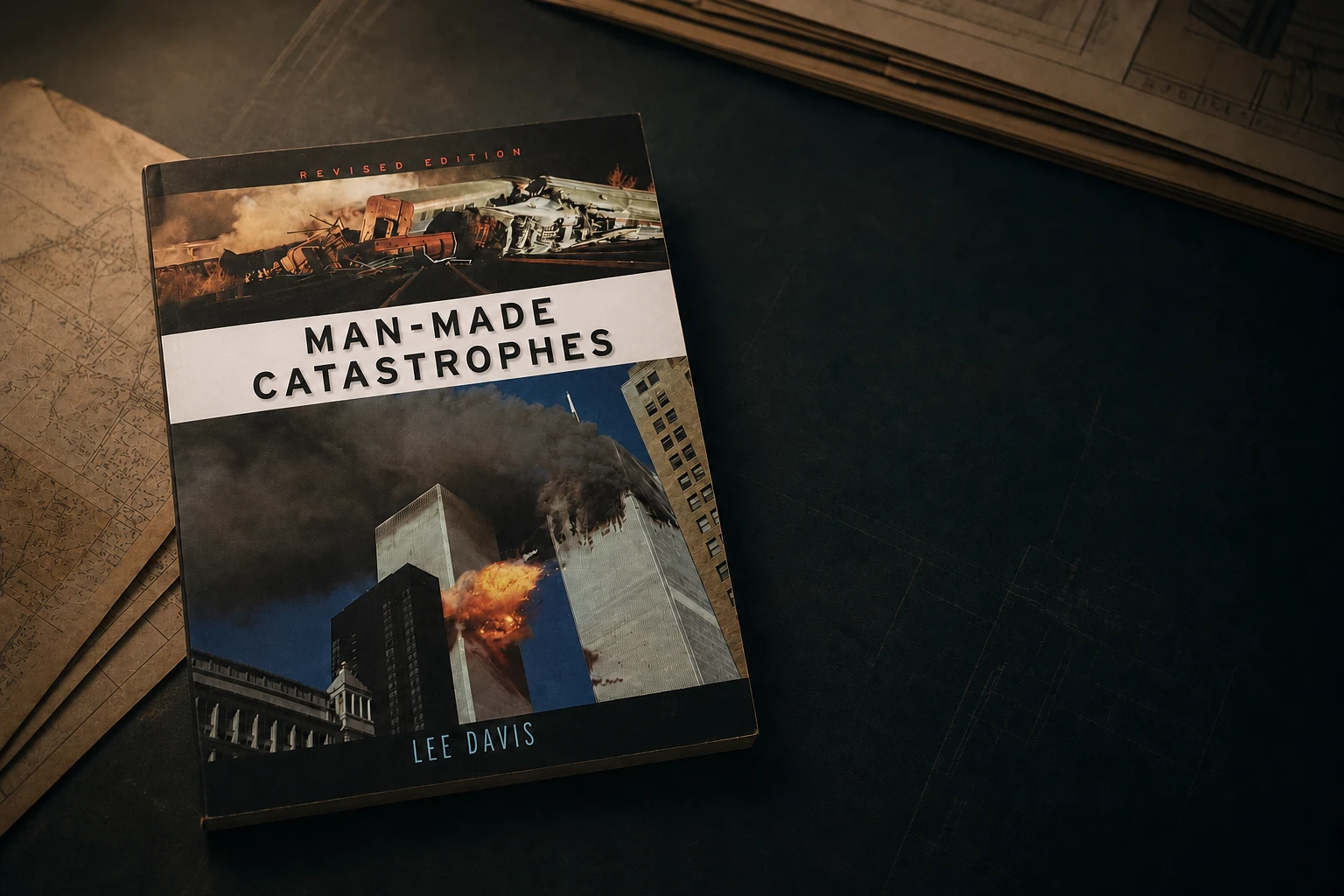
Lee Davis’s Man-Made Catastrophes appeared through Checkmark Books in 2002. A contemporary review described the revised work as an international encyclopaedia of non-natural disasters and noted the addition of September 11. Its cover places the burning World Trade Center beneath the title and carries a thin red line across the top: Revised Edition.
Those two words now ask something of the history beyond the book. What must people revise after catastrophe has exposed how harm became possible?
The question inside the title
The title Man-Made Catastrophes points directly towards human responsibility. It also gathers very different chains of causation beneath one label.
A deliberate attack, a failed component, an unsafe procedure and an overlooked warning all involve human action. Each creates a different investigation. A hazardous event becomes a disaster through its interaction with where people live, how systems are built, what protections exist and how well a community can respond.
The United Nations Office for Disaster Risk Reduction defines a disaster through that interaction: a hazardous event meets conditions of exposure, vulnerability and capacity, producing serious disruption and loss. This systems view gives investigators a demanding question. They must establish how the harm became possible across a chain of design, maintenance, decisions, conditions and response.
The first visible failure may be only one link.
The evidence room after the headline
Investigators work with objects that have already carried human consequences. They examine wreckage and structural materials. They gather designs, inspection files, maintenance records and operating procedures. They interview witnesses and survivors. Each source can alter the sequence; each sequence can alter the explanation.
After the September 11 attacks, teams at the US National Institute of Standards and Technology investigated why the World Trade Center buildings collapsed, how occupants evacuated and how emergency response unfolded. They drew on interviews, design and maintenance records, structural steel, photographs, video and audio.
The evidence had to carry several experiences at once: the physical behaviour of the buildings, the movement of people trying to leave and the conditions facing emergency responders. A useful finding had to explain those relationships clearly enough for architects, engineers, code bodies and emergency planners to act on it.
NIST ultimately produced recommendations concerning structural integrity, fire resistance, evacuation and emergency communications. Relevant codes and standards were later updated. Evidence from one place and time had begun moving towards buildings that had not yet been designed.
That movement reveals the next difficulty. An investigation can identify the change. Other people must carry it into practice.
When evidence becomes a recommendation
The US National Transportation Safety Board issues recommendations when its investigations identify a specific safety concern. Those recommendations are directed to the organisations best placed to act: regulators, manufacturers, operators, government agencies and industry bodies. The Board then tracks the response, often for years, until a recommendation can be closed.
The finding therefore enters another chain of responsibility. A regulator may need to change a rule. A manufacturer may need to alter equipment. An operator may need to rewrite a procedure or retrain staff. Each action has its own decision-maker, timetable and consequences.
Chemical industry investigations show how far that chain can extend. The US Chemical Safety and Hazard Investigation Board examines equipment failure, human error and the safety-management systems that allowed a danger to survive. Its recommendations can reach procedures, training, equipment, standards and oversight across organisations connected to the risk.
A broken part identifies one failure. The inspection history, operating instructions, training and oversight reveal who could prevent the same conditions from forming again. Investigation makes responsibility useful when it connects a finding to the people able to change the system.
The long life of a recommendation
A recommendation begins a period of work whose duration cannot be read from the original headline.
Some recommendations are adopted quickly. Others depend on regulators, standards organisations, manufacturers or entire industries. The NTSB may track a response for years. An open recommendation keeps the connection visible between the evidence and the organisation expected to act.
The work travels through a maintenance manual rewritten after an investigation. It enters a building code debated and amended, an evacuation procedure tested before it is needed, a component removed from service or a training program changed. Each step moves the lesson away from the site of the catastrophe and towards people exposed to a similar risk.
This is where the story remains unfinished. Investigators can preserve the evidence, test explanations and identify corrective action. The protection promised by their work arrives when the recommendation changes what somebody designs, inspects, maintains or does.
The passage from finding to practice is the long life of a catastrophe. It can continue after the wreckage is cleared, the inquiry closes and the event disappears from daily news.
The other revised edition
The small red words on Lee Davis’s cover now point in two directions.
They record a book changed by events through 2002. They also evoke the revisions pursued by investigators: a clearer explanation of failure, a recommendation addressed to someone with power to act, a standard amended, a procedure rewritten.
The book remains fixed at the moment it went to press. The systems shaped by catastrophe continue to change through people who preserve evidence, listen to testimony, test explanations and follow recommendations across the years.
Its red label names one revised edition. The work after catastrophe pursues another—in buildings, vehicles and workplaces whose people may never know which piece of evidence helped make them safer.
This item was found through the Sir John Monash Museum Free Book Swap when this article was prepared. Items come and go, so it may no longer be on the shelf — but there is always something else waiting to be discovered.
Sources and further reading
- Man-Made Catastrophes by Lee Davis, Open Library
- Book Reviews, Fall 2002, Center for Land Use Interpretation
- Definition: Disaster, United Nations Office for Disaster Risk Reduction
- World Trade Center Investigation, National Institute of Standards and Technology
- Safety Recommendations, National Transportation Safety Board
- About the CSB, US Chemical Safety and Hazard Investigation Board