
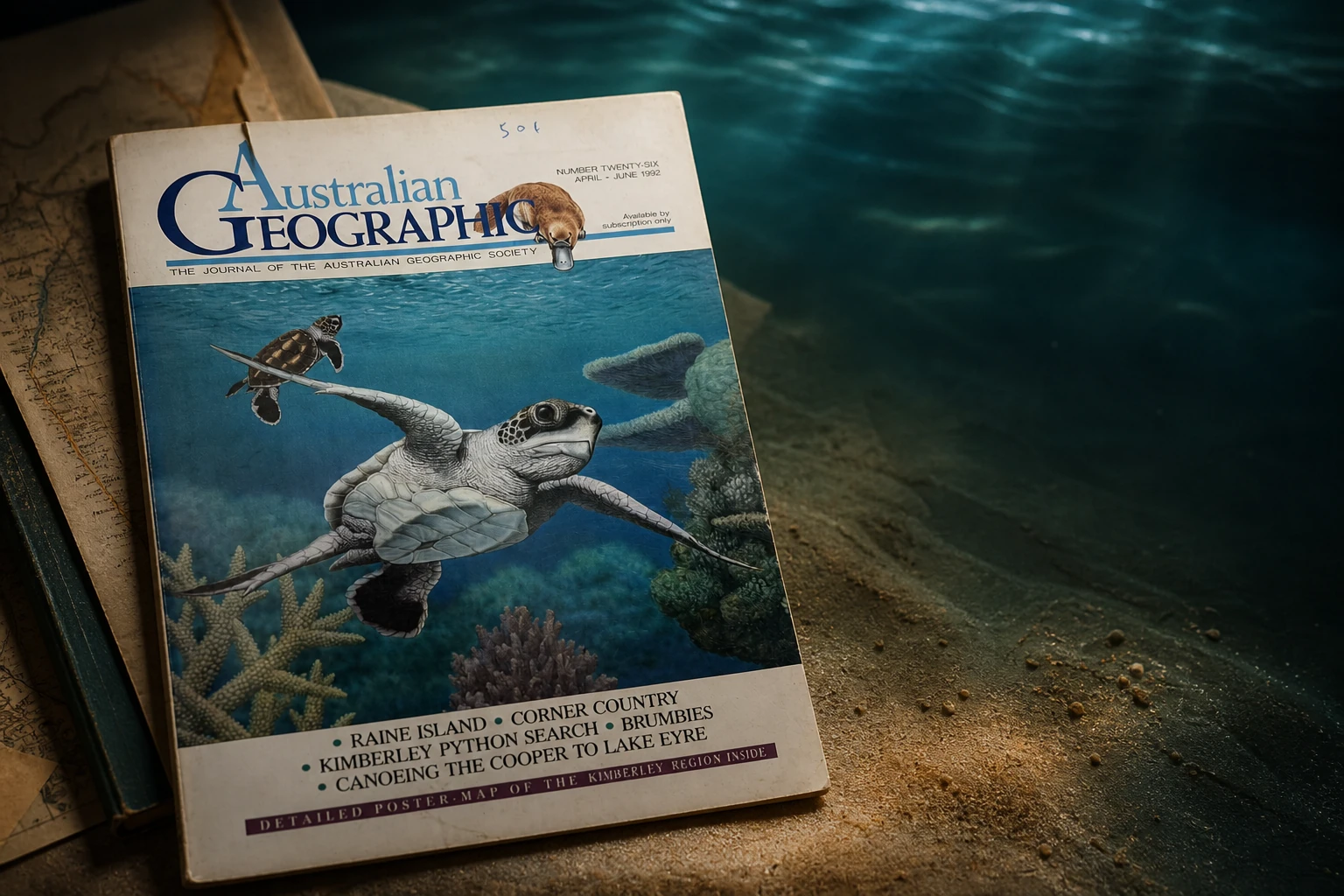
A green turtle carries decades to the beach.
By the time she is old enough to breed, at least thirty years have passed. Her return to Raine Island joins a movement far larger than one animal: in a great nesting season, tens of thousands of females converge on this small place at the far northern edge of the Great Barrier Reef.
The numbers suggest abundance. The journey onto the sand tells a more difficult story.
When the beach is crowded, a female may make repeated nesting attempts. Research at Raine Island found that attempts took longer and demanded more energy in a denser season. A nest finally laid may still be reached by a high tide. Even above the waterline, embryos can die before hatching for reasons that remain complex. The turtle has survived the ocean for decades, yet the future of her young turns on the conditions inside a chamber of sand.
This long return is the story behind an image found at the Sir John Monash Museum community swap. On the cover of Australian Geographic, Number 26, April–June 1992, a green turtle seems to fly through blue water. A line below the illustration reads simply: “Raine Island”. The magazine opened the door. The turtle carried us through it.
The island beneath the gathering
Raine Island is the world’s largest green-turtle nesting site. Together with nearby Moulter Cay, it receives about 90 per cent of the nesting activity of the northern Great Barrier Reef green-turtle population. Turtles converge there from feeding grounds across northern Australia and the wider region.
The island is also part of a much older human story. The Wuthathi People and Meriam Nation People of Ugar, Mer and Erub hold long cultural connections with Raine Island, its waters and marine life. Those responsibilities are living ones. Traditional Owners take part in decisions about the island and in the work undertaken to protect it.
Raine Island’s importance is easy to express as spectacle: a small island, an immense arrival, a beach alive with turtles. Scale can deceive, however. A crowded nesting ground can appear vigorous even while the population’s prospects are weakening.
That contradiction became stark in the mid-1990s. During the enormous 1996 nesting season, almost no hatchlings emerged. Low nests were being inundated by high tides, but water did not explain every loss. Researchers also found high early embryo mortality in nests that remained dry. There was no single, simple failure to repair.
A future decided by degrees
For a green turtle, heat does more than make nesting harder. It helps determine whether a hatchling develops as female or male: warmer sand produces more females; cooler sand, more males.
The imbalance documented in the northern Great Barrier Reef population is extraordinary. In a 2018 study, researchers examined turtles at feeding grounds and used genetics to trace their origins. Of those from the warmer northern rookeries, 99.1 per cent of juveniles and 99.8 per cent of subadults were female. Adult-sized turtles were also strongly female-biased, though less extremely so.
These figures describe sampled groups, not every turtle beneath every stretch of sand. Their meaning nevertheless reaches across generations. The Great Barrier Reef Marine Park Authority considers the northern population to be in significant decline, with very few males recruited in recent years.
The danger is not the sudden disappearance of turtles from the beach. It is that the great return may continue to look magnificent while becoming harder to sustain. An adult female arriving now embodies conditions from decades ago, when she began life. The hatchlings produced today belong to a future we will wait decades to understand.
Giving each return a better chance
At Raine Island, conservation has meant changing the ground beneath the turtles.
Teams have moved tens of thousands of cubic metres of sand, raising and reshaping parts of the nesting beach above tidal inundation. The work doubled the area of viable nesting habitat. Protective fencing helps keep exhausted females away from dangerous sections of the island’s rocky centre, while rangers and researchers rescue turtles that become overturned, trapped or heat-stressed.
The work brings together Wuthathi and Meriam Nation Traditional Owners, government agencies, reef managers, researchers, business and the Great Barrier Reef Foundation. The Foundation estimates that the interventions have enabled hundreds of thousands of additional hatchlings to begin life.
Each hatchling matters. So does the honesty to recognise that this is not a completed rescue.
The Reef Authority reports that hatchling production has continued to decline since 2019 despite the gains made through management. The beach can be raised, vulnerable adults protected and nests given better odds, but the wider pressures continue: warming sand, rising seas, storms and changing habitats along the turtles’ migrations.
The timescale resists a neat conclusion. A hatchling emerging in 2026 will not be old enough to breed until the 2050s at the earliest. By then, the success of work being done today will depend on conditions across an ocean and on a nesting island that must remain viable through decades of change.
What the turtle carries
The turtle on the magazine cover is fixed forever in blue water, flippers spread, always approaching and never arriving. The living turtle has no such stillness. Her story is measured in migrations, difficult nesting attempts and years beyond the reach of any single project or publication.
She also carries a warning about what our eyes can miss. Abundance in one season does not guarantee renewal. A beach full of females does not answer the question of where the males will come from. A hatchling reaching the sea is a beginning whose outcome may remain unknown for more than thirty years.
The old magazine gave us a turtle suspended in wonder. Raine Island reveals the greater story: a long return, repeated across generations, and a future being decided one nest at a time.
This item was found through the Sir John Monash Museum community swap when this article was prepared. Items come and go, so it may no longer be on the shelf — but there is always something else waiting to be discovered.
Sources and further reading
- Raine Island National Park: nature, culture and history, Queensland Government
- Raine Island priority place, Australian Government
- Marine turtles in the Great Barrier Reef Outlook Report, Great Barrier Reef Marine Park Authority
- Environmental Warming and Feminization of One of the Largest Sea Turtle Populations in the World, Jensen and colleagues, 2018
- Patterns of nesting behaviour and nesting success for green turtles at Raine Island, Hamann and colleagues, 2022