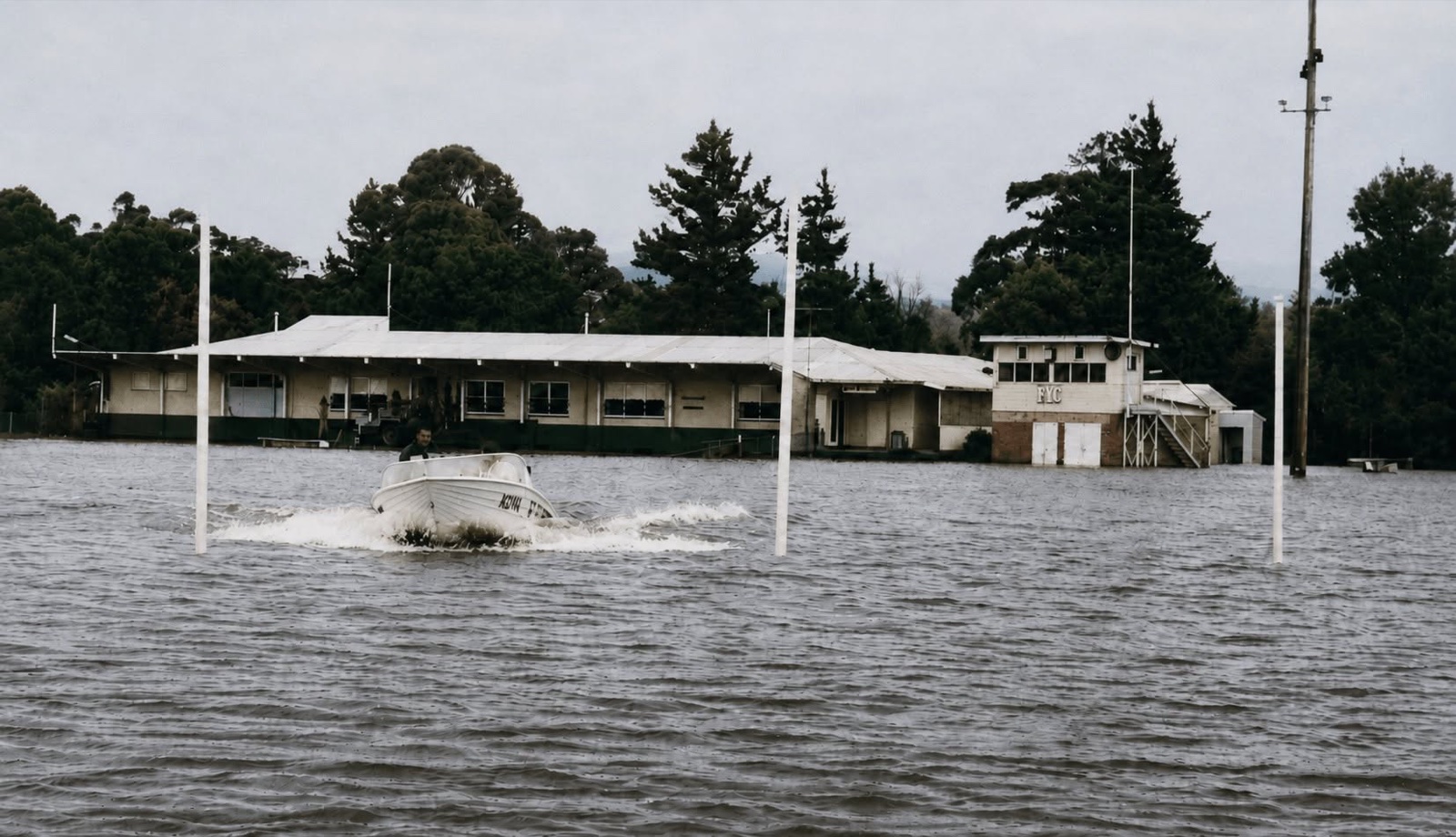
It was November 1971. Don Suckling and Ross Simpson had looked across the flooded oval and found a use for it. The boat went in. A ski rope followed. One of Yallourn’s most carefully prepared public spaces became a water-skiing course between the goalposts.
The same ground had hosted an official VFL premiership match. Len Hutton had made 75 there for the touring Marylebone Cricket Club. Johnny Wardle had taken twelve wickets. Olympic athletes had competed before thousands of people only days after the Melbourne Games. Generations of local children had trained there, groundsmen had guarded its surface, and volunteers had marked its lines and filled its clubrooms.
Then the water rose, and Yallourn played on the water.
The episode carried the character of the town in a single afternoon. Yallourn expected high standards. Its people also knew how to enjoy the moment when the world ignored the plan.
A sporting ground made from a swamp
The ovals began in wet ground. From 1928, volunteers worked to drain an area remembered as the Melbourne Swamp. Water had to be removed, the ground formed and the surface prepared before the first boundary could be marked or the first wicket rolled. The land required labour before it could become recreation.
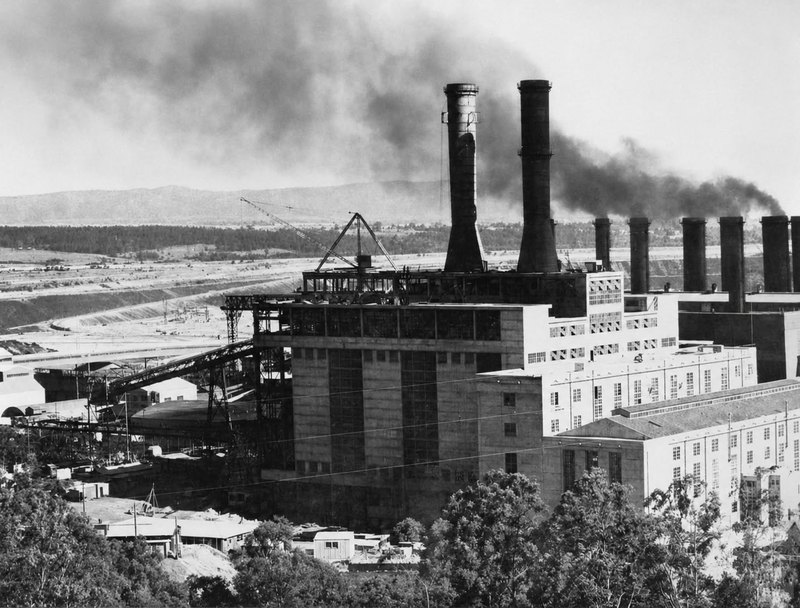
That work belonged to the wider construction of Yallourn. The State Electricity Commission was building a power industry, a town and a way of life around Victoria’s brown coal. Houses appeared along planned streets. Schools, gardens, shops and public buildings followed. Sporting grounds formed part of the same civic design.
The people operating boilers, excavators, workshops and transmission systems needed places to play after work. Their children needed room to run, train and compete. Families needed a boundary line around which they could gather on Saturday afternoons. Yallourn’s sporting grounds carried all of those expectations.
William Henry Brewer helped give them structure. Known across the town as “Dad” Brewer, he had arrived during Yallourn’s early industrial years and managed the SEC brickworks that supplied materials for the developing township. He later became one of the central organisers of Yallourn sport. Football, cricket, soccer, bowls and the Sports Oval Trust all carried his influence. He served Yallourn Football Club, helped establish and lead the cricket club, supported the bowling club and held senior positions across local sporting organisations.
His contribution was eventually written into the grounds themselves. The pavilion at No. 1 Oval carried his name.
Brewer understood that a club required the same things as a town: people willing to attend meetings, collect subscriptions, organise fixtures, maintain facilities and return the following year to do it again. Grand sporting occasions depended on that quiet administrative work. Someone had to keep the minutes, arrange the umpires, find transport, inspect the rooms, manage the gate and make certain the ground was ready.
Yallourn developed that capacity early. It built clubs deep enough to outlast individual players and organised enough to attract major events.
The men who made the grass
The oval’s reputation began underfoot. John “Jock” Lawson arrived at Yallourn in 1929 to take responsibility for the SEC’s parks and gardens. He had trained in Scotland, worked at Glasgow Botanic Gardens and Kew, and later served at the Ballarat Botanical Gardens. His task at Yallourn reached across the town’s formal gardens, street plantings, bowling greens, parks and sporting surfaces.
A cricket wicket demanded exact work. The soil had to be prepared, rolled and protected. Moisture had to be judged. The outfield required a consistent surface. Rain changed the timing of every decision. A badly prepared pitch exposed itself with the first ball that lifted unexpectedly or stopped in the wicket.
Lawson and the grounds staff treated that work as a profession.
Alf White assisted in preparing the turf for the 1955 visit by the English tourists. Covers stood ready if the weather turned. The outfield was cut and presented with the care expected at a major metropolitan ground.
Later players remembered Bob MacGregor guarding the oval during football training. He watched the movement of boots across the grass and intervened when drills threatened the surface. Norm Hall recalled that MacGregor monitored training “like a hawk.” The description places him near the boundary, studying the traffic around the wicket square and acting before damage became visible.
The ground developed its spring, evenness and colour through this constant attention. Players experienced the finished surface. Groundsmen experienced every week of work beneath it.
The day VFL football came to Yallourn
On Saturday 14 June 1952, Yallourn joined Sydney, Hobart, Brisbane, Albury and Euroa as a host of the VFL’s “National Day.”
The league had taken every match in Round Eight beyond its usual Melbourne grounds. St Kilda and Footscray were sent to Yallourn. The decision placed the town among the regional and interstate centres trusted to stage premiership football.
Rain began before the players arrived.
A curtain-raiser between Footscray Fifths and Central Gippsland schoolboys opened the surface and churned the wet soil. Ground staff spread coal dust in an effort to manage the mud. At Yallourn, coal entered the football story directly. It mixed with rainwater and soil, clung to jumpers and darkened the players from boots to shoulders.
Ken Mulhall later remembered the St Kilda side looking like chimney sweeps.
About 3,500 spectators gathered around the oval. They watched Ted Whitten kick an early goal for Footscray and saw St Kilda’s Alan Squire work through the wet conditions in the ruck. Jack McDonald kicked two goals for the Saints. Whitten finished with two for Footscray.
St Kilda won 7.7 to 5.4, its first victory of the season.
The score remained modest because every possession had to be earned from the ground. The ball skidded, stopped and disappeared beneath bodies. Marks required strength through wet hands. Kicks came off heavy boots. Players rose from packs carrying Yallourn across their skin.
The league had brought metropolitan football to a brown-coal town. The oval answered with rain, mud, coal dust and a complete premiership contest.
Len Hutton walks onto the wicket
Three years later, the same sporting precinct received the Ashes-winning English tourists.
The Marylebone Cricket Club came to Yallourn in February 1955 for a match against a Victoria Country XI. Play was scheduled for Saturday and Monday, with Sunday kept as a rest day. The tourists stayed at the Yallourn Hotel. Local people gathered nearby for a glimpse of men whose names had travelled through newspaper columns and radio broadcasts across the summer.
England had secured the Ashes. Several leading Test players were rested. The side that came to Yallourn still carried immense stature.
Captain Len Hutton opened the batting. Reg Simpson and Tom Graveney joined him in the order. Godfrey Evans kept wicket. Alec Bedser, Peter Loader and Johnny Wardle carried the bowling attack. These were men accustomed to Test grounds, packed grandstands and international scrutiny.
Yallourn gave them a country oval prepared to the same standard.
Victoria Country batted first and made 182. Peter Loader took four wickets. Johnny Wardle took five. The most substantial resistance came from William Desmond “Bill” Young, who made 56 against the English attack.
Young had come from Stratford and had already established himself as one of Gippsland’s finest footballers. His cricket innings at Yallourn added another layer to an extraordinary sporting life. One year later he entered the VFL with St Kilda, kicked 56 goals in his debut season and led the league’s goalkicking. He would lead St Kilda’s goalkicking for five consecutive seasons.
At Yallourn, his job was different. He stood at the crease against Bedser, Loader and Wardle and gave the country side its best score.
Local players carried the town directly into the match. Dick Sagar of Yallourn kept wicket for Victoria Country. A Yallourn fast bowler named Grant opened the bowling. Their familiar ground had become a stage for international cricket.
When the MCC batted, Hutton made 75. Simpson scored 59 and Graveney 50. The tourists declared at 307 for eight. Victoria Country then made 99 in its second innings. Wardle took seven more wickets and completed match figures of twelve for 91. MCC won by an innings and 26 runs.
The result belonged to the touring side. The ground belonged to Yallourn.
English cricketers, journalists and commentators praised the oval as the finest country ground they had encountered on tour. Lawson’s daughter later recalled Hutton writing to thank her father and comparing the Yallourn surface favourably with the Adelaide Test ground used that summer.
That praise reached beyond grass and soil. It recognised the work of Lawson, White and the SEC staff who had prepared a country oval for men who knew precisely what a great cricket ground felt like.
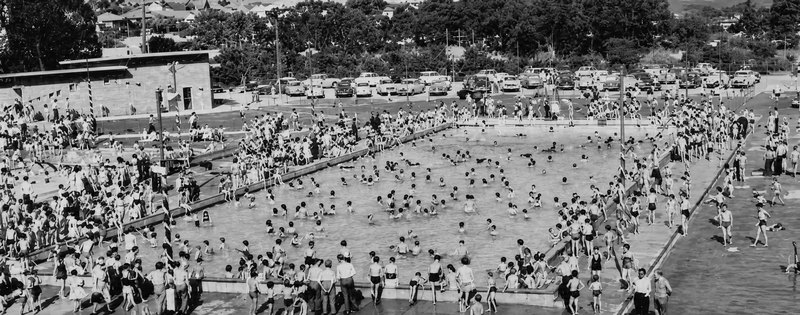
The match also changed the rhythm of the town. Schools and banks closed at noon on the Monday. Businesses anticipated missing staff. Temporary seating increased the capacity. Some children released from school for the cricket found their way to the swimming pool instead.
Across Yallourn, normal routines gave way to the arrival of England.
Yallourn invites the Olympics
The following year, Melbourne hosted the Olympic Games.
Yallourn’s athletic organisers saw an opportunity.
Members of the Yallourn Amateur Athletic Club travelled to the Olympic Village and approached team officials directly. They invited athletes from around the world to compete at Yallourn on 2 December 1956, immediately after the Olympic track-and-field program had concluded.
The invitation carried confidence. The club had a ground, an organisation and a town capable of receiving them.
Athletes from Europe, Asia, Africa and the Americas accepted. A special train was arranged from Melbourne. Harry Hopman, already one of Australia’s most prominent sporting leaders, opened the meeting. About 13,000 people gathered at the oval.
The crowd watched Georgios Roubanis of Greece compete in the pole vault only days after winning the Olympic bronze medal with a Greek-record clearance of 4.50 metres. At Yallourn he won again.
René Djian of France, a competitor at the Helsinki and Melbourne Olympics, won the 800 metres. Czechoslovakia’s Štěpánka Mertová, who would compete at two Olympic Games, won the women’s discus.
The event became known as the Little Olympics.
Vic Gust, president of the Yallourn Amateur Athletic Club, helped drive the organisation. His family participated in the club and carried the memory of the day forward. Bill Titulaer also belonged to that athletic community. His son Tony later described him as a “possibilitarian,” a man inclined to see what could be achieved and then begin the work required to achieve it.
A group of local athletics officials went to Melbourne during the Olympic Games, entered the international village and asked world-class competitors to travel to a power town in Gippsland. The athletes came. A crowd larger than the population of many regional centres filled the oval to see them.
For one afternoon, Yallourn stood inside the Olympic story.
The weeks between the great occasions
The oval’s real life continued after the special trains departed.
Children played junior football behind houses near Hernes Oak in teams called the Reds and Blues. They travelled to matches at Hill End, Moe and Yallourn North in the back of a furniture truck. Norm Hall began among those young players, captained the Latrobe Valley schoolboys and later represented Victoria in a team led by future Brownlow medallist Ross Smith.
Joe Carmody coached Yallourn’s young footballers. He worked at a menswear shop, held team meetings in his room at the Yallourn Guest House and treated bruises with a heat lamp before applying liniment. He loaded players into his vehicle and drove them to Windy Hill to watch Essendon. Hall remembered him as a man concerned with the development of the boys as well as the result on Saturday.
Jack Huxtable learned football administration in Yallourn. He served as club secretary in the early 1950s, later led the Latrobe Valley Football League and became president of the Victorian Country Football League. His work helped strengthen elite pathways for country players and contributed to the system that eventually gave Gippsland footballers access to statewide under-age competition.
The oval gave people room to become players, coaches, administrators and mentors.
Its influence reached beyond No. 1 Oval. In 1967, India played an All-Gippsland XI at No. 2 Oval during the tourists’ Australian visit. India was captained by Mansoor Ali Khan Pataudi, the Nawab of Pataudi. Norm Byrne captained Gippsland, and Yallourn cricketer John “Jumbo” James joined the local side.
James had already produced one of district cricket’s most severe bowling performances, taking all ten wickets for 28 runs against Morwell in the 1963–64 season. At No. 2 Oval, he faced an international touring team on home ground.
Yallourn’s second oval could carry that occasion because the sporting culture extended across the whole precinct.
The lake disappears
By November 1971, decades of football, cricket and athletics had accumulated beneath the grass of No. 1 Oval.
Then floodwater covered it.
The boat moved through a landscape built by Brewer’s generation, prepared by Lawson’s staff and used by Whitten, Hutton, Wardle, Young, Roubanis and thousands of local competitors. Its wake crossed the wicket. Water moved around the goalposts. The pavilion bearing the history of Yallourn sport stood behind the improvised course.
Don Suckling and Ross Simpson turned the flood into an event of their own.
The water was later drained. The oval returned to football.
That detail completes the story. The ground commanded serious work when serious work was required. Its surface could host elite competitors because people had spent years building, rolling, mowing, organising and protecting it. When the oval became a lake, the people of Yallourn recognised the conditions in front of them and found the sport the conditions allowed.
Yallourn’s sporting grounds were made from drained land and maintained by skilled hands. They brought VFL football, Ashes winners, Olympic medallists and an Indian Test team into the daily landscape of a town built beside an open cut.
Children rode to matches in a furniture truck. A coach treated bruises beneath a heat lamp. A groundsman watched training like a hawk. Schools closed for England. Thirteen thousand people gathered to watch Olympians. Coal dust turned league footballers into chimney sweeps.
Then a motorboat passed between the goalposts.
Sir John Monash Museum
30 Yallourn Drive, Yallourn
Open
Tuesday 10:00am–2:00pm
Sunday 10:00am–3:00pm