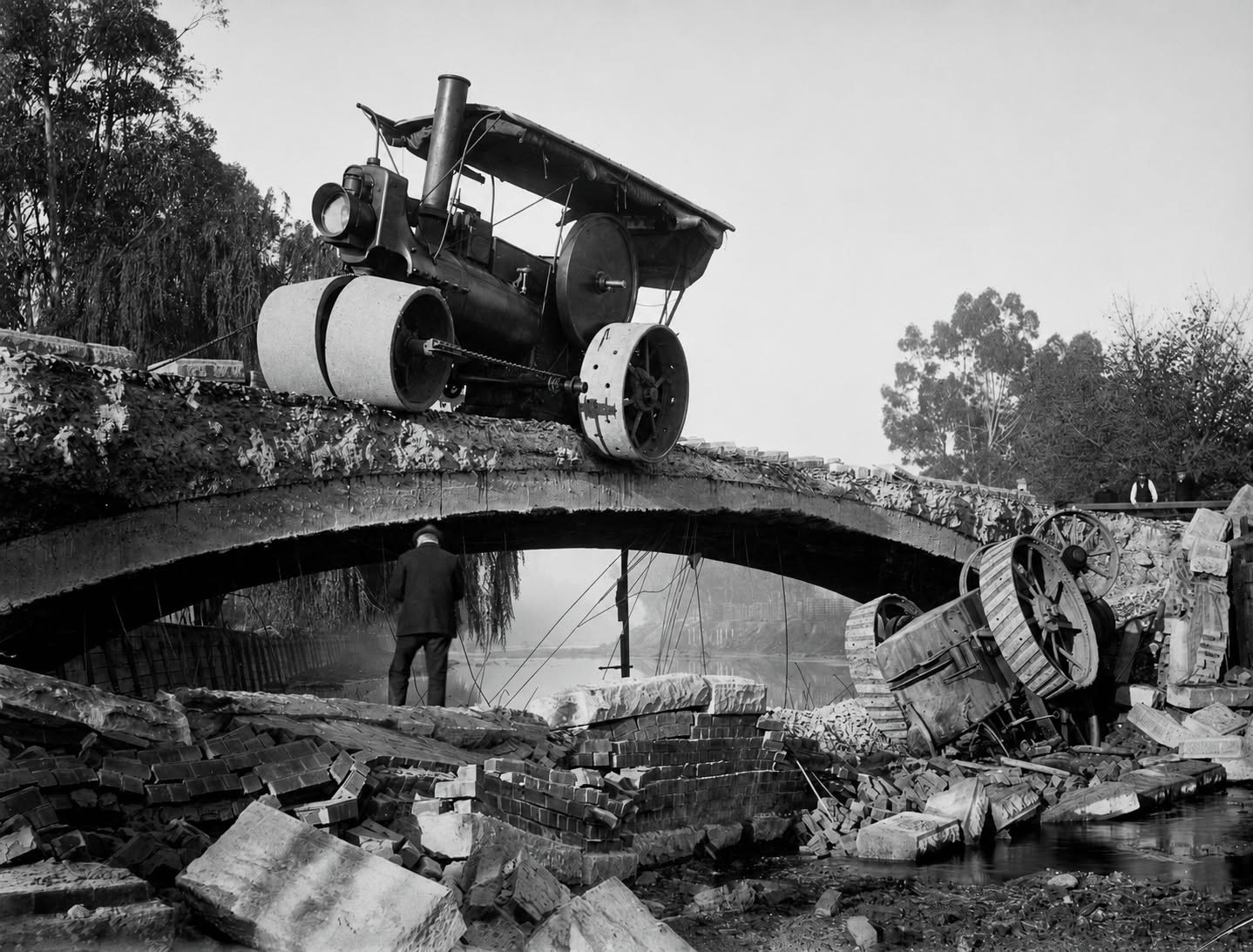
Concrete splintered from the arch. Masonry fell into Bendigo Creek. The traction engine overturned among the shattered remains of the bridge, its wheels left pointing towards the sky. The steamroller remained above, balanced on the surviving section with its heavy front drum close to the broken edge.
Several men escaped the collapse.
Albert Edward Boldt did not.
Boldt, a well-known Bendigo contractor and timber merchant, was carried down with the traction engine and crushed beneath it. The wreckage around him marked the failure of one of the most ambitious reinforced-concrete bridges yet attempted in Victoria—and the most serious engineering crisis of John Monash’s early career.
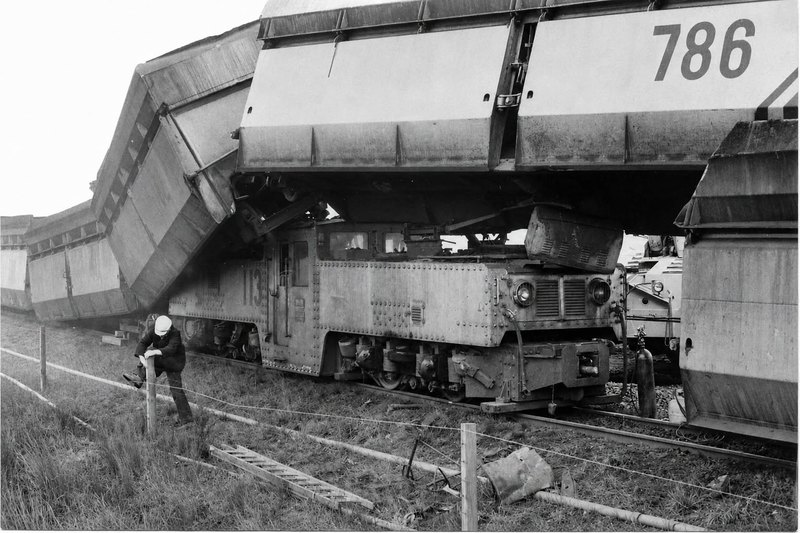
The surviving image preserves the scale of that moment. A man stands beneath the fractured arch while broken bricks, concrete blocks and machinery fill the creek bed around him. Above, the steamroller remains almost improbably upright. The photograph carries the stillness that follows sudden destruction: the machinery has stopped, the bridge has opened beneath it, and the consequences have become permanent.
A new material for a growing city
Bendigo entered the twentieth century as a wealthy goldfields city confronting the physical legacy of mining. Bendigo Creek had been altered by decades of settlement, industry, sludge and debris. Municipal works were undertaken to reshape and improve the watercourse, and new bridges were required to carry the city’s roads across it.
Monash and his business partner, Joshua Thomas Noble Anderson, secured contracts to build a group of reinforced-concrete arch bridges over Bendigo Creek and nearby Back Creek. Their bridges used the Monier system, an emerging method that placed iron reinforcement inside concrete so the two materials could carry different kinds of force together.
Concrete was exceptionally strong under compression. Iron could carry tension. Combined correctly, they promised bridges that were strong, durable and adaptable, with fewer of the limitations associated with timber, masonry and iron structures.
Monash understood the possibilities immediately.
He and Anderson had acquired rights to use the Monier system in Victoria and South Australia, placing their firm at the front of a major change in Australian construction. Reinforced concrete would eventually become one of the basic materials of modern civilisation. In 1901, its behaviour was still being explored through calculations, practical experience and structures that had to prove themselves under load.
King’s Bridge became the most demanding bridge in the Bendigo contract.
The road crossed the creek diagonally rather than squarely. The result was a sharply skewed arch approximately 28.5 metres long, made as three adjoining reinforced-concrete arch sections across its width. Its angle produced a structure whose forces were far more complicated than those in an ordinary bridge.
That complexity sat inside a bridge that appeared almost complete.
Then came the test.
Thirty tons on the arch
A steamroller was driven onto King’s Bridge to test its strength. A steam traction engine was also placed on the crossing, concentrating an extraordinary weight over the new arch.
The machinery represented the industrial world the bridge was being built to serve. Steamrollers compacted the roads of growing towns. Traction engines hauled heavy loads and powered machinery. A modern bridge needed to carry modern weight.
As the test continued, concrete began to break away.
Then approximately one-third of the bridge’s width failed.
The traction engine plunged into the creek bed, taking Albert Boldt with it. The steamroller remained on the surviving section. Other men scrambled clear as the arch beneath them separated and fell.
The death of Boldt placed the failure beyond the realm of professional embarrassment or financial loss. A family had lost a man. Bendigo had witnessed a fatal public-works disaster. Reinforced concrete, the material Monash and Anderson had championed, now stood beneath intense scrutiny.
An inquest convened in Bendigo’s Warden’s Court. Lawyers represented Boldt’s relatives, the council, and Monash and Anderson. Witnesses were questioned about the design, workmanship, materials, supervision and loading of the bridge.
The central question carried enormous weight:
Why had King’s Bridge fallen?
Professor Kernot enters the story
Monash and Anderson turned to Professor William Charles Kernot, the University of Melbourne’s first professor of engineering and one of Victoria’s leading authorities on structural design.
Kernot visited the site four times. He examined the plans, inspected the remains and tested the materials used in the bridge. His evidence at the inquest began to separate assumption from fact.
The cement had performed well. The concrete was sound. The surviving abutments showed substantial strength. The collapse had been caused by something deeper than poor material.
The bridge’s severe skew had changed the path of the forces moving through the arch. Conventional assumptions treated the arch thrust as though it would travel in a relatively predictable direction towards the abutments. King’s Bridge directed that force towards the sharp corners of the structure, concentrating pressure where the bridge was least able to carry it.
The bridge had obeyed physics with complete precision. The calculations available to its designers had failed to describe that behaviour fully.
Monash had followed accepted engineering practice while pushing a relatively new construction system into unusually difficult geometry. The bridge exposed the limits of that practice. Its collapse turned an abstract weakness in contemporary engineering knowledge into broken concrete, twisted machinery and the death of Albert Boldt.
The load test had been severe. Professor Kernot considered it heavier than the bridge tests with which he was familiar. Yet the test had also revealed a structural weakness that ordinary traffic might otherwise have discovered later, without warning and perhaps with even greater loss.
King’s Bridge had failed publicly and catastrophically. Monash now had to decide what the failure would make of him.
Responsibility became reconstruction
Monash and Anderson rebuilt the bridge at their own expense.
They retained the abutments, introduced a central pier and replaced the original long arch with two shorter arches of approximately 13.2 metres each. The revised arrangement dramatically reduced the forces carried into the ends of the bridge and gave the structure a more reliable way to transfer its load into the ground.
The rebuilt bridge passed its test.
It remains part of Bendigo’s road network today. The crossing was later widened with a companion structure, while the early Monash and Anderson bridge survived beneath generations of traffic. Its heritage significance now rests partly in the fact that it embodies both failure and correction: the evidence of an emerging technology, the limits of early design knowledge and the engineering response that followed disaster.
Monash’s decision to rebuild cannot restore Albert Boldt’s life. Engineering responsibility begins with that truth.
Monash investigated the cause. He sought expert judgement. He accepted the financial consequences. He changed the design rather than defending it. He returned to the site and completed the work.
The bridge that stands emerged from the lessons of the bridge that fell.
From Bendigo to Yallourn
Professor Kernot’s place in Monash’s story did not end beside the broken arch.
His nephew, Charles Home Kernot, later became a senior engineer with the State Electricity Commission of Victoria. He was closely involved in the construction and commissioning of Yallourn Power Station from 1921 to 1927, then continued through major SEC works including the Sugarloaf–Rubicon hydroelectric development, the recovery of the Yallourn open cut following the 1934 Latrobe River flood, and the Kiewa hydroelectric scheme. He eventually rose to become the SEC’s chief engineer.
That family connection creates a remarkable line through Victorian history.
In Bendigo, William Charles Kernot helped Monash understand why an experimental bridge had failed.
Twenty years later, Charles Home Kernot helped build the power system through which Monash intended to transform Victoria.
The connection reached into the civic landscape of Yallourn itself. Kernot Hall opened in the Yallourn town square in April 1959. It became a place for concerts, conventions, weddings, exhibitions, meetings, reunions, television programs and wrestling. The hall stood within the community created around the power undertaking, carrying the name of an engineering family whose relationship with Monash had begun amid the wreckage in Bendigo.
The name later travelled to Morwell, where Kernot Hall became one of the Latrobe Valley’s best-known public venues.
For local people, this turns a distant bridge collapse into part of a familiar landscape. Kernot is a name spoken at community events, exhibitions, dinners, concerts and gatherings. Monash is a name carried by roads, institutions, memorials and the museum at Yallourn. Their histories intersected long before either name became part of the Valley’s geography. They intersected when a bridge fell.
The engineer before the general
The Monash remembered across Australia is usually the general of the Western Front: the commander associated with planning, coordination, technology and the disciplined use of every available resource.
The Monash remembered in the Latrobe Valley is also the engineer and public administrator: the man who led the State Electricity Commission, advanced the development of Yallourn and treated Victoria’s brown coal as the foundation of a modern electricity system.
King’s Bridge reveals the formation of that man.
It shows Monash working in a field where knowledge remained incomplete and ambition carried real risk. It shows him facing evidence that contradicted accepted assumptions. It shows the cost of structural failure in the most human terms. It shows a professional reputation placed under pressure and a response built around investigation, redesign and completion.
Those qualities later appeared on a far larger scale.
At war, Monash insisted that plans, logistics, artillery, infantry, aircraft, engineers and communications had to operate as one system. At the SEC, he approached mines, power stations, transmission networks, finance, housing, transport and workforce organisation as parts of another immense system.
King’s Bridge gave him an early and severe lesson in what happens when one part of a system carries forces its designers have failed to see.
What remains
King’s Bridge still crosses Bendigo Creek.
Traffic passes over a structure whose earlier form collapsed during a test more than 125 years ago. Most motorists will never see the broken arch, the overturned traction engine or Albert Boldt beneath the machinery. They will never hear Professor Kernot explaining how the force had travelled through the structure, or watch Monash return with a bridge divided into two shorter spans.
The road remains open because the failure was examined rather than hidden.
The bridge also carries a warning that belongs to every era of engineering: confidence must remain answerable to evidence. New technology demands courage, discipline and humility. Calculations describe reality only when the assumptions beneath them are sound. Responsibility begins when the structure behaves differently from the plan.
Albert Boldt’s death gives that lesson its enduring weight.
King’s Bridge became part of Monash’s education long before Yallourn, the SEC or the Western Front placed him at the centre of Australian history. It taught him that failure must be faced in full, that expert knowledge must submit to physical reality, and that leadership is measured by the work undertaken after the collapse.
The bridge fell beneath John Monash.
The engineer who emerged rebuilt it.