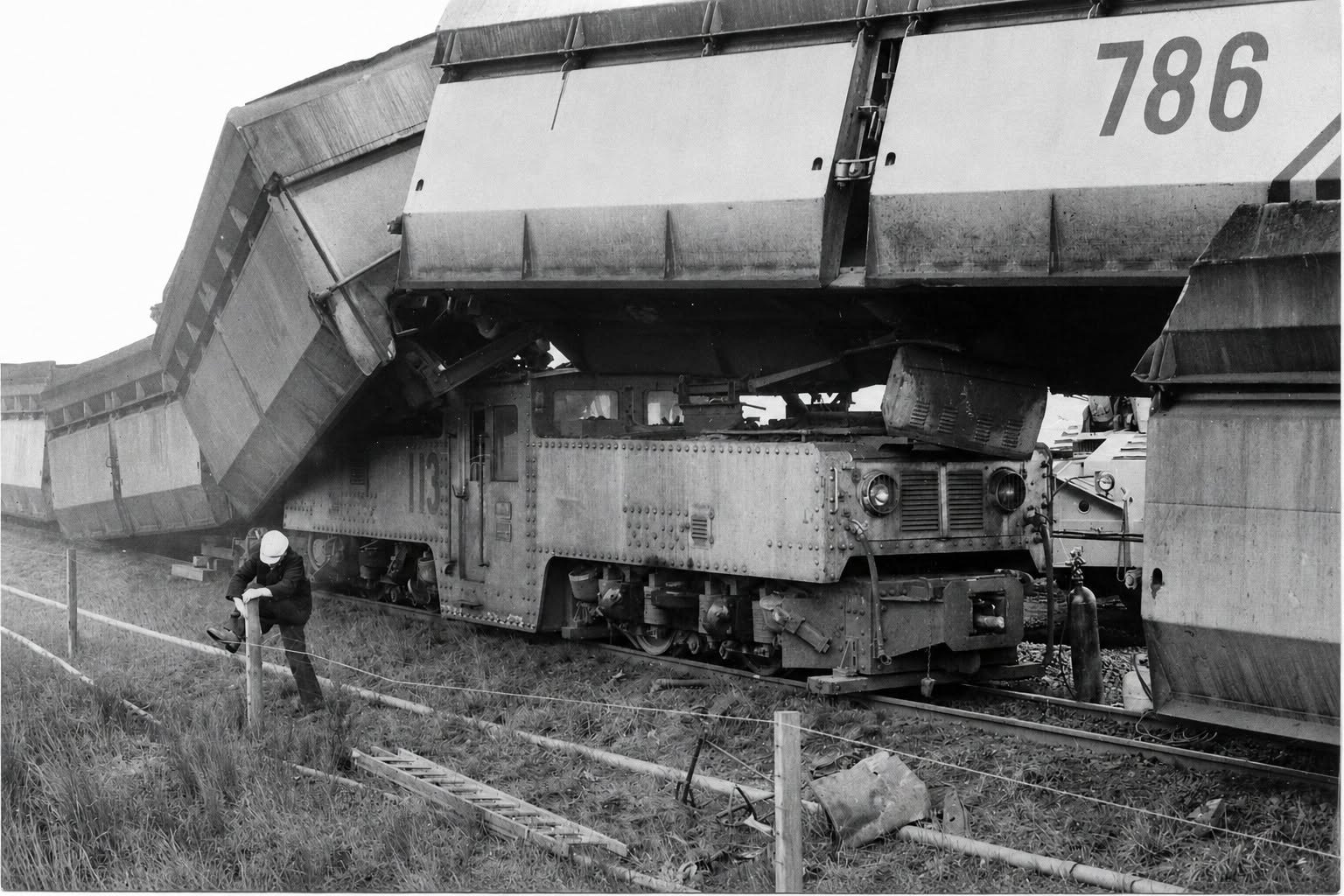
The stillness stands out. Carriage No. 786 rests across the roof of electric locomotive No. 113, its steel underframe lifted high above the cab and held there at an angle that seems to defy the weight involved. Behind it, another wagon has folded into the wreckage. A worker stands nearby, reduced almost to insignificance by the scale of the machinery surrounding him, while the open cut stretches away beyond the collision as though the mine itself has paused to absorb what has happened.
Everything here was built for movement. The locomotive was designed to pull coal through one of the largest industrial landscapes in Victoria. The wagons were built to carry the mine’s output towards the power station and briquette works. The track beneath them was created to move sideways as the excavation advanced. Even the earth around them was in a constant state of removal and rearrangement. On 24 August 1980, that entire system came abruptly to rest around locomotive No. 113.
The official record reduced the event to a few spare facts. An empty coal train travelling from Morwell collided with locomotive No. 113. The leading carriage rose over the locomotive, leaving No. 786 suspended across its roof. The damage was severe enough for No. 113 to be written off, ending a working life spent hauling coal through the shifting levels of the Yallourn Open Cut.
The driver survived. The position of the carriage above the cab reveals how narrow that survival may have been.
Industrial reports are written in the language of machinery because machinery can be measured. Steel bends by a certain amount. A locomotive is repaired or condemned. A section of track is cleared and returned to service. The people inside the machinery are harder to contain within a line of official text. They carry the memory home. Their families hear what happened. The men in the workshop study the damage, imagine the moment of impact and quietly recognise how easily the driver’s name might have appeared in a different kind of report.
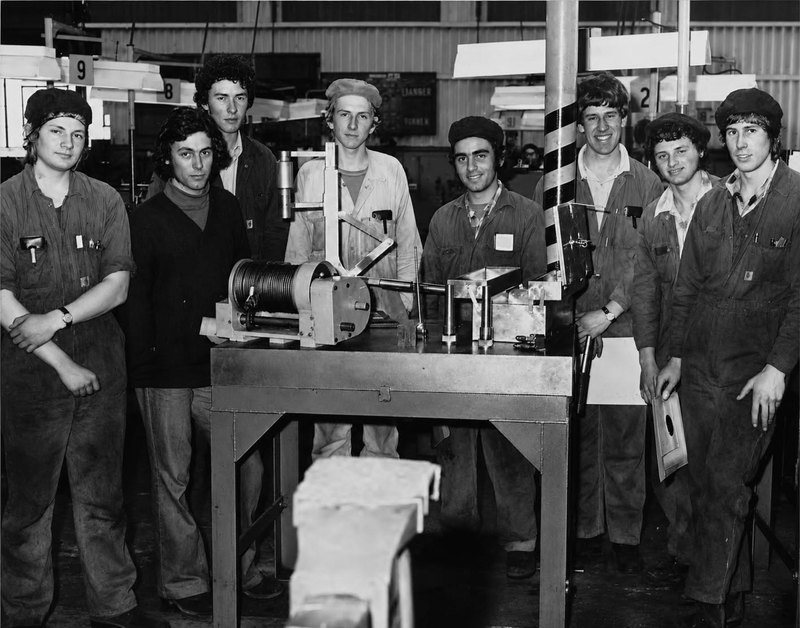
For a young apprentice named Denis Meany, the wreck became part of his education in Yallourn’s industrial world. He remembered the image of the collision as the prized possession of his supervisor, a private record of one of the railway’s more spectacular failures. The State Electricity Commission documented its achievements carefully, but accidents of this scale rarely belonged to the public face of the organisation. When the opportunity arose, Meany quietly gave the image what he later described as “a new home.”
The gesture was mischievous, personal and unexpectedly valuable. Decades later, it preserved the moment when Yallourn’s immense engineering system revealed its human vulnerability.
The railway inside the open cut was one of the most unusual transport systems in Australia. Its rails were set 900 millimetres apart, and its electric locomotives drew power from overhead wires carrying approximately 1100 volts of direct current. Coal trains moved from the dredgers towards the power station and briquette works, while overburden trains carried away the clay and soil lying above the brown-coal seam.
The engineering challenge began with the mine itself. An open cut has no permanent edge. The face advances as coal is removed, while the levels, gradients and access routes alter around it. Track laid beside a dredger could become inconvenient within weeks and useless soon afterwards. A railway built in the conventional manner, with deep ballast and fixed electrical structures, would constantly find itself stranded beside a landscape that no longer existed.
Yallourn’s answer was a railway capable of changing its position. Temporary track rested on sleepers laid directly across the working levels, while the supports for the overhead electrical wires were mounted on extended sleepers connected to the railway. Mechanical track-shifting machines could lift the rails, sleepers and electrical supports together, easing the entire formation sideways as the dredgers moved deeper into the coal.
The system expressed the practical intelligence that became a hallmark of the State Electricity Commission. Its engineers did not attempt to discipline the mine into behaving like a conventional railway environment. They designed a railway that accepted the instability of the mine and moved with it.
For the people working there, that ingenuity created a workplace with its own demanding rhythm. Drivers guided locomotives through fog, rain, darkness and coal dust. Track workers maintained points and alignments across ground that might soon be shifted again. Electricians kept the overhead system alive as the railway changed position. Fitters and boilermakers repaired machines returning from the open cut carrying the strain of heavy loads, unstable track and continuous operation.
The open cut worked through the night because Victoria’s demand for electricity did not stop at sunset. Long before Melbourne homes switched on lights in the morning, the Yallourn railway was already awake. Electric motors drew current through the overhead wires, dredger buckets cut into the face, wagons filled beneath enormous machinery and locomotives began another journey through the mine.
Shane Browne, who worked on the electric locomotives during the early 1980s, remembered the maintenance crews as a great team of people. Their knowledge lived partly in manuals and partly in experience accumulated over years of listening, watching and repairing. Each locomotive developed a reputation. Some were regarded as reliable and straightforward to maintain. Others returned to the workshop with recurring faults and familiar weaknesses.
To the SEC, a locomotive was a numbered industrial asset. To the tradesmen responsible for keeping it alive, it had a history, a temperament and a recognisable voice.
Browne was particularly fascinated by the mercury-arc rectifiers supplying direct current to the railway’s overhead wires. These devices belonged to an earlier and more visible era of electrical engineering. Under load, mercury vapour glowed with an intense blue light while the equipment produced a deep electrical hum. As locomotives accelerated and drew power, the rectifiers responded, filling their surroundings with light and sound.
The railway could therefore be sensed before it appeared. Its presence travelled through the metallic beat of machinery, the hum of electrical equipment and the distant movement of wagons across the open cut. Yet the trains themselves could approach with surprising quietness.
Fine brown-coal dust collected between the wheels and the rails, softening the usual clatter of railway movement. In an environment already filled with dredgers, motors, wind and industrial activity, a heavy electric locomotive could be much closer than a worker realised.
The SEC fitted loose steel rings known as janglers around the wagon axles. As a train moved, the rings struck together and produced a continuous metallic warning. Their purpose was simple and immediate. A worker concentrating on a set of points, a fitter beside temporary track or a driver approaching an industrial crossing needed to hear that a train was coming.
The janglers became part of the acoustic landscape of Yallourn. Their clatter carried across the levels as a reminder that the railway never ceased to demand attention.
Danger belonged to the work because the work took place inside a landscape under constant transformation. Temporary track could settle or move. Points could fail. Trains operated on steep gradients and around dredgers whose scale dwarfed the locomotives beside them. Many movements involved engines pushing wagons from behind, which restricted the driver’s view of the leading end of the train. Darkness and fog reduced that margin further.
The collision involving No. 113 exposed the consequences when several parts of that system failed to remain in harmony. One movement had stopped. Another continued. The impact forced carriage No. 786 upwards and across the locomotive below, turning the orderly geometry of railway engineering into a mass of displaced weight.
The men arriving at the wreck would have recognised the machinery immediately. They knew the coupling systems, the bogies, the electrical equipment and the physical limits of the steel. They also knew the driver. In a large city, an industrial accident might involve strangers brought together by circumstance. Yallourn was a community built around a shared system of work. Drivers, fitters, electricians, supervisors and apprentices lived in the same town, played sport through the same clubs and met one another in the shops and streets after the shift had ended.
The man inspecting the cab might have known the driver’s family. The tradesmen preparing to recover the locomotive may have served their apprenticeships beside him. The apprentice standing at a distance could have seen the same men playing cricket or football the previous weekend.
Bad news travelled quickly through Yallourn because the workforce and the community were woven together.
The town was designed around industry, but life there extended far beyond it. Workers left the open cut and returned to tree-lined streets, sporting grounds, community halls, churches and gardens. They played in the Yallourn Band, joined the fire brigade, served on committees and raised families whose lives were closely connected with the organisation employing much of the town.
A man could spend the day maintaining a locomotive and the evening helping to run a sporting club. A foreman responsible for hazardous work in the mine might also be the neighbour who helped a young family settle into Yallourn. The electrician who repaired a traction motor could sit beside the locomotive driver at a community event later that week.
The machinery was immense. The relationships around it were intimate.
That intimacy gave the work additional weight. A locomotive failure affected production, but an accident affected people whose lives continued beyond the mine gate. The crew called to clear the wreckage understood both consequences. They had to restore the railway, assess the damage and return the system to operation. They also had to face the fact that someone they knew had survived a collision whose outcome could easily have been fatal.
Once No. 113 reached the workshops, the emotional force of the accident gave way to the disciplined work of assessment. Tradesmen examined motors, bogies, control equipment, brakes, couplings and fractured steel. They determined what could be salvaged and what had passed beyond repair. The locomotive had spent decades hauling coal through the open cut, but the collision had brought its service to an end.
No. 113 belonged to a generation of larger Henschel electric locomotives introduced during the early 1950s. It weighed approximately 61 tonnes and developed around 760 kilowatts. Those specifications explained what it could do, but they could not describe the years of accumulated labour around it: the drivers who worked its controls, the tradesmen who kept it operating, the apprentices who learned its systems and the thousands of journeys it made through a mine that never retained the same shape for long.
The locomotive’s loss reduced the railway’s working fleet at a time when the system itself was approaching the end of its life. Conveyor belts had begun replacing rail haulage as excavators grew larger and the mine moved towards continuous material handling. The transition unfolded progressively through the 1960s, 1970s and early 1980s.
The railway disappeared for the same reason it had been created: the mine had changed.
Its removal did not diminish what it had achieved. For close to six decades, the railway carried coal through a landscape that resisted permanence. It survived floods, fires, unstable ground, derailments and continual expansion. It supported the power station and briquette works through a period when Victoria’s homes, factories, railways and industries increasingly depended on Yallourn.
Every movement formed part of a chain. Dredgers exposed the coal. Trains carried it. Boilers turned it into heat. Turbines converted that heat into electricity. Transmission lines carried the power towards places far beyond the Latrobe Valley.
A broken locomotive could interrupt that chain. A delayed coal train could become a production problem. Enough disruption could reach factories, businesses and homes whose occupants would never know the names of the workers responsible for restoring the flow.
That responsibility shaped the culture of the SEC. Sir John Monash became its chairman in 1920 and helped establish an organisation founded on technical excellence, disciplined planning and public purpose. The railway that developed at Yallourn reflected those values, but its daily success depended on the people who translated institutional ambition into practical work.
The engineers designed the system. The workforce kept it alive.
Most of the railway eventually disappeared. Locomotives and wagons were scrapped, track was lifted and electrical equipment removed. The sounds that had once filled the open cut faded with the machinery that produced them.
Locomotive No. 113 did not survive. Carriage No. 786 became part of a remembered accident rather than a continuing railway. The apprentice’s decision ensured that the moment itself remained visible.
What he preserved carries the full weight of Yallourn’s story. It contains engineering brilliance and human fallibility, industrial strength and personal vulnerability, public achievement and private memory. It shows a system powerful enough to help build modern Victoria, brought to silence in a single violent instant.
The stillness stands out because everything around it had spent a lifetime moving.