By 1979, most of the town had already gone. Houses had been removed. Familiar streets had thinned. Families who had built their lives around the power station, the schools, the gardens, the clubs and the shops were being relocated as the open cut moved closer. Yallourn, the model town built to power Victoria, was nearing the end of its physical life.
Yet the pool remained.
The swimming pool was never simply a place to cool off in summer. It was part of the town’s civic fabric. It was where children learned confidence in water, where school houses competed, where the Yallourn Swimming Club built discipline and pride, where families gathered, where teenagers tested boundaries, where champions trained, where volunteers gave decades of service, and where a town built for electricity showed that public life mattered too.
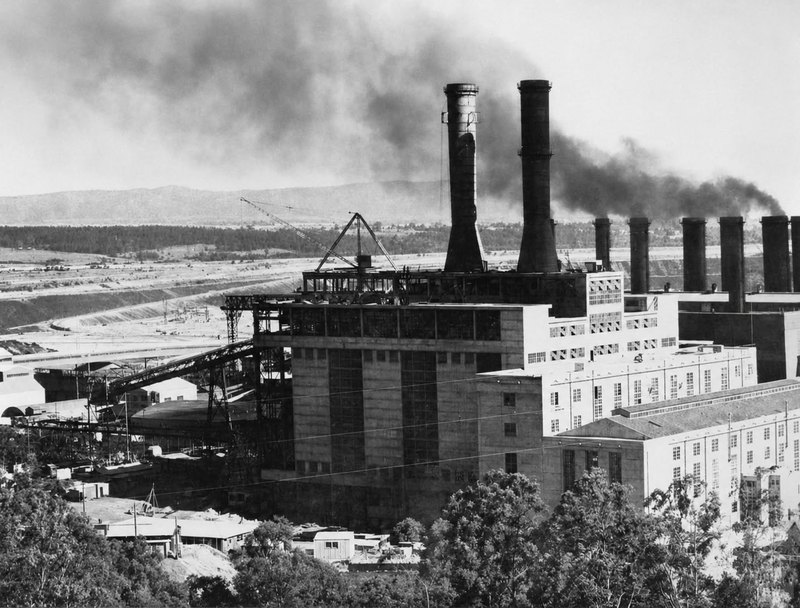
The State Electricity Commission built Yallourn to house the people who would operate one of Victoria’s most important power systems. The coal came from the open cut. The power stations turned that coal into electricity. The electricity fed homes, factories, railways and workshops across the state. Victoria depended on Yallourn.
But a town cannot be made from boilers, turbines and coal faces alone. It needs schools, halls, gardens, ovals, churches, clubs, shops, theatres, libraries and places where children can spend a summer afternoon until the whistle, the siren or their parents call them home.
The pool was one of those places.
Yallourn’s swimming story began before there was a grand concrete pool near Parkway and Lake Avenue. It began in the Latrobe River, at a natural bathing place known locally as “Fanny Bay,” near the power station. On Sunday 19 January 1927, the improved river swimming area was opened after work by the Working Men’s Club of Western Camp, supported by residents of Yallourn and Brown Coal Mine.
It was a very early Yallourn kind of facility: practical, communal and made useful by people who saw a need and acted on it. Before the mature town, before the Olympic-size pool, before the club’s strongest competitive years, there was a river bend, a sandy bottom, a pontoon, a diving board, and a community learning how to make life around a power scheme.
The Yallourn Swimming Club traces its beginnings to this river era. Arthur Brogan, one of the club’s great long-serving figures, later recorded how swimmers earned the 25-yard Herald certificate by swimming out to a pontoon anchored upstream. The confident ones could make the distance and return. Those who could not were brought back by Harry Nairn, who carried them on his back.
It is a small detail, but it opens the whole world of early Yallourn swimming. There was danger. There was humour. There was courage. There was community instruction before the language of “aquatic education” made it sound formal. Children were learning to swim in a river town beside a power station, watched over by adults who understood that water was joy and risk in the same moment.
By January 1933, the Yallourn Swimming Club was already strong enough to hold its first annual carnival at the Latrobe River Swimming Pool. Around 700 people attended. The attendance tells us that swimming had moved beyond a casual pastime. It had become a public event. People travelled to watch, compete, gather and belong.
Yallourn’s first purpose-made town pool came in the mid-1930s. The available community histories record that the pool was filled with water on 23 December 1936 and used for many years before being drained. It was remembered by later swimmers with affection, but also with the frankness Yallourn people often brought to their memories. Kevin Brogan later called the old pool the “mud hole,” a description that somehow makes it sound less like a failure and more like a loved piece of childhood infrastructure.
It had a wooden three-metre diving tower. It hosted Learn to Swim campaigns. It gave the growing town a more defined swimming place than the river. It also carried the limitations of its time.
The push for a modern pool grew through the 1950s. Yallourn had a serious swimming club, a growing population of children, and a community that understood the value of proper facilities. Lois Gust, one of Yallourn’s best-known swimmers, later recalled that the drowning of a six-year-old boy in the old pool made the need for a new facility feel urgent. In a town full of families, swimming was pleasure, sport and safety education at once.
The new pool did not simply appear. It was fought for, raised for, argued for and waited for. Local fundraising helped make it possible. Community sources record that residents raised £5,000, with the State Electricity Commission contributing money as well. The old pool was dug up during construction, and for a time Yallourn swimmers had to travel to Morwell.
Then came Saturday 7 November 1959.
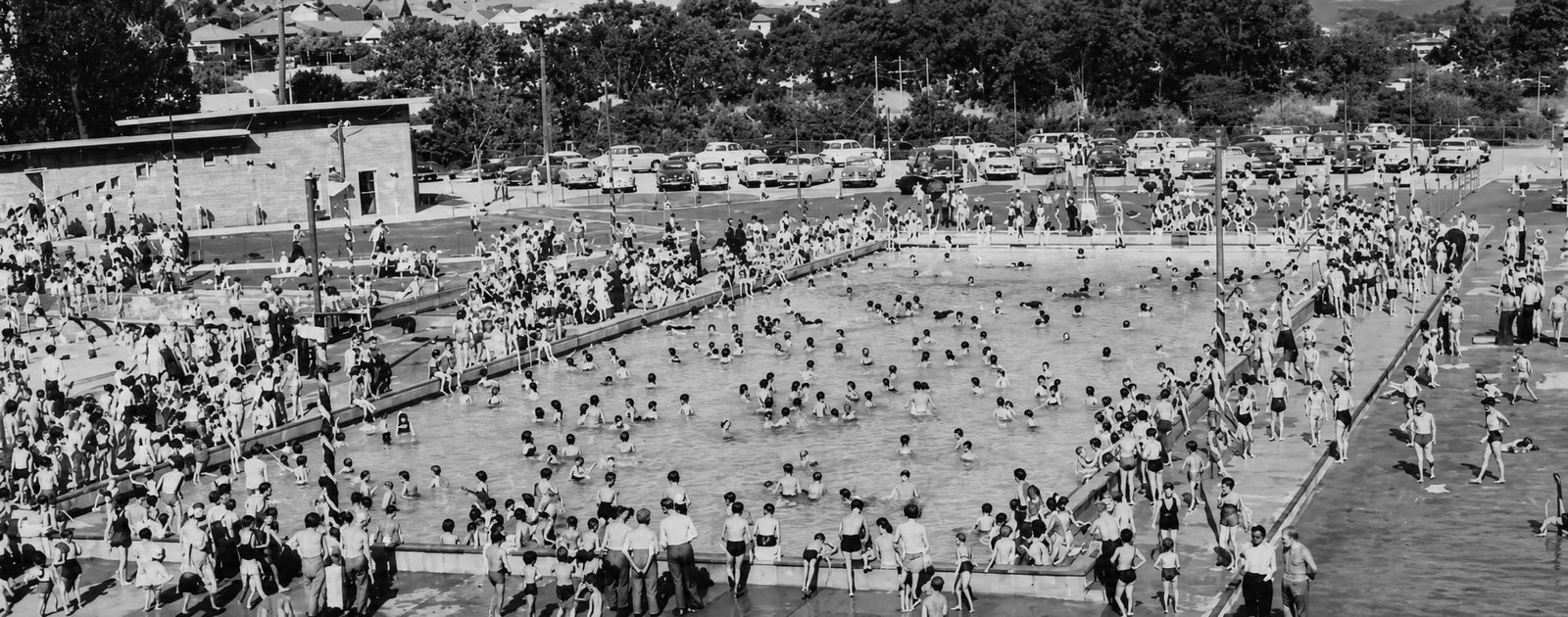
The new Yallourn pool opened near the corner of Parkway and Lake Avenue. It was a serious facility: an eight-lane Olympic-size pool, 55 yards long and 20 yards wide, with a diving pool at one end. Beside it sat a fenced-off junior or paddling pool, 20 yards by 10 yards. There were male and female dressing sheds, a clubroom, first-aid room and kiosk.
For a town built in the Latrobe Valley around brown coal and electricity, this was a statement. Yallourn was saying that its children, swimmers, schools and families deserved facilities of quality. The pool was not tucked away as an afterthought. It belonged to the civic life of the town.
Hundreds attended the gala opening. The ceremonial first swim was given to Lois Gust, then an 18-year-old assistant librarian and a celebrated Yallourn swimmer. In 1959 she had been named “Miss Australian Olympics,” part of a national fundraising effort for the 1960 Rome Olympic Games. Yallourn’s committee raised more than three times its quota, an achievement that speaks to the town’s habit of taking civic responsibilities seriously.
Lois was asked to swim 100 metres as part of the opening. She became the first person to officially swim in the new pool.
Officially is the useful word.
Lois later remembered that a few local boys had jumped the fence the night before and tested the water for themselves. They gave it their seal of approval. Anyone who grew up around public pools will recognise the truth in that. Every town has ceremony, and every town has boys who believe ceremony should be preceded by reconnaissance.
That little act of mischief gives the opening day its warmth. On one side there were officials, speeches, a gala crowd and a celebrated local swimmer marking the start of a new era. On the other side there were boys climbing a fence in the dark because the new pool was too tempting to leave untouched until morning.
Both belonged to Yallourn.
The new pool became one of the defining places of summer life. John Gloz later remembered the pool opening around 10:00am, a siren announcing session times, and swimmers being cleared out before the swimming club took over for training. He recalled entry prices, lifeguards, broken arms from slippery black tiles, skylarking divers, and even beer bottles thrown over the fence by Friday-night hooligans, delaying Saturday morning opening.
These are memories rather than council minutes, but they are exactly the kind of memories that tell us what a place meant. Public pools live in rules and rosters, but they survive in memory through sounds and sensations: the slap of bare feet, the sting of chlorine, the cold shock of the first dive, the roughness of concrete, the echo of voices, the kiosk queue, the lifeguard’s whistle, the long walk back to the towel.
For Yallourn children, the pool was one of the great theatres of growing up.
It was also a place of standards.
The Yallourn Swimming Club became one of Victoria’s strongest country clubs. After the new pool opened, the club dominated competition for several years and produced swimmers who competed across Gippsland and beyond. The club travelled to Morwell, Traralgon, Warragul and Sale, and to Victorian Country Championships in places such as Mildura, Bendigo and Shepparton.
This sporting culture did not build itself. It came from volunteers who stayed.
Hugh Graham gave 46 years to instruction. Arthur Brogan contributed 32 years to the club, including 21 years as secretary, and received a Swimming Victoria Award in 1973. Others served as coaches, organisers, officials and quiet workers behind the scenes. Their names may not be widely known across Victoria, but they mattered deeply in Yallourn. They were the people who turned a pool into a club, and a club into a training ground for discipline, confidence and pride.
The list of swimmers connected with Yallourn is long. Lois Gust, Ron Boyd, Doug Woods, Bill Davey, Graeme Kitney, Neville Gapes, Jim Richardson, Geoff Hall, Janet Walton, Robyn Garden, Sandra Doxford, Lorraine Dupree, Margaret Wood, Heather Stewart, Jenny James, Mary Hutchinson and many others appear in club histories and recollections. Ron Boyd was remembered as an outstanding backstroke swimmer who narrowly missed selection for the 1952 Helsinki Olympic team.
That is the larger point. Yallourn’s pool produced achievement. It trained children. It hosted school carnivals. It gave a country industrial town access to facilities and standards that connected local young people to wider competition.
Yallourn High School students attended swimming carnivals there. House competitions brought the school together. Intra-school and inter-school events filled the pool with noise, colour and rivalry. For many former residents, the pool sits in memory alongside the theatre, the gardens, the schools, the town square and the sporting ovals as one of the places where Yallourn became more than a workplace.
The State Electricity Commission’s role in Yallourn is often remembered through industry: the open cut, the briquette works, the power stations, the workshops, the transmission lines. That is understandable. Yallourn existed because Victoria needed electricity. But the town also reflected an older civic belief that industry and human life had to be planned together.
Sir John Monash understood engineering as public service. His work was never only about structures, machines or calculations. It was about use. A bridge was valuable because people could cross it. Brown coal was valuable because it could be turned into electricity. Electricity was valuable because it could power homes, factories, hospitals, trams, workshops and daily life.
That way of thinking flowed through Yallourn. The town was built around production, but it was also built around people. The pool fits that story perfectly. It was practical. It improved safety. It supported health. It created recreation. It built sporting skill. It gave children a place to grow up in public, watched by a town that knew who they were.
The contrast with the end of Yallourn is what gives the story its ache.
By the late 1970s, the town was being dismantled. The place that had been planned, planted, named, walked, swept, mowed, painted, watered and loved was being removed for coal. Houses disappeared. Streets lost their households. Familiar landmarks became memories before the people who remembered them had finished living their lives.
Yet the pool remained open almost to the end.
There is something powerful in that. A town can lose houses first. It can lose shops, services and streets. But while the pool remains, summer still has somewhere to go. Children can still swim. Former residents can still picture the water. The pool becomes a kind of civic pulse, still beating after much of the body has gone.
When Yallourn’s pool finally closed in 1980, the swimming story did not end completely. As part of the resettlement of former Yallourn residents, replacement facilities were provided at Yallourn North, including a swimming pool, football oval and netball courts. The Yallourn North pool opened on 12 December 1980.
But it was a continuation, not a preservation.
The old Yallourn Olympic-size pool did not survive as a relic. It was not fenced off as a ruin or kept as a monument. It disappeared with the town. Today, the place where it sat belongs to a changed landscape. The pool that once held the heat, noise and movement of Yallourn summers is gone.
What remains is memory, record and meaning.
The story of the Yallourn pool reveals something essential about the town. Yallourn was built to power Victoria, but it was also built to sustain the people who did that work. Its pool began in a river bend, grew into a town facility, became an Olympic-size civic landmark, produced strong swimmers and stronger memories, and then outlasted almost everything around it.
The pool held water.
For decades, it also held Yallourn’s children, families, volunteers, champions, school carnivals, summer mischief and community pride.