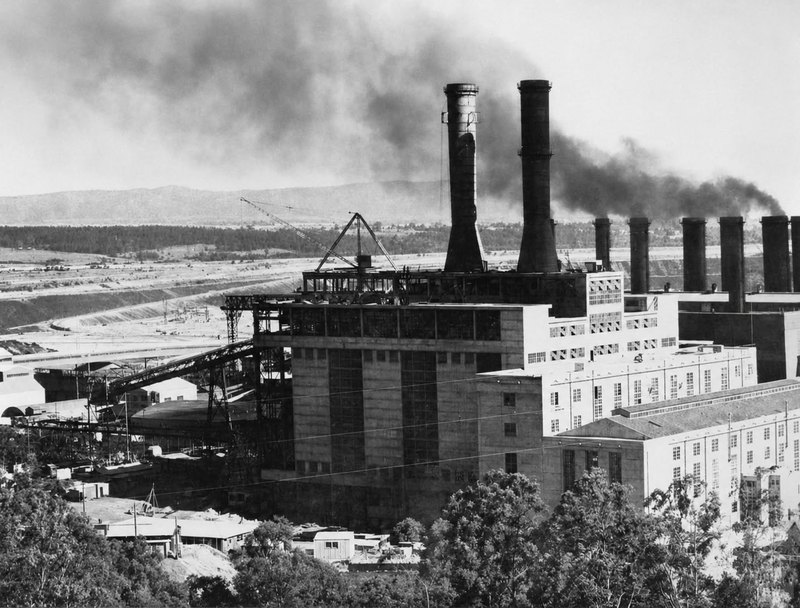
He died in 1931. The school opened fourteen years later, on Tuesday, 6 February 1945, in the town built by the State Electricity Commission he had once led.
Yet the school carried one of Monash’s deepest convictions: a community grows stronger when its people are equipped for life.
Yallourn High School was part of a much bigger idea. A town built to power Victoria could also help prepare its children for knowledge, service, confidence and contribution. The same town that generated electricity for homes across the state also generated opportunity for the children of the Latrobe Valley.
That idea was there from the beginning.
The first headmaster, J.E. Menadue, opened the school with about 300 students. Almost half of them — 47 percent — arrived by bus from surrounding towns and settlements: Morwell, Moe, Trafalgar, Traralgon, the Brown Coal Mine settlement and Yinnar.
Every school morning, students came into Yallourn from across the district. Some travelled from farms, some from mining settlements, some from towns still shaping their own identities. They arrived in a planned town where education, work, sport, music, gardens and civic life were all part of the same community vision.
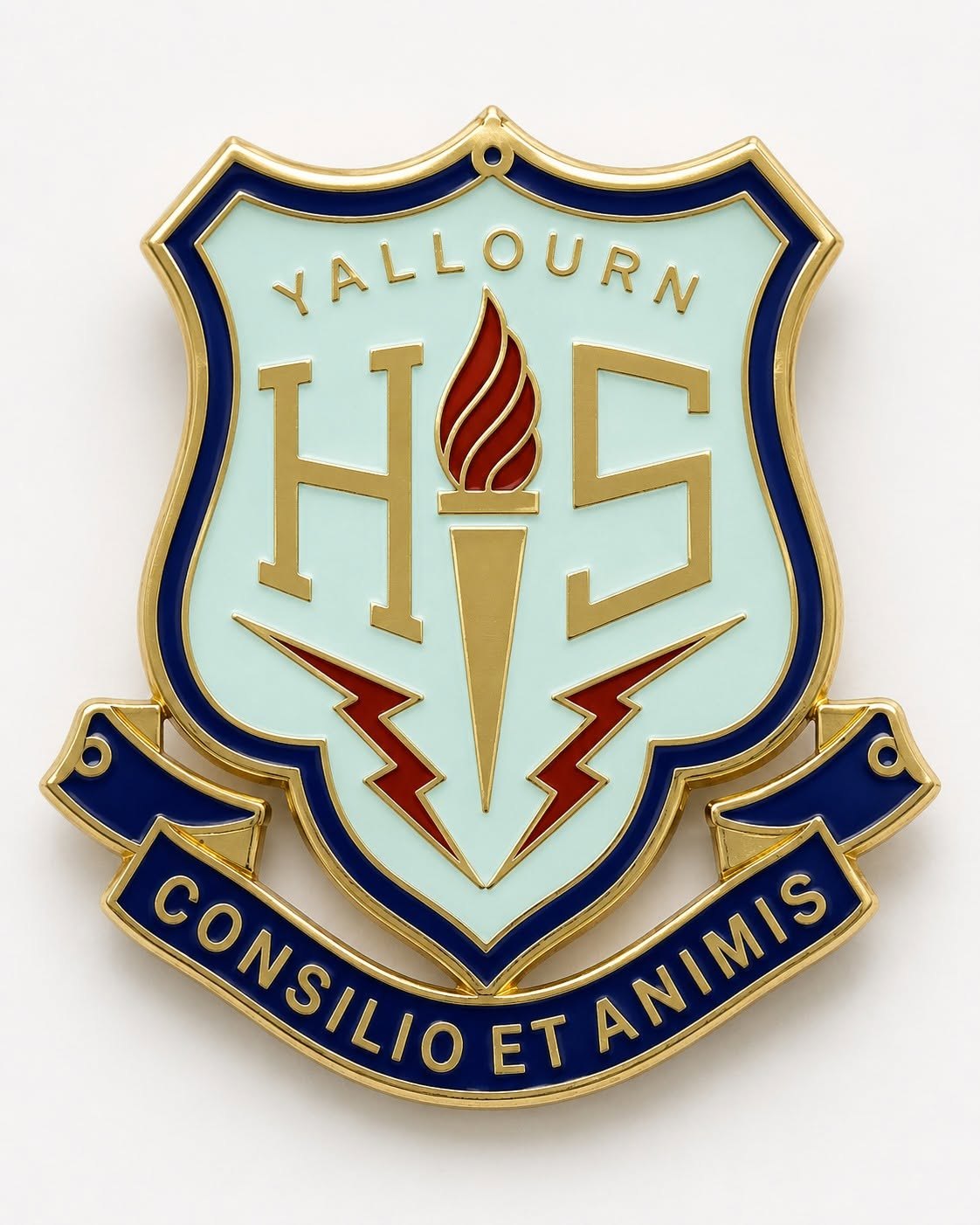
The badge they wore told that story with remarkable clarity.
At its centre stood a torch, the symbol of learning. On either side were lightning bolts, the symbol of the electricity that gave Yallourn its purpose. Knowledge and power sat together on the same badge, worn by students in a town built to bring light to Victoria.
Beneath the badge were the words:
Consilio et Animis.
The first headmaster translated the motto as:
“Let us by wisdom and courage strive to excel in all that is good and great.”
Wisdom and courage belonged naturally to the Yallourn story.
Wisdom was the discipline of planning, engineering, teaching, building and preparing for the future. Courage was the spirit required to create a town from open ground, educate children across a growing region, and ask a young community to aim higher than circumstance.
Those same words also sit comfortably beside the life of Sir John Monash. His achievements were built on preparation, intellect, discipline, leadership and nerve. He believed education had a public purpose. He urged people to equip themselves for life, and to do so for the benefit of the whole community.
Yallourn High School lived that creed in classrooms, on stages, across sporting fields, in school magazines, on bus routes, and in the memories students carried for the rest of their lives.
Even the school magazine had a name that belonged unmistakably to Yallourn.
It was called The Pylon.
A pylon carried power across the landscape. The Pylon carried the life of the school across time. Its pages recorded names, photographs, achievements, humour, house activities, reports, concerts, sporting results and the ordinary moments that become precious when a school is gone.
Former student Jean Humphries later wrote that she had kept her school tie, her prefect badge and five copies of The Pylon for the rest of her life.
That is the power of belonging. A tie, a badge and a magazine become anchors to a place, a time and a younger self.
The daily rhythm of the school reflected the daily rhythm of Yallourn. By 1947, the school ran from 8:46am to 3:30pm, shaped by the SEC’s industrial conditions after the introduction of the 40-hour week. The school bell and the working town moved to the same larger pulse.
That same year, Yallourn High School introduced Domestic Science and Needlework, recorded as the only high school in Gippsland offering the course at that time. The school also took part in community service with the practical generosity of the post-war years. Students collected 165 dozen eggs for Yallourn Hospital through the Egg Day Appeal, and supported relief efforts including Food for Britain and UNRRA clothing drives.
The school taught responsibility as part of education.
By 1954, Yallourn High School was carrying the weight of a growing community. Around 550 high school students were enrolled, with another 150 state school pupils sharing the grounds. Classrooms filled. Extra spaces were pressed into use. The local demand for education had grown with the town itself.
Yallourn believed in education, and the numbers proved it.
The school’s achievements reached far beyond its classrooms.
One of its great stories came through music.
In 1956, teacher Val Pyers became director of the Yallourn High School Choir and formed the Yallourn Madrigal Singers. From a regional high school in a power station town, the choir reached a standard that carried Yallourn’s name into Melbourne’s musical life.
By December 1962, the choir was performing at Melba Hall, the University of Melbourne’s recital hall. Its performances attracted attention from Melbourne music critics, including composer Felix Werder.
In August 1963, the Yallourn High School Choir presented Music Theatre at Kernot Hall.
Nineteen songs.
Three nights.
A full school production.
A vinyl record pressed from the performance.
The cover survives. The sleeve survives. The songs survive.
That record is a remarkable artefact. It carries the voices of students from a town that no longer exists in the same form. It preserves ambition, discipline, rehearsal, nerves, applause and pride. It gives Yallourn High School a sound that can still be heard.
Sport gave the school another field for achievement.
The Yallourn Blues girls’ hockey team was formed in 1957 under art teacher John Nicholls and became part of the wider hockey culture that continued through the Yallourn Hockey Club. Teacher Keith Hollingsworth encouraged students into athletics, with students including Gwen and Win remembered for their success in shot put.
School rivalry also had its place. In 1959, Yallourn Technical School defeated Yallourn High School 9–0 in soccer — a local contest that still carries the sharp smile of town memory.
Some students went on to significant sporting careers. Frank Goode, a former Yallourn High School student, played for Moe and then 73 games with North Melbourne in the VFL. Former Yallourn High School prefect Peter Hutchinson played 363 games for Power House in the VAFA, captained the club for six years, won seven Best and Fairest awards, and was later named a VAFA Legend.
The school opened doors in other ways too.
In 1956, students travelled to the Melbourne Olympic Games. One former student later recalled that the excursion had a lasting effect on her life decisions. A school trip became part of a life’s direction.
That is education at its most powerful. A teacher, a performance, a badge, a bus ride, a sporting field, a magazine, a choir, an excursion — each one can become a turning point.
Yallourn High School closed in 1977.
That same year, former students held their first official reunion dinner. The school’s formal life ended, and its memory-keeping began. Students became custodians. The institution moved from classrooms into story.
This is why the badge still matters.
This is why The Pylon still matters.
This is why the Music Theatre record still matters.
This is why school ties, prefect badges, team photographs, choir programs, house names, bus memories and teacher names still carry emotion across generations.
Yallourn High School gave its students more than lessons. It gave them a place in a shared story. It asked them to strive for “all that is good and great.” It connected wisdom with courage, learning with service, and individual achievement with community purpose.
The school is gone from daily life. Its meaning remains.
For those who wore the badge, wrote for The Pylon, sang in the choir, played for the school, travelled in by bus, stood on stage at Kernot Hall, or kept a tie in a drawer for the rest of their life, Yallourn High School remains part of who they became.
It also remains part of the larger Monash story.
A town built to power Victoria also helped prepare its children for life.
Consilio et Animis.
By wisdom and courage.
That was the motto.
That was the promise.
That is the legacy.