In April 1923, the men working in the foundation of Yallourn’s new chimney had nothing above them but sky.
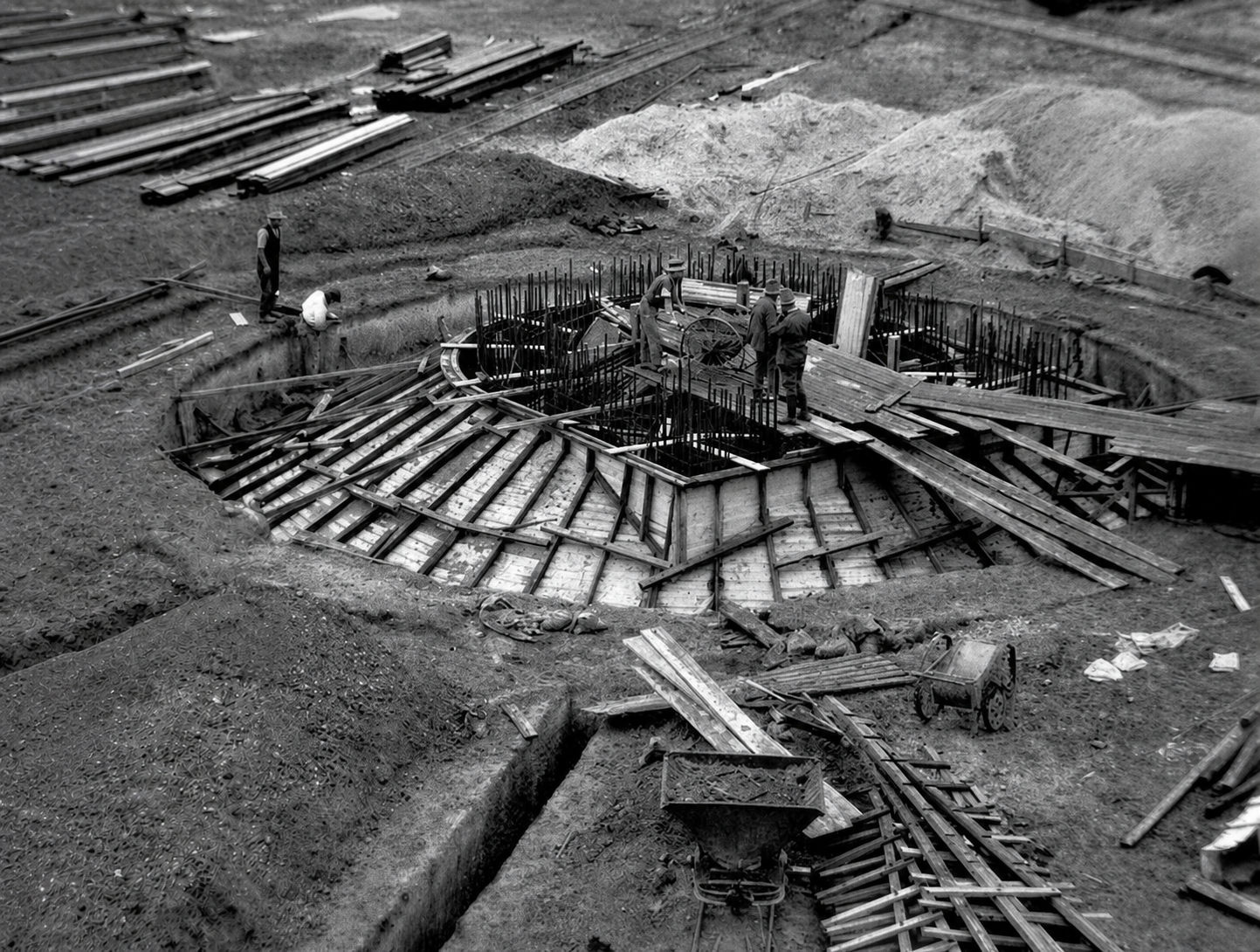
A photograph taken at Yallourn shows men standing inside a great circular excavation. Around them are timber planks, reinforcing rods, piles of material, a small cart and an ordinary builder’s wheelbarrow. The men were standing where Australia’s tallest structural erection would begin. Within little more than a year, a reinforced-concrete chimney would rise from that excavation to 328 feet 8 inches — 100.2 metres — above Yallourn.
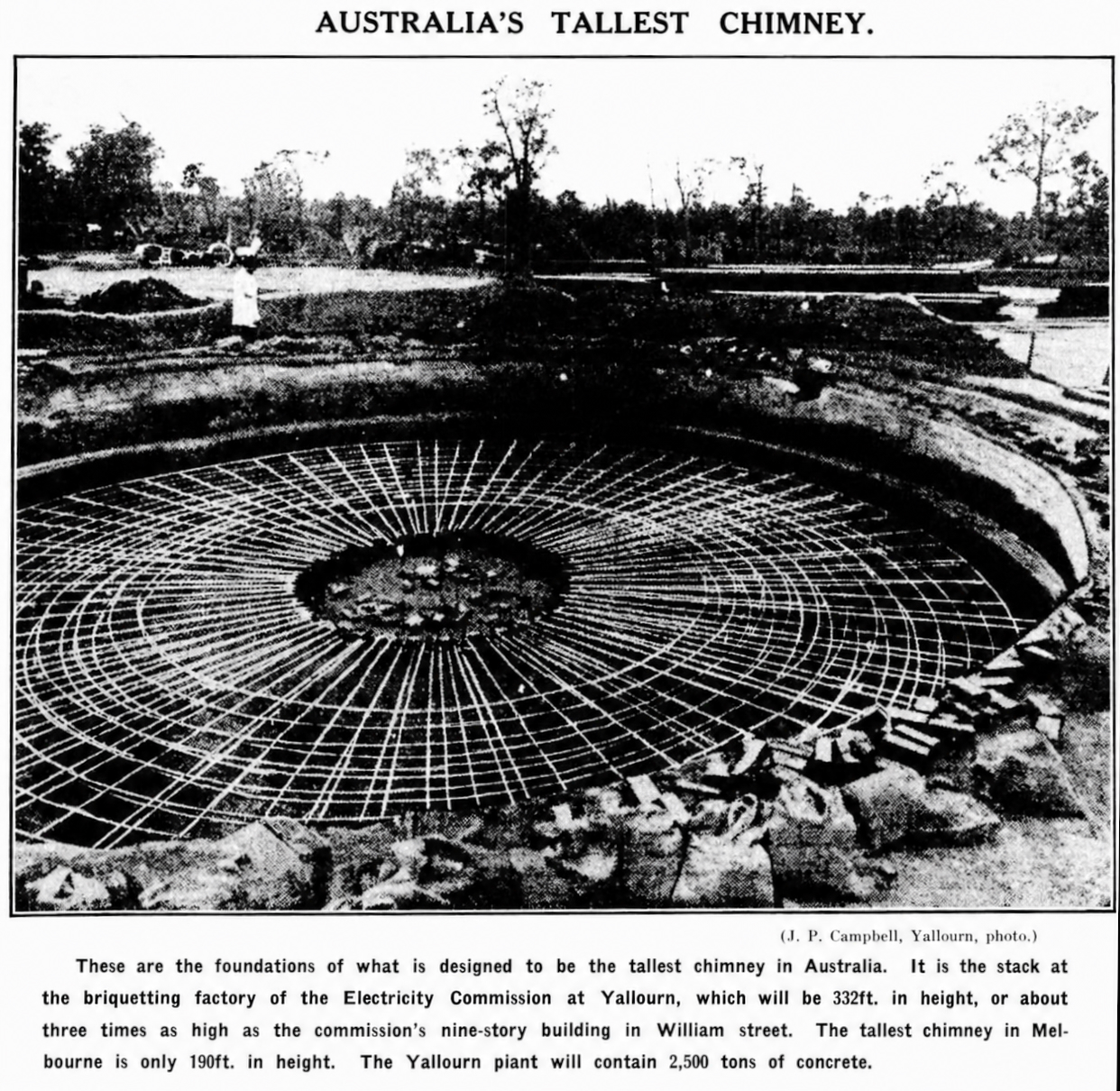
The Argus called it “Australia’s Tallest Chimney” and the “Yallourn giant”. The name captured its scale. Its height raised the more compelling question: why did the boilers at Yallourn need a chimney that high?
The answer lay in the coal. Yallourn’s brown coal combined an enormous energy resource with an extraordinary amount of water. Before it could become a briquette capable of being loaded onto a train and sent to a factory, boiler room or home, much of that moisture had to be driven out.
The problem beneath Yallourn
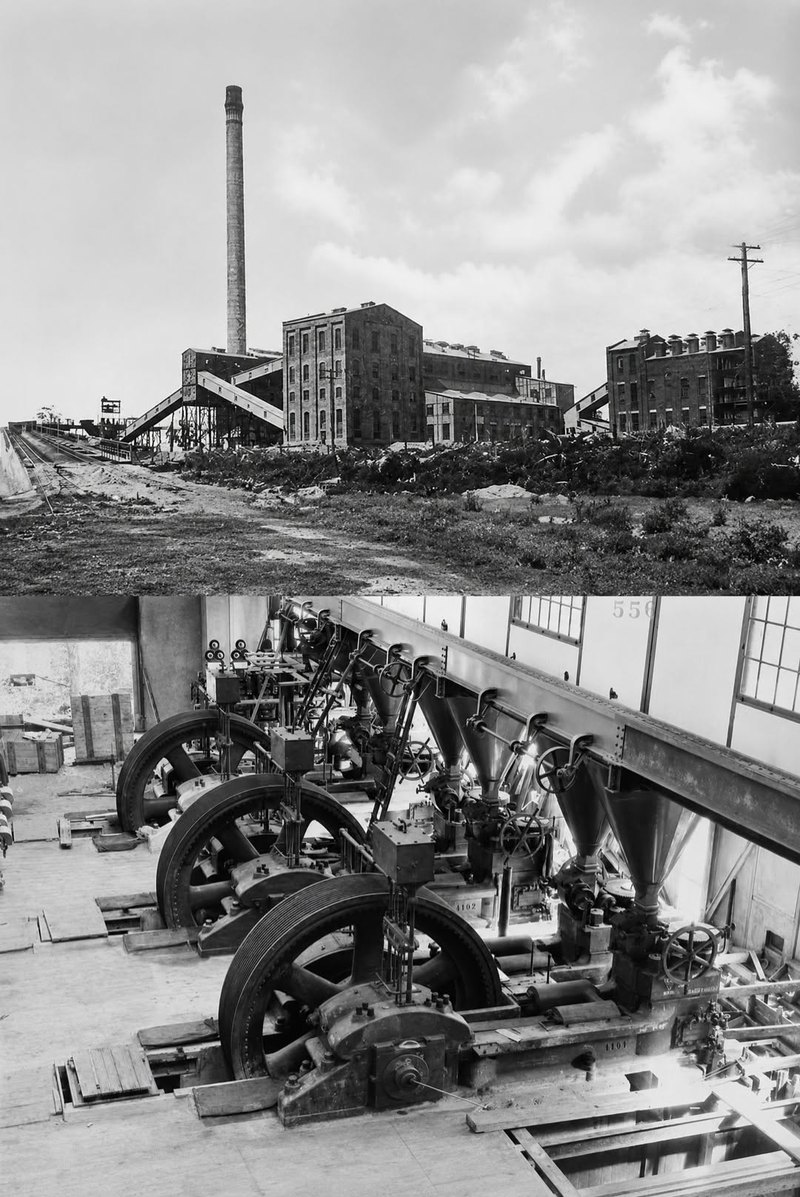
Turning wet brown coal into a transportable fuel required crushing, drying, cooling and pressing, and the drying stage demanded heat on a formidable scale. The first installation at the briquette works contained five Babcock and Wilcox water-tube boilers, four normally operating while the fifth remained in reserve. Each boiler was expected to consume roughly 100 tons of Yallourn coal every 24 hours.
Keeping those fires alive meant feeding them enormous quantities of fresh air while moving the resulting gases through the boilers and flues and out of the works. About 2,000 cubic feet of gas every second had to be kept moving. The chimney formed part of the mechanism that made the boilers work.
Inside the chimney, hot gas formed a tall, light column. Beside it, the cooler outside air formed a heavier column. At ground level, the difference between their weights created pressure: the heavier outside air pushed fresh air through the furnaces while the lighter gases rose through the stack. The taller the chimney, the greater that pressure difference became.
The engineers could create the necessary draught with mechanical fans or with height. Tall natural-draught chimneys were established practice in briquetting works, and at Yallourn they chose height.
At Yallourn, airflow became architecture. The appetite of the boilers below dictated the height above, and a national record emerged from an industrial necessity.
Before the giant could rise
Before the chimney could climb into the air, the engineers had to work out how the ground would carry it. The circular base was 45 feet — 13.7 metres — across, and workers dug down 8 feet 6 inches until they reached hard clay considered capable of carrying the enormous load. Groundwater posed another problem, so a ring drain was installed to carry it away.
The April 1923 photograph captures this stage before the landmark existed. The workers stand among clay, timber and reinforcing steel, building the part of the structure that would eventually disappear beneath everything above it. The wheelbarrow in the foreground looks almost comically ordinary beside the scale of what was being attempted. Australia’s tallest chimney began with tools that men could push by hand.
Above the foundation, the engineers chose reinforced concrete. Yallourn’s hand-made bricks served the houses of the new town, but the forces within a chimney of this scale would have required far more brickwork and a larger structure. Machine-made bricks brought from Melbourne were costly. Reinforced concrete gave the engineers their practical answer.
Then came the more difficult task of putting it into the sky.
The engineers later recorded, with characteristic restraint, that “some close thought was necessary” to keep the formwork rigid and plumb while providing safe conditions for the men working on it. The form had to contain tons of wet concrete in exactly the right shape as the chimney rose. The workplace climbed with the structure, while wind, weight and alignment had to be accounted for hundreds of feet above the ground.
By late 1923, people looking up from below had begun to suspect something was wrong.
“His” chimney was leaning
The half-built chimney had become one of the most visible things at Yallourn. It rose above a place where the mine, factories and town itself were still taking shape, and from some angles observers thought the stack appeared to lean.
The rumour travelled far enough for The Sun News-Pictorial to send a reporter to Yallourn. Sir John Monash inspected the chimney with other visitors and dismissed the supposed crookedness as an optical illusion. The newspaper referred to it as “his” chimney, a neat piece of journalistic shorthand for the chairman of the State Electricity Commission and the man whose name had become inseparable from the wider Yallourn undertaking.
The engineers checked the stack for plumb before work began each day. The men building it had another calculation to make. Their workplace was climbing hundreds of feet above the ground, and they argued that the danger justified additional pay.
The dispute became a strike and delayed construction for three months. From below, the chimney was becoming a national engineering achievement. From the working platform, it was also a very long way down.
A new shape on the skyline
By June 1924, the stack had reached its full height and the brick lining inside was being completed. The engineering decisions made in the clay, the boiler room and the rising formwork were about to be tested together.
Trial production at the Yallourn briquette works began in November 1924, with commercial sales following in February 1925. By the middle of 1926, production had reached 350 tons of briquettes a day. Wet brown coal entered the works, water was driven out, and the dried material was pressed into fuel that could be transported and used elsewhere.
The chimney kept air moving through the boiler furnaces and carried the resulting gases away. Its record-breaking height was working machinery within the larger Yallourn system.
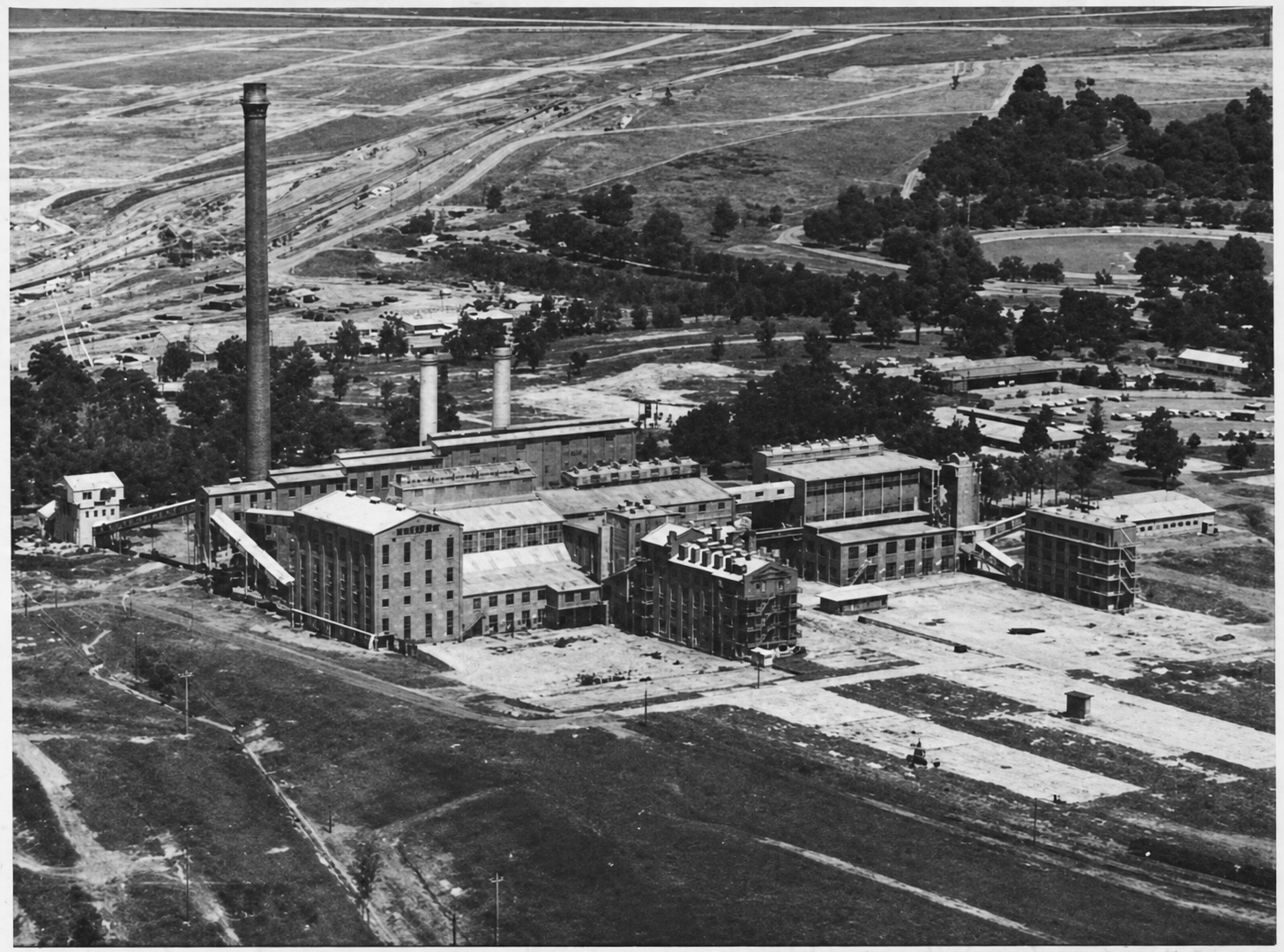
Around it, the State Electricity Commission was assembling a mine, power station, briquette factory, transmission network and new town. Each part depended upon the others.
Monash sat at the head of that undertaking. Engineers calculated it and workers built it. German knowledge and equipment used in the first briquette factory met Australian coal, Australian conditions and local engineering judgement. Sometimes those problems were solved underground, sometimes in boiler rooms and drawing offices, and sometimes hundreds of feet above the ground.
The giant becomes ordinary
Once completed, the chimney settled into the daily rhythm of the works. Boilers fired, briquettes were produced, trains moved and people went to work beneath the structure that had briefly made national news. The record became part of Yallourn’s familiar skyline.
Newer structures eventually exceeded its height. The Yallourn chimney continued working for decades, and generations of people came to know it simply as part of the town.
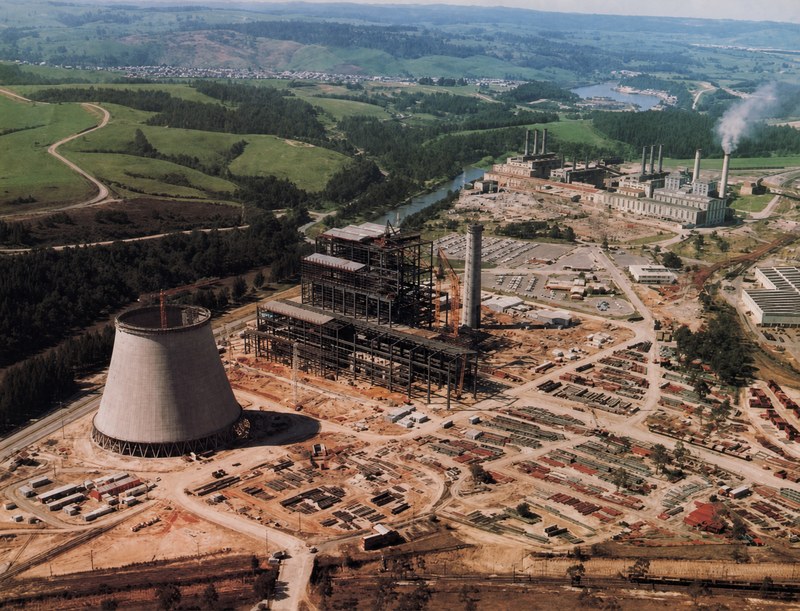
That changed when the briquette works closed in 1971 and production became centred on Morwell. Buildings were dismantled, machinery disappeared and the old industrial landscape began to come apart. The great chimney remained for a time, standing above a site that was gradually losing the reason it had been built.
In June 1975, people gathered to watch it fall. The chimney had required exact calculations, concrete, brick and men willing to stop work over the danger of building it. Now it came back to earth.
Look at the wheelbarrow again
The photographs of the completed chimney preserve the landmark people remembered. The April 1923 photograph preserves the people, materials and decisions from which it began.
The men stand among timber, clay, reinforcing steel, a cart and a wheelbarrow. Engineers still had to calculate the foundation, design the formwork and keep the rising stack plumb. Workers still had to turn those calculations into a structure in the sky.
Someone had to decide that Yallourn’s wet brown coal could become an industry. Someone had to work out how to build the chimney that industry required. And someone had to climb up and build every metre of it.
Look again at the wheelbarrow in that first photograph, and then at the empty sky above the men beside it.
Yallourn was about to fill it.