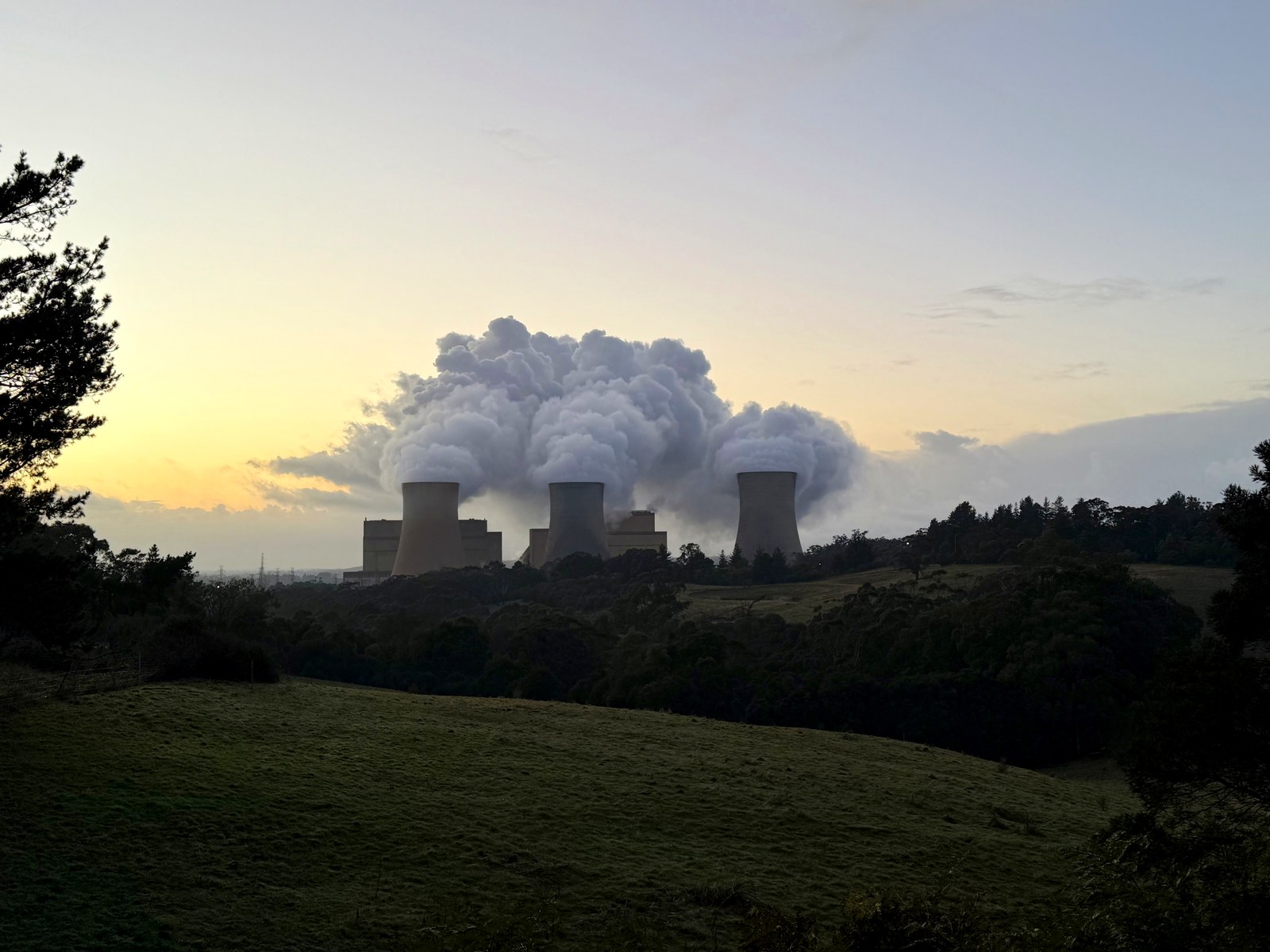
The curved shells rose above the open cut, the power stations and the garden town whose streets were steadily emptying below. Each completed section altered the skyline until the structures became visible across the Latrobe Valley, standing above the landscape like three immense industrial chimneys without smoke.
They were cooling towers, although that simple description barely captures what they represented.
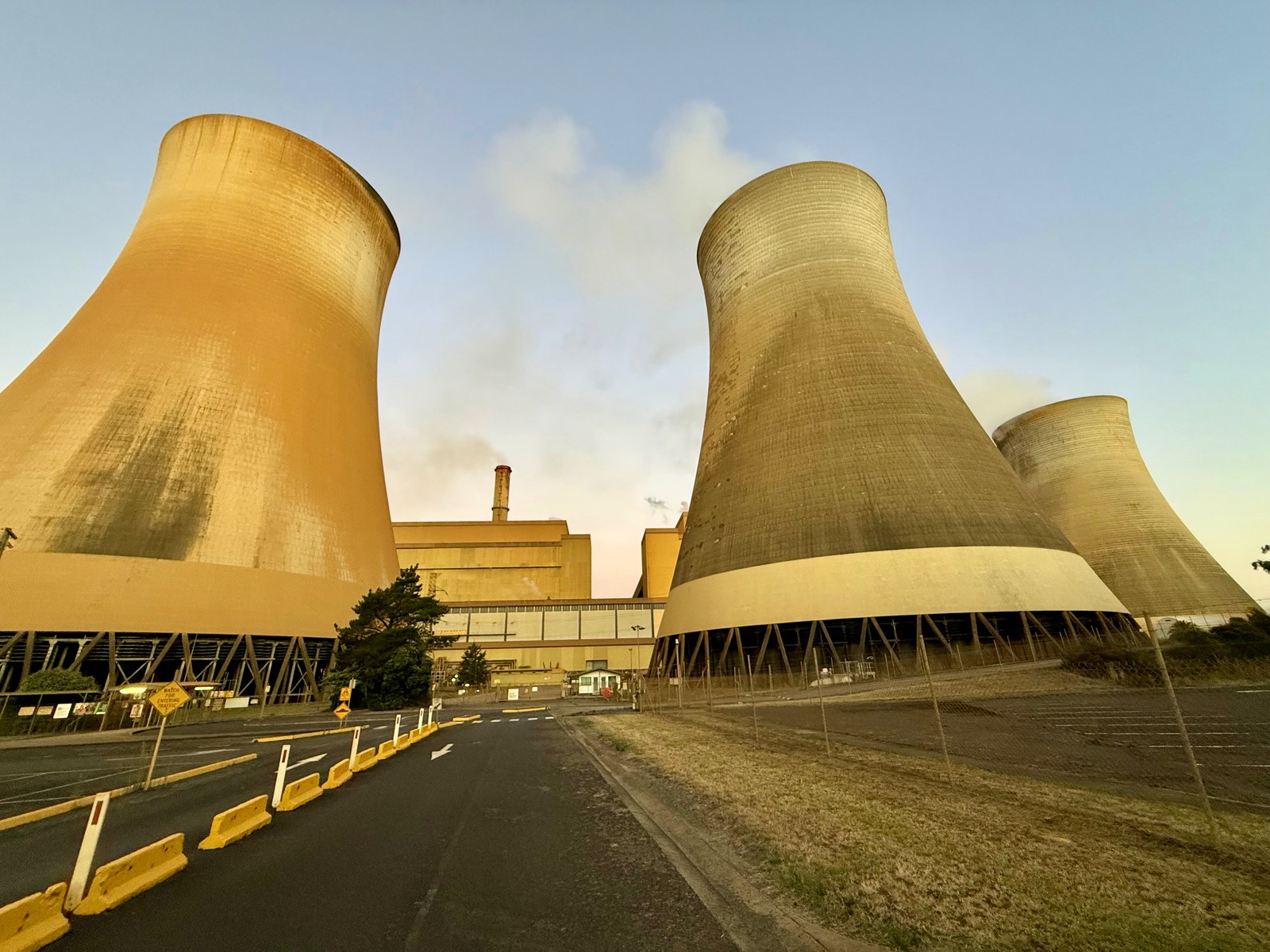
Yallourn W’s three reinforced-concrete natural-draught cooling towers introduced a new form of power-station engineering to Australia. They were the first natural-draught concrete cooling towers used at an Australian power station, created to circulate enormous quantities of cooling water through a closed system without relying upon banks of large mechanical fans.
They also rose during one of the most consequential periods in Yallourn’s history.
The town established beside the power scheme was being dismantled. Houses were being removed. Schools were closing. Familiar streets were thinning. The old Yallourn power stations, which had carried Victoria through decades of industrial expansion, were reaching the end of their working lives.
Above them, the new towers kept rising.
Their construction marked the transfer of responsibility from one Yallourn to another.
THE SECOND PROBLEM OF ELECTRICITY
A thermal power station begins with heat.
Coal burns in the boilers. Water becomes high-pressure steam. The steam is directed through the turbines, where its force turns the machinery connected to the generators. Electricity flows into the transmission system and travels outward through the state.
That sequence creates another engineering problem.
Once the steam has passed through the turbine, it must be cooled and condensed back into water. The generating cycle depends upon it. Without effective cooling, the station cannot maintain the conditions needed for efficient turbine operation. Heat has performed its work and must now be removed so the water can return to the boilers and begin the cycle again.
The cooling system therefore sits at the heart of a steam power station.
It determines how the station manages waste heat, how much water it requires, how efficiently the turbines operate and whether the generating units can continue carrying their load through long summer days, cold winter nights and periods of intense demand.
The original Yallourn stations met this requirement through the nearby Latrobe River.
The river’s flow was unreliable. The State Electricity Commission constructed a weir to provide a more stable body of water from which the stations could draw. Cooling water passed through the condensers, collected heat from the exhaust steam and returned to the river system.
That arrangement served the earlier stations.
Yallourn W belonged to another scale.
A NEW STATION FOR A GROWING STATE
Victoria’s demand for electricity had grown far beyond the world for which the earliest Yallourn generating units had been designed.
The original power scheme began sending electricity to Melbourne in 1924. Stations A, B, C, D and E followed across the decades, each stage reflecting another period of industrial growth, household electrification and expanding public expectation.
Factories, railways, shops, offices and homes increasingly depended upon a continuous electricity supply. Refrigerators, heaters, lighting, machinery and public transport had drawn power into the ordinary routines of Victorian life.
The SEC could no longer think in terms of isolated generating plants serving limited districts. It had built an interconnected state system. A major failure in the Latrobe Valley could be felt far beyond the mine or the station gates.
Yallourn W was constructed to carry that responsibility into another generation.
The new station was built west of the earlier complex as the open cut expanded and the physical geography of Yallourn changed around it. Its four generating units entered service in stages across the 1970s and early 1980s. Built as a 1,450-megawatt station, Yallourn W was later rated at 1,480 megawatts.
The new station required a cooling system capable of operating at that scale.
It also entered service during a period of changing environmental regulation. From 1975, discharge-licence conditions required the station to operate on a closed cooling-water cycle for much of the year.
The Latrobe River could no longer carry the entire burden in the way it had for the earlier stations.
The towers became the solution.
A DUTCH IDEA ARRIVES AT YALLOURN
The shape now associated with Yallourn W began with an engineering idea developed on the other side of the world.
Dutch engineers Frederik van Iterson and Gerard Kuypers devised and patented a reinforced-concrete cooling tower using a hyperboloid form during the First World War. The first towers in this design lineage were built at the Staatsmijn Emma coal mine near Heerlen in the Netherlands by 1918.
The form combined structural efficiency with natural airflow.
Its wide base allowed outside air to enter. The narrowing middle accelerated the upward movement of warm air. The upper section widened again, assisting the discharge of moisture-laden air into the atmosphere. The curved shell gained strength from its geometry, allowing an immense structure to be formed from a comparatively thin reinforced-concrete wall.
The tower’s appearance followed its work.
Every curve had a purpose.
By the time construction began at Yallourn W, the engineering principle had been used internationally for decades. Its arrival in the Latrobe Valley nevertheless represented an Australian first. Yallourn W’s towers were the first concrete natural-draught cooling towers of their kind used at an Australian power station.
The achievement lay in applying a proven international engineering system to the particular demands of Yallourn: a large generating station, an expanding mine, a constrained river system and a state electricity network that required reliable continuous output.
MAKING WEATHER FROM WATER
At ground level, a cooling tower reveals itself through movement.
Heated water from the station’s condensers enters the lower portion of the structure and is distributed across an internal system. It falls through layers of fill that break the flow into smaller streams and droplets, increasing the surface area exposed to air.
Cooler air enters through the open base.
The warm water heats that air. A small proportion of the water evaporates, carrying heat away from the remaining flow. The warmed, moisture-laden air rises through the narrowing throat of the tower and escapes from the top.
The cooled water gathers below and returns to the station.
Then the cycle begins again.
The main airflow is created by natural draught. The tower does not require enormous fans to force air through the structure. The difference in temperature and density between the warmer air inside and the cooler air outside creates the upward movement.
The height and shape of the tower do the work.
Inside, water descended continuously through the fill while air moved inward through the base and upward through the shell. The tower created its own weather: falling water, moving air and mist contained inside an enormous concrete curve.
From outside, the operation appeared almost serene.
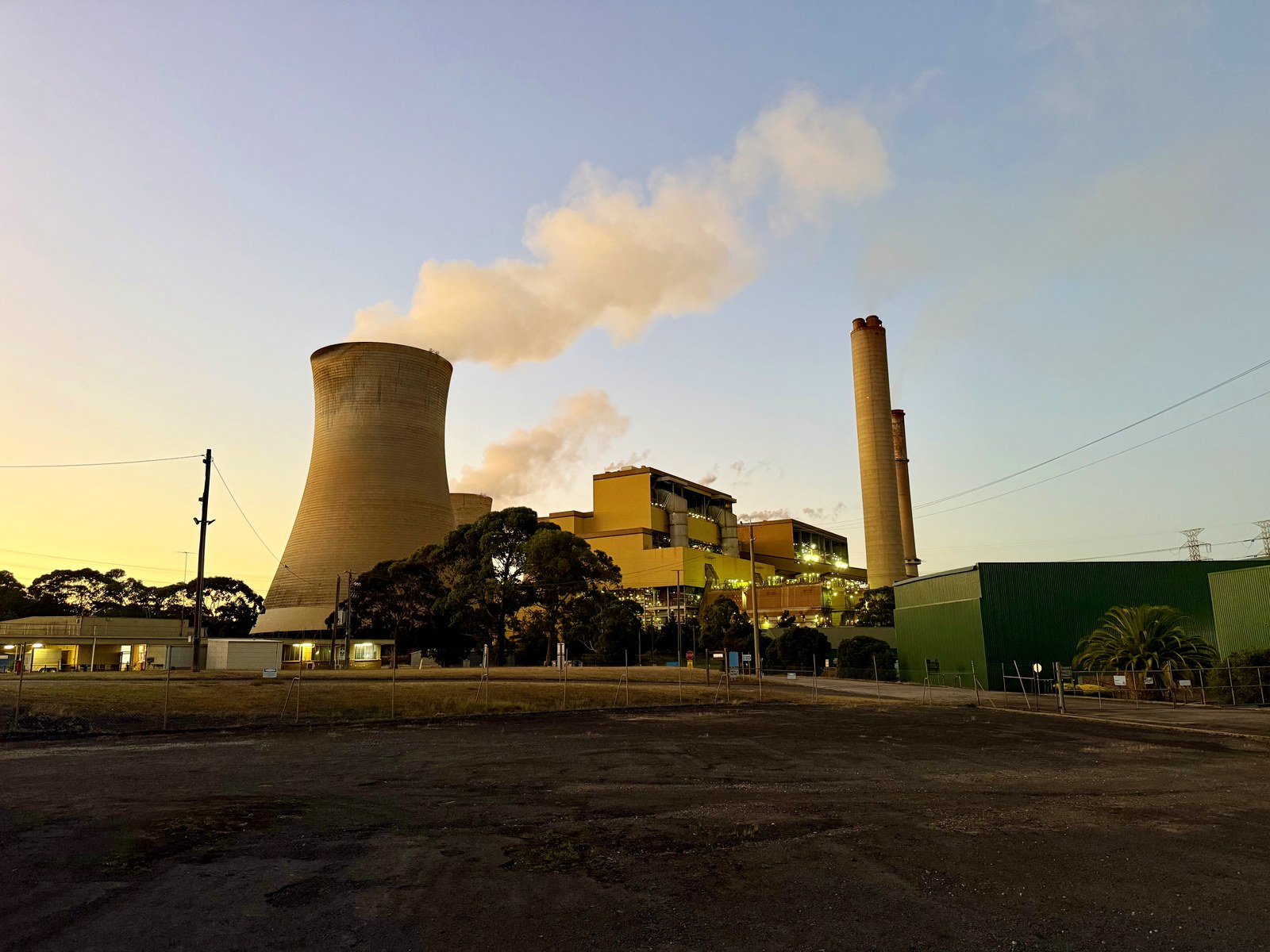
A white plume formed above the rim and drifted with the wind.
That plume has often been mistaken for smoke. It was principally condensed moisture carried from the cooling process, not the combustion gases released separately through the station’s chimneys.
The cooling towers dealt with heat.
Their plume showed the water cycle at work.
BUILDING THE CURVE
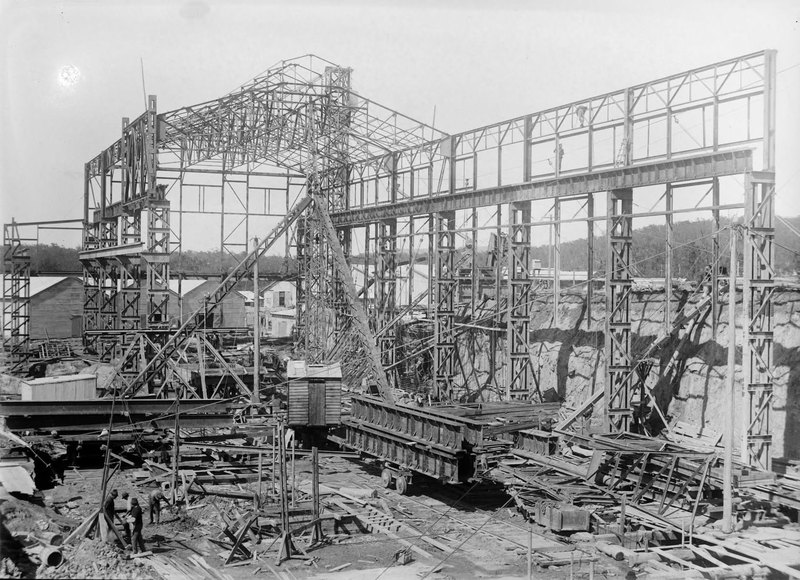
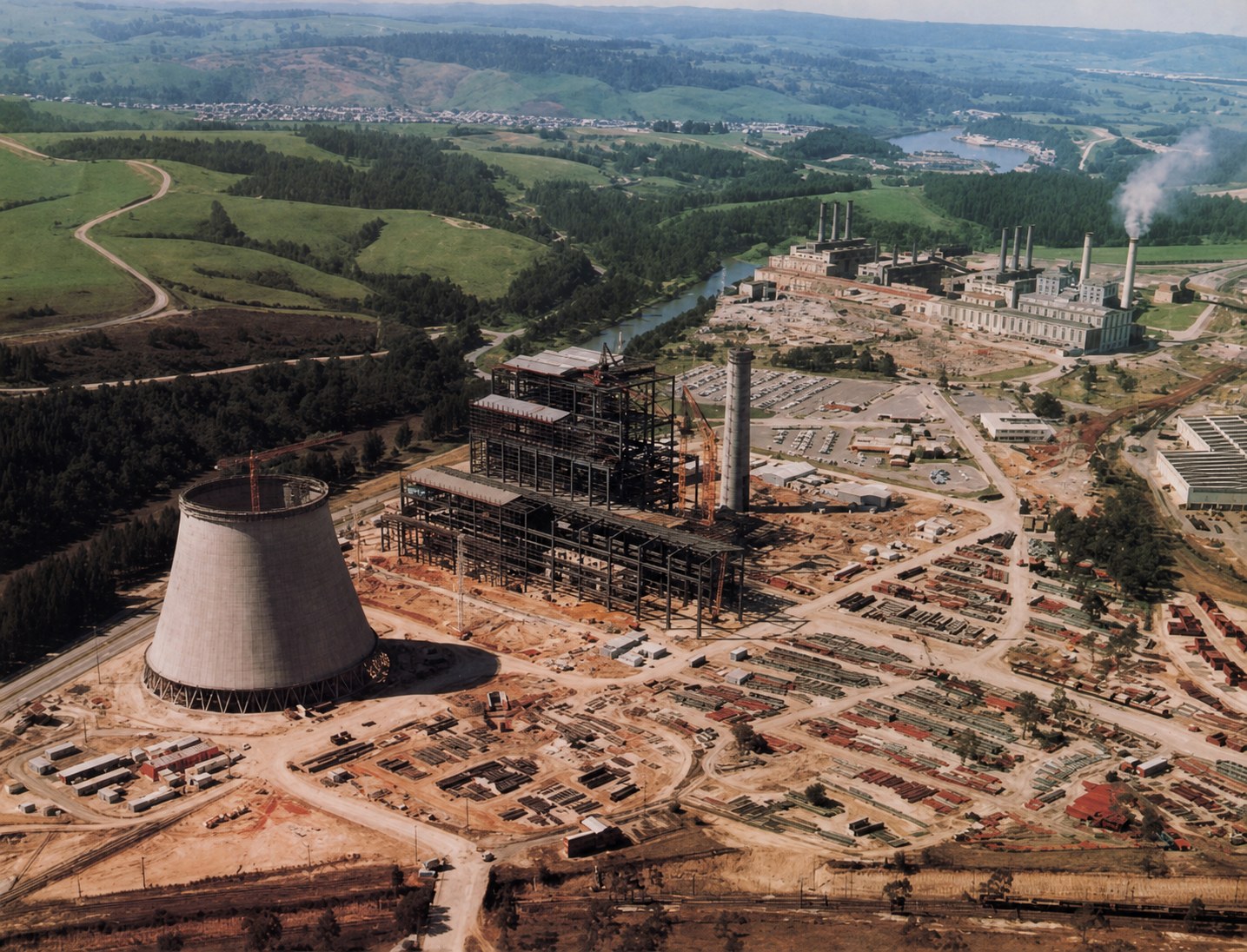
The towers demanded precision long before water flowed through them. Photographs taken in September 1969 show excavations for a cooling tower in the foreground as the Yallourn W boiler house rose behind it.
The completed structure appears smooth from a distance.
Its construction depended upon the shell’s changing geometry remaining true as it rose.
The people who built the towers worked inside a calculation expressed in concrete.
They did not produce a conventional building with floors, windows and rooms. They produced a hollow shell whose shape had to remain true from the open ring at its base to the rim high above the valley.
Once completed, the structure itself became part of the cooling machinery.
The concrete did not simply enclose the process.
The concrete created the draught.
THREE TOWERS ABOVE A VANISHING TOWN
The engineering story alone would have made the towers significant.
Their timing gave them another meaning.
As Yallourn W grew, the town of Yallourn was being removed to provide access to the brown coal beneath and around it. The decision had been announced years earlier. By the 1970s, its physical consequences were visible in the streets.
Houses disappeared from blocks. Some buildings were demolished. Others were moved and given new lives in surrounding communities. Schools, clubs, churches and public institutions faced closure, relocation or reinvention.
The town’s population declined as the towers climbed.
This placed two futures in the same view.
Below stood Yallourn, the Garden City created as part of the first great brown-coal power scheme. Its curved streets, public gardens, schools, theatres, sporting grounds and civic buildings had been designed to give workers and families a complete community beside the industry they served.
Above it rose the concrete structures of Yallourn W, created to meet the electricity demands of a state that had outgrown the station and town built during the Monash era.
The towers did not cause the town’s removal. They became the most visible sign of the larger industrial transformation taking place around it.
A resident looking toward the new station could see Victoria’s energy future being assembled in concrete.
The same view carried the knowledge that their own street might soon disappear.
THE TWO YALLOURNS
The first Yallourn expressed itself through civic design.
Its administrative buildings, landscaped streets, town square, theatre, schools and gardens demonstrated that the SEC saw electricity generation as a complete public undertaking. Industry required workers. Workers required houses, health, education, recreation and community.
The town was built around that proposition.
Yallourn W expressed the next era through scale.
Its generating units were larger. Its structures were heavier. Its systems were designed for a state whose dependence upon electricity had become absolute. The station stood within an industrial landscape reshaped by decades of mining, power generation and engineering expansion.
The cooling towers became the architectural identity of this second Yallourn.
Their curved profiles could be recognised from roads, farms, neighbouring towns and distant hills. Their plumes changed with the conditions. On still mornings, moisture rose vertically before dissolving into the sky. Under stronger winds, it bent away from the tower and travelled across the valley. In cold weather, the plume appeared thicker and more persistent.
People learned to read the station from a distance.
The towers said that Yallourn W was running.
MONASH AND THE INSTITUTION HE BUILT
Sir John Monash never saw the towers.
He died in 1931, more than four decades before Yallourn W’s first generating unit entered service. He played no direct role in their design, approval or construction.
His connection lies in the institution that built them.
Monash became General Manager of the Victorian electricity undertaking in 1920 and permanent Chairman of the State Electricity Commission in 1921. He drove the development of the Latrobe Valley brown-coal scheme and the state electricity network built around it.
He understood infrastructure as a system.
Coal in the ground had little public value until it could be mined, converted into electricity, transmitted across the state and supplied reliably to the people and industries that needed it. That required mines, power stations, transmission lines, workshops, training systems, houses, roads, schools and disciplined administration.
The cooling towers inherited that way of thinking.
They were constructed by another generation of engineers responding to another generation of problems, yet the underlying method remained recognisable: understand the constraint, organise the knowledge, apply the technology and build at the scale Victoria required.
Monash established the undertaking.
Yallourn W continued it.
THE LANDMARK AT THE END OF AN ERA
The three towers remain part of Yallourn’s skyline.
They have stood through the retirement and demolition of the earlier A–E stations. They have outlasted the streets, houses and public buildings of the original town. They have watched the open cut expand, generating units undergo maintenance, governments change, electricity markets restructure and public expectations shift around the industry they serve.
Their working lives are now approaching an end.
Under the current transition agreement, Yallourn W is scheduled to retire by 30 June 2028.
The towers that announced a new age of electricity generation during the 1970s now stand at the edge of another transformation. Their future is bound up in the decommissioning and site-planning decisions now under way.
Their historical meaning is already clear.
They represent the moment when Yallourn had to solve the problem of scale: larger generating units, greater heat, constrained water, stricter operating conditions and a state whose homes and industries expected electricity to be available whenever a switch was turned.
They also carry the memory of the landscape beneath them.
The towers rose while Yallourn’s houses were leaving. They became the landmark of the power station that replaced the earlier complex. For more than half a century, they have marked the place where heat, water, coal, engineering and human labour were organised to keep Victoria running.
The town disappeared.
The towers kept working.
They stand today as the concrete signature of the second Yallourn—and of the people who built Victoria’s electricity system one solution at a time.