That fact could have ended the conversation. Instead, Monash and his engineers went back to first principles: not how do we make this coal behave like the coal we already understand, but what is this material, what does it do, and what does it actually require. That same discipline is now being applied to one of agriculture's most serious and least discussed climate problems — nitrous oxide.
The Wrong Coal
The real mistake with Victorian brown coal was never the moisture. It was the comparison. Black coal had become the working model — harder, drier, easier to transport and burn, already understood by two generations of engineers. Judged against it, brown coal looked inferior. But Victoria was never going to have a Newcastle coal seam under the Latrobe Valley. It had something else: a vast, shallow, energy-rich deposit that simply refused to behave like the fuel everyone already knew how to handle.
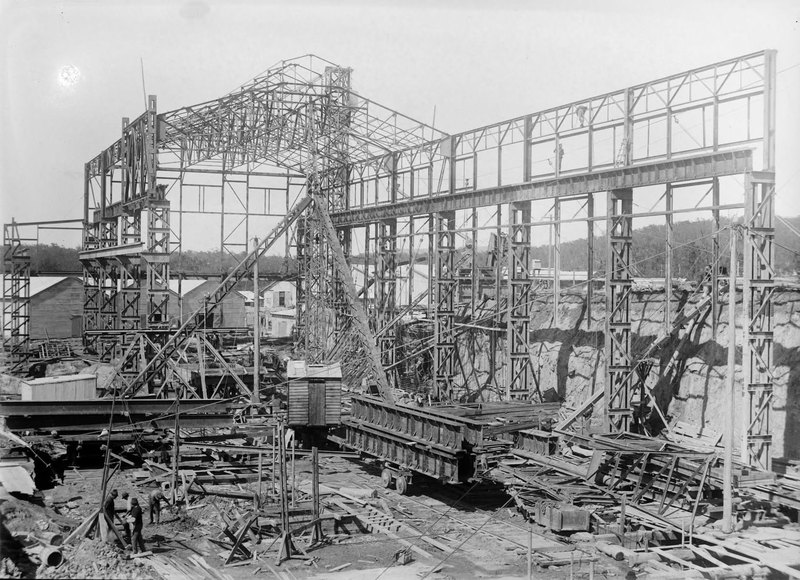
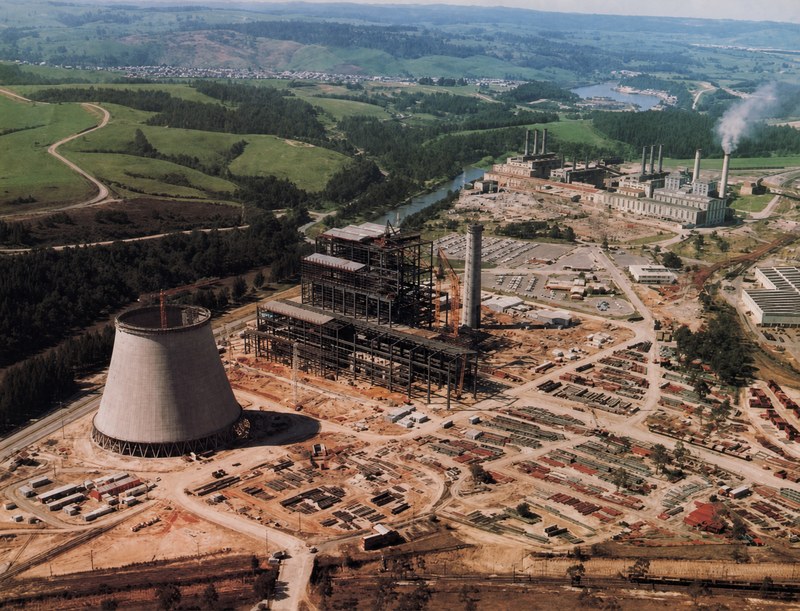
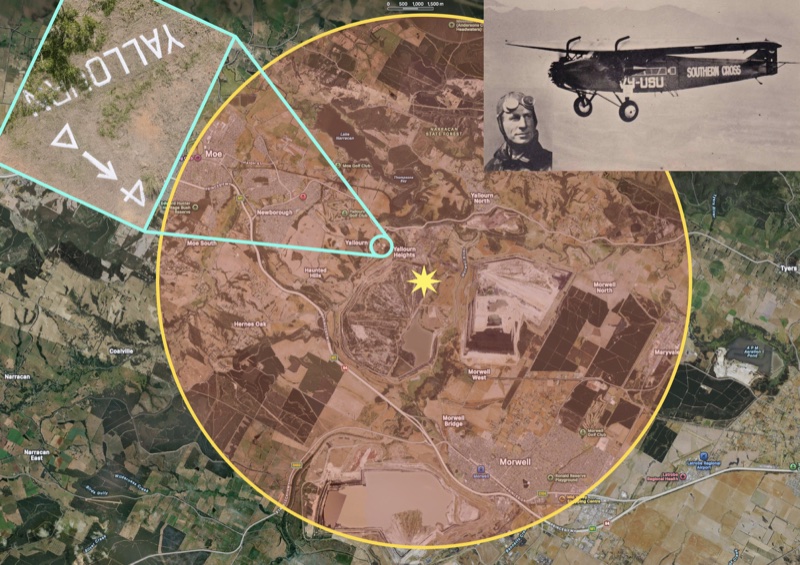
Engineering Heritage Australia records Yallourn Power Station as the first large power station in the Latrobe Valley, and the first anywhere to consume brown coal at scale — a project that broke new technical ground precisely because the coal was so wet, so low-grade, and so difficult to burn. Monash's contribution here was methodological rather than mechanical: he asked what the coal required, then built the mine, the power station, the briquette factory, the transmission line to Melbourne and the town around that answer, rather than trying to force the coal to imitate something it wasn't.
On 15 June 1924, power generated from Yallourn's brown coal began flowing down the transmission line into Melbourne, after less than four years of construction. A history prepared for the Hazelwood Mine Fire Inquiry records that, given its scale and technology, Yallourn was hailed at the time as the only undertaking of its kind in the British Empire.
A Town Built Around a Question
The power problem required more than machinery. It required people, and that meant building a town.
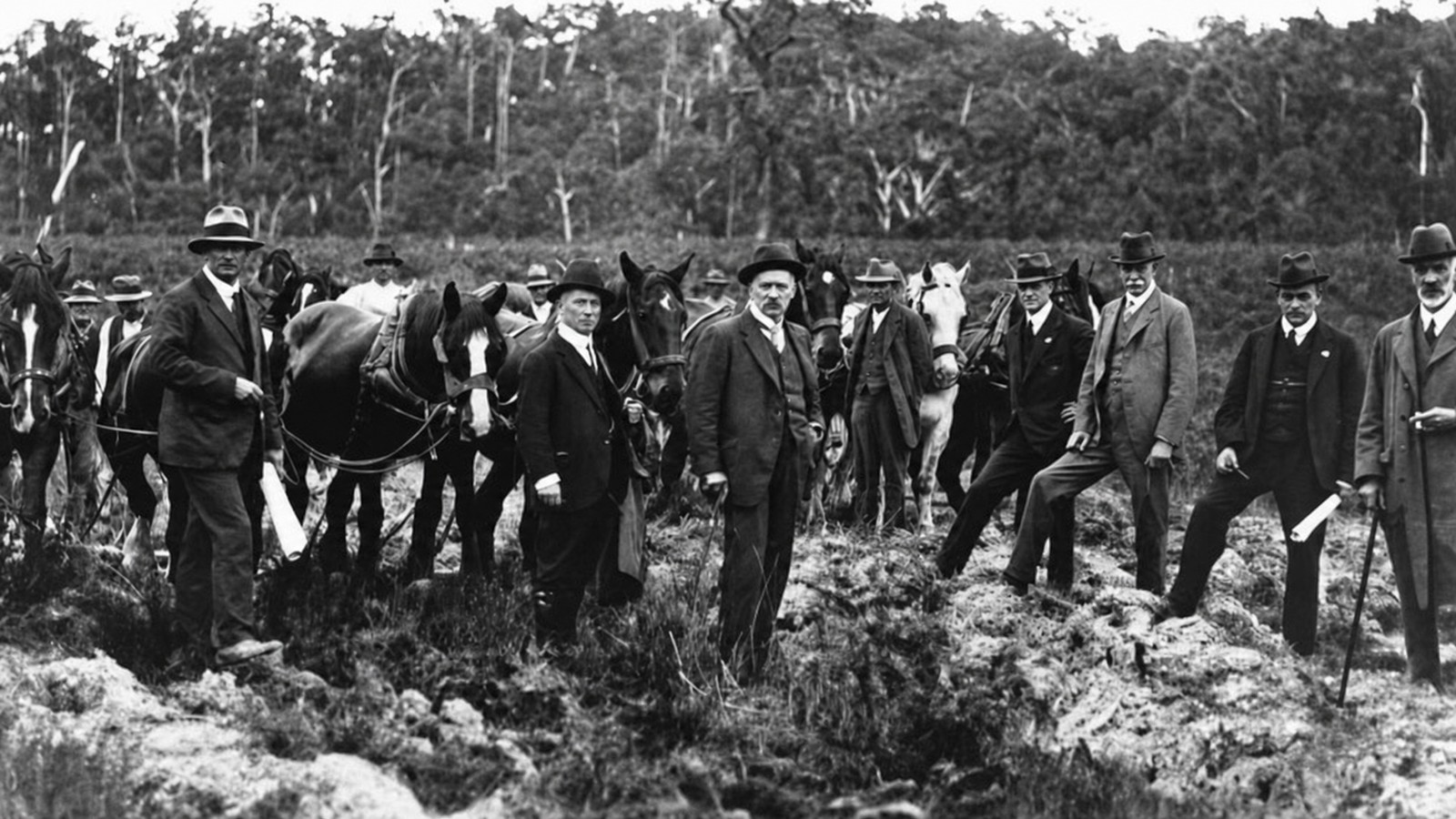
The first sod was turned at Yallourn on 5 February 1921. Horse-drawn scoops and Bucyrus steam shovels worked through timber, scrub and overburden, and a temporary power plant came into service on 25 April 1921 to supply the construction camps and the village of Morwell. The first power station building ran nearly 100 metres long, its steelwork shipped from Glasgow, housing twelve boilers imported from the United Kingdom. The open cut set aside for the project covered a full square mile and was estimated, in the 1920s, to hold 150 million tons of coal — enough, by the calculations of the time, to run a 150-megawatt station for a century.
Then came the town itself. Public Record Office Victoria records that Yallourn was shaped by the Garden City movement, planned as a self-contained community balancing industry, green space and agriculture — the early township plan stipulated that every house should have room to grow vegetables. By the time power began reaching Melbourne, Yallourn already had 200 houses and buildings and a primary school under construction for 350 pupils, according to Victorian Places. The hospital followed in 1929, the technical school in 1936, the civic theatre in 1939.
A town built on coal made room for gardens, because the people running the SEC understood something practical: a power industry cannot run on machinery alone. It needs families, skills, trust, education and civic pride, working the same system as the boilers.
The Sir John Monash Museum now stands inside the SEC Production Centre — the heritage-listed "Whitehouse," identified by the Latrobe Valley Express as the last remaining building of the original Sir John Monash brown coal development. It is the place where Victoria first learned to think differently about this coal.
Before It Was Fuel, It Was Forest
The next question about this coal starts with what it actually is.
Before Yallourn's coal was fuel, it was forest. Museums Victoria describes Gippsland's coal forming from wet, humid forests that began accumulating around 40 million years ago and grew thickest around 18 million years ago, in a near-coastal landscape where brackish water regularly flooded the forest floor and waterlogged the soil into peat swamps. The coal preserved what grew there in remarkable detail — leaves, fruits, branches, whole tree trunks, southern beech, araucarian conifers, and giant fossil Kauri pines at Yallourn that match trees found today in Queensland, Southeast Asia and the Pacific, with reeds, mosses, ferns, liverworts and sundews in the understorey.
Before the coal seam was a mine face, it was a living rainforest, drawing carbon out of the air the way every forest does.
Coal belongs to the carbon cycle — it is that cycle, paused underground. A plant draws carbon from the atmosphere and becomes root, stem, leaf, bark, flower and seed. It dies, and in the ordinary run of things its carbon returns to soil, water, air and new growth within years or decades. In Gippsland's ancient swamp forests, that return journey was interrupted: plant material accumulated faster than it could fully decompose, waterlogged soil turned to peat, and burial and pressure turned peat into brown coal over millions of years.
Yallourn's twentieth-century question was how to release energy from that paused carbon. Its next question may be how to return some of that carbon's original function — feeding growth — back to the soil it came from.
The Nitrogen Problem
Modern agriculture runs on nitrogen because plants do. Nitrogen builds proteins, enzymes and chlorophyll, and drives the leaf growth behind the food that fills paddocks and supermarkets. Synthetic nitrogen fertiliser now supports food production for more than half the world's population — one of the genuine triumphs of twentieth-century chemistry.
It created its own problem in the process.
Nitrogen does not reliably stay where farmers put it. Globally, around half — and in some farming systems more — of the nitrogen applied as fertiliser may not be recovered by the crop. Nitrogen fertiliser itself can also account for a substantial share of farm production costs. Poor nitrogen efficiency is therefore both an environmental problem and an economic one.
Lost nitrogen moves through several pathways. It can leach through soil and enter waterways, escape into the atmosphere as ammonia, or be transformed by soil microbes into nitrous oxide.
The last of these carries an outsized climate cost. Using the IPCC Sixth Assessment Report value cited by the US Environmental Protection Agency, nitrous oxide has a global warming potential 273 times that of carbon dioxide over one hundred years and can persist in the atmosphere for more than a century. CSIRO reports that, globally, agricultural production accounted for around 74 per cent of human-caused nitrous oxide emissions over the past decade.
Improving nitrogen retention is therefore not a minor efficiency question. If more of the nitrogen applied to a paddock can remain in the plant-soil system long enough for the crop to use it, agriculture may be able to produce more from each kilogram of manufactured nitrogen while reducing losses to water and the atmosphere.
The question is whether the answer is simply to keep making and applying nitrogen in the same way.
Ancient Plant Carbon and Modern Agriculture
This is where brown coal becomes unexpectedly relevant, through the same chemistry that made it awkward as a fuel.
Victorian lignite is geologically young and formed from ancient plant material that never completed the transformation into hard black coal. Compared with higher-rank coal, it retains an oxygen-rich organic structure and humic characteristics that matter in soil, not only in a furnace.
That distinction is important.
Humic substances are not conventional fertilisers in the way urea is. They do not simply replace one kilogram of nitrogen with another. Their potential lies in changing what happens to nutrients once they enter the soil — influencing nutrient retention and availability, soil chemistry, root development and the efficiency with which plants access applied fertiliser.
For nitrogen, that creates a different question.
If a significant proportion of conventional fertiliser nitrogen is lost before a crop can use it, the answer may not simply be to manufacture and apply more urea. It may be to design a fertiliser system that holds nitrogen in the plant-soil system for longer and makes a greater proportion of each kilogram applied available to the crop.
Peer-reviewed laboratory, soil-column and glasshouse research into brown coal-urea fertilisers has produced results consistent with that possibility.
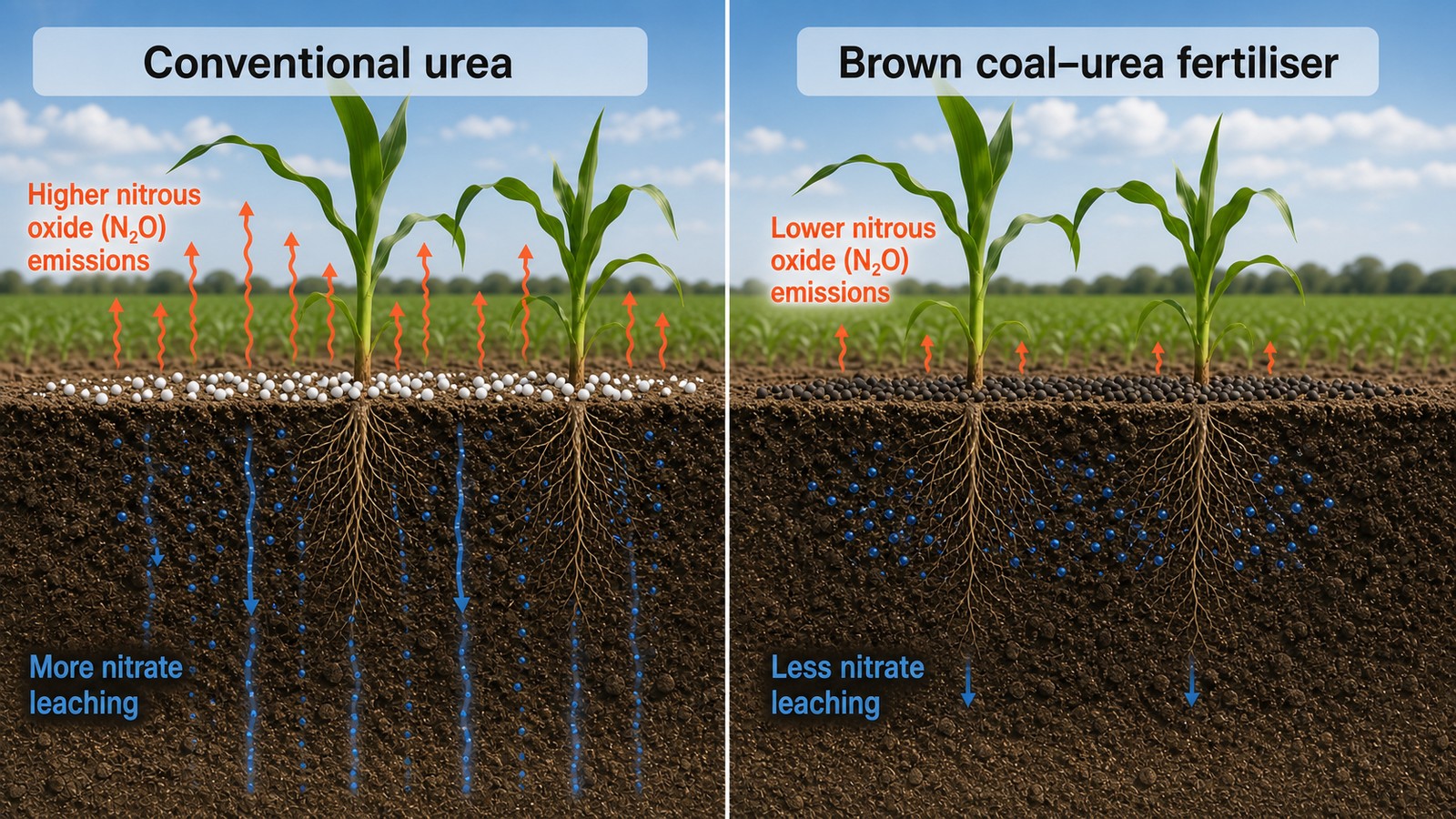
One study found urea-brown coal granules reduced measured nitrous oxide emissions by up to 40 per cent, reduced mineral nitrogen leaching and retained more nitrogen in the topsoil than conventional urea under the experimental conditions.
In controlled silver-beet research, a brown coal-urea fertiliser increased nitrogen uptake while reducing measured nitrous oxide emissions by 29 per cent and ammonia emissions by 36 per cent compared with urea alone.
Further research across three Australian soil types found brown coal-urea granules reduced cumulative nitrous oxide emissions by between 31 and 42 per cent compared with conventional urea. The same experiments also recorded lower mineral nitrogen leaching.
The significance of these results may be broader than emissions reduction.
They point to a more fundamental possibility: that the organic and humic characteristics retained in brown coal may help change the efficiency with which manufactured nitrogen is delivered to plants.
That does not make brown coal a substitute for nitrogen. Plants still require nitrogen, and urea remains an extraordinarily concentrated and effective source of it.
The question is whether every tonne of urea currently used needs to be used in the same way, or ultimately in the same quantity, if more of its nitrogen can be held, cycled and made available to plants rather than lost before the crop can use it.
None of this is settled science delivering a finished product. The published research has largely been conducted under controlled laboratory, soil-column and glasshouse conditions. Crop type, soil type, application rate, formulation and climate all matter. Commercial-scale field validation and full life-cycle assessment remain essential.
But chemistry, soil biology and plant research are converging on an intriguing possibility: that the carbon and humic characteristics locked in this coal, once treated purely as undesirable characteristics of a fuel, may be capable of doing useful work when returned to soil rather than burned.
Monash's Method
This is the argument the museum exists to make.
Yallourn is not valuable only for what it produced. It is valuable for how it thought.
Brown coal presented an awkward material. It contained extraordinary quantities of water, had a lower energy density than black coal and did not comfortably fit the established assumptions of the coal industry.
The response was not simply to dismiss the resource because it was the wrong kind of coal.
The material itself was studied. Its limitations were made specific. Engineering systems were designed around what Victorian brown coal actually was, rather than what conventional wisdom said coal ought to be.
Monash and the State Electricity Commission built an industry where many had seen a dead end.
That discipline travels further than electricity.
It is the habit of returning to the thing itself rather than the reputation attached to it — asking what a material is, what it does, what it requires and what problem it might solve once it is understood on its own terms.
Today, brown coal carries a reputation almost entirely shaped by combustion and carbon emissions. That history cannot and should not be ignored.
But neither should it prevent a different scientific question being asked.
What if the characteristics that made Victorian lignite a difficult fuel — its ancient plant carbon, oxygen-rich organic chemistry and humic character — are precisely the characteristics that give it value in soil?
Nitrogen loss is a genuine agricultural and environmental problem. Agriculture is the world's largest human-caused source of nitrous oxide, and inefficient nitrogen use is one of the mechanisms behind it. Controlled research has shown that brown coal-urea formulations can reduce nitrogen losses and improve the retention and uptake of applied nitrogen under particular experimental conditions.
Those facts are worth holding together rather than filing them under separate arguments about coal and separate arguments about climate.
The question was never whether the past deserves defending.
It is whether the discipline that built Yallourn — checking the inherited answer against the evidence, rather than against its reputation — can be pointed at a problem sitting in front of us now.
Field trials, soil type, crop type, application rate, processing method, transport, commercial scale and full life-cycle accounting: all of it still needs to be worked through before that discipline earns a conclusion.
Monash would have expected nothing less.
He did not succeed by making vague claims about brown coal. He succeeded by making the problem specific enough to solve.
Yallourn's first question helped power a state.
Its next question may be whether the same ancient plant material can help agriculture use nitrogen more efficiently — protecting the soil, the water and the air downstream of how we feed ourselves.
The Sir John Monash Museum stands inside the last remaining building of the development that asked the first question.
That may be exactly the right place to ask the next one.
Open Tuesdays 10am–2pm and Sundays 10am–3pm.
30 Yallourn Drive, Yallourn.
Sources: US Environmental Protection Agency, Understanding Global Warming Potentials; CSIRO, Global Nitrous Oxide Budget 2024 coverage; Rose et al., A slow release nitrogen fertiliser produced by simultaneous granulation and superheated steam drying of urea with brown coal (2016); Saha et al., Nitrogen Dynamics in Soil Fertilized with Slow Release Brown Coal-Urea Fertilizers, Scientific Reports (2018); Saha et al., A slow release brown coal-urea fertiliser reduced gaseous N loss from soil and increased silver beet yield and N uptake, Science of the Total Environment (2019); Museums Victoria, Gippsland brown coal formation; Engineering Heritage Australia; Public Record Office Victoria; Victorian Places; Hazelwood Mine Fire Inquiry historical material; Latrobe Valley Express; Gippsland Basin Bioregional Assessment.