
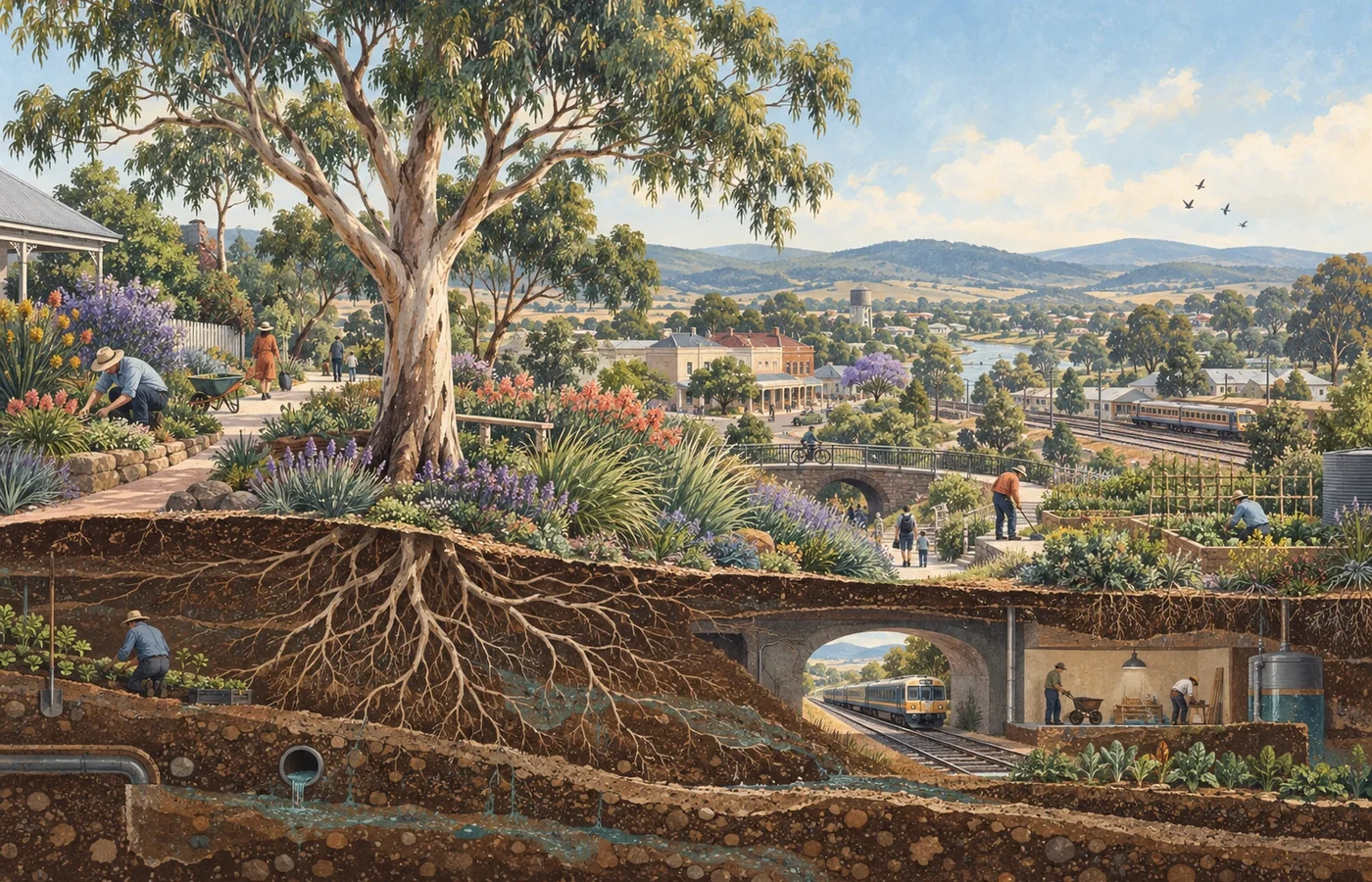
A mature tree carries years of work beneath its canopy.
Someone chose where it would grow. Someone prepared the ground, planted it and returned with water. Other people protected the space around it, maintained the street and made decisions about the place the tree would become part of. Its shade is the visible result of connected choices accumulating over time.
Ebenezer Howard built that kind of connection into his Garden City proposal. Trees, gardens and open land gave the idea its most recognisable form. Land, rent, employment, food, transport and public works supplied the structure that would keep the settlement functioning.
The Social System Beneath the Garden City follows that structure through Howard's proposal and its selective translation at Yallourn. Its central idea is simple and demanding: a living place depends on the relationships that sustain it.
The value created by a place
Howard imagined a Garden City within a larger estate. Homes, workplaces, shops, schools, libraries, parks and recreation occupied the urban area. Around it, farms, orchards, market gardens, allotments and smallholdings kept agriculture close to the people and markets it served. A railway connected the town with other settlements and the wider economy.
The same estate formed the financial base. Trustees would hold the land for the settlement. Ground rent would first meet the cost of purchasing and developing it. The remaining revenue would support roads, schools, parks and other common works.
Howard was asking who should receive the value created when people bring a place to life. Residents and businesses would make the settlement useful. Their rent would help maintain the shared setting in which homes, work and public life continued.
That mechanism made stewardship part of the plan. Parks needed maintenance. Streets and transport needed investment. Farms needed people with knowledge of the ground. Howard wrote about vegetables, fruit and flowers as forms of cultivation that could reward the close attention of individuals and small groups.
The Garden City joined these efforts into one civic system. The public realm and private initiative could strengthen the same place.
Yallourn's system of work and care
Garden City thinking reached the Latrobe Valley through Yallourn, where the State Electricity Commission built a town for employees beside the brown-coal mine and power station.
The SEC planned housing, work and civic life together. Yallourn included green areas, sporting facilities, schools, a hospital and a theatre. Home plots gave residents room to grow vegetables. Streets and public spaces carried the landscape through the town.
Authority took a different form at Yallourn. The SEC owned most land and buildings, employed much of the population and administered the town. Howard's model directed land value through trustees and a municipal structure for the settlement's benefit. Yallourn placed ownership, employment and administration with the organisation responsible for electricity production.
The physical relationships remained powerful. Work stood close to home. Gardens entered residential life. Recreation, education and public facilities formed part of the same designed town. People then carried those structures into daily life through employment, cultivation, sport, learning and the ordinary care of their surroundings.
Yallourn gives Latrobe a local way to understand the Garden City as organised human effort. The town's green character grew from plans, institutions, resources, workers and residents acting across time.
Power of Colour makes the work visible
Power of Colour brings gardens, community creativity and professional botanical work into a shared regional programme.
The programme creates opportunities to recognise the people behind the finished result: the gardener who learns which plants belong together, the person who makes room for habitat, and the professional who brings botanical colour into food presentation. Each contribution has its own purpose and skill. Together, they widen the picture of how living material enters the life of a place.

Two current Awards carry that idea through distinct forms of care.
The Biodiversity Garden Award recognises a garden that supports diverse planting, habitat and visible garden life. It directs attention towards the relationships within a garden: plants chosen for different roles, places where life can feed or shelter, and the continuing observation that helps a living space develop.
Eligible Garden Award entries are located within the Latrobe City municipal boundary and assessed in place. The garden remains connected to its own ground, street and local conditions while becoming part of the wider Power of Colour story.
The Taste of Colour Award is an Industry Showcase award for a dish, dessert, drink or food presentation using edible flowers or botanical colour. Professional entries for this award are accepted regardless of location. It brings another kind of knowledge into view: choosing living ingredients and botanical colour, understanding how they can be used, and applying professional skill to the finished presentation.
The two Awards recognise different work. One begins in the relationships that support life within a garden. The other carries edible flowers or botanical colour into professional food presentation. Their connection belongs to a larger chain linking cultivation, knowledge, creativity and the ways people share living material.
Registrations open 1 October 2026. Power of Colour takes place on 14–15 November 2026, with garden activity across Latrobe on Saturday and community and industry showcases at the Sir John Monash Museum on Sunday. The Power of Colour Awards page holds the latest Award and participation information.
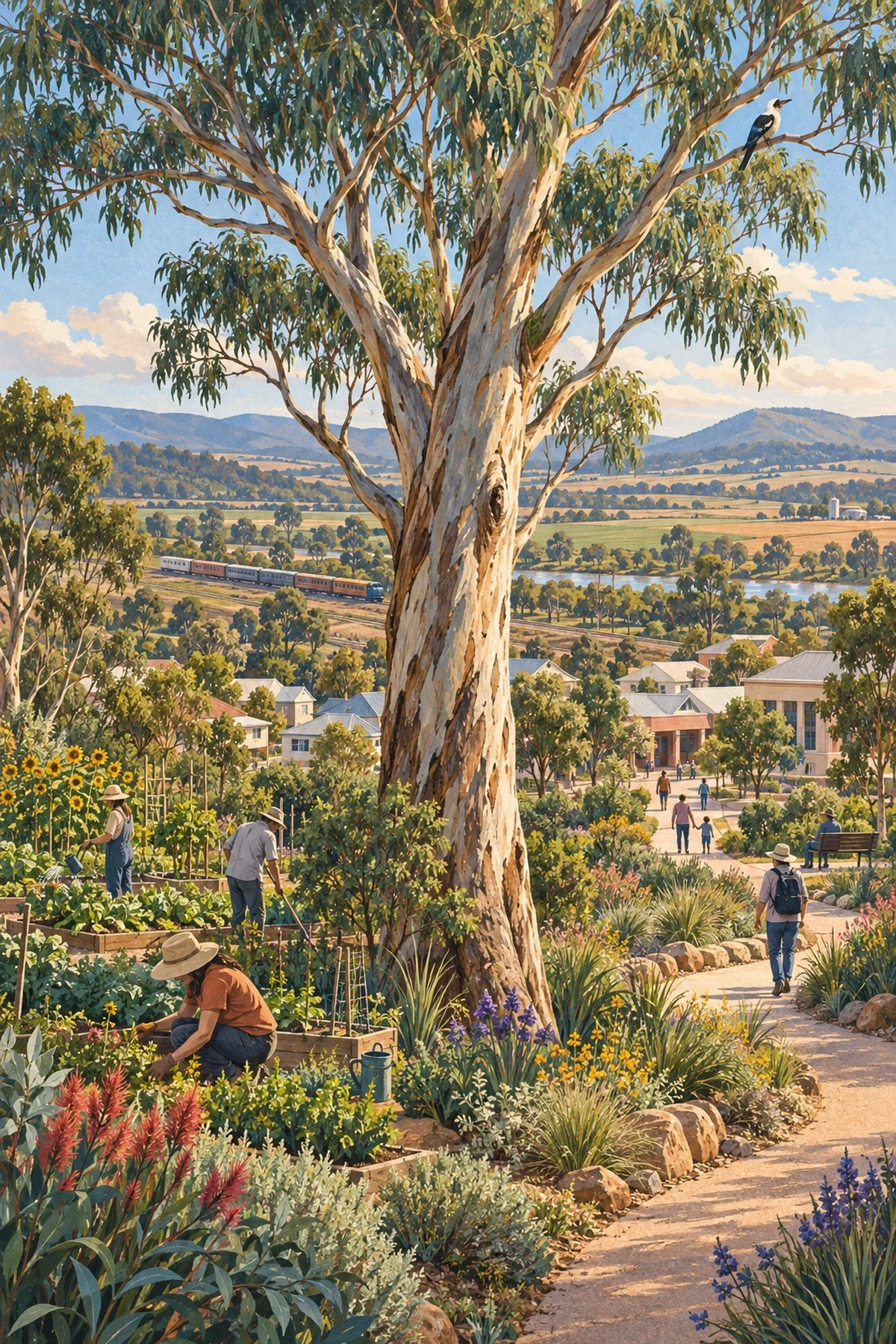
Howard's Garden City asked people to see a settlement as a set of connected responsibilities. Yallourn gave some of those responsibilities a distinctive institutional and regional form. Power of Colour now invites attention to the people who keep working with living things in the places around us.
A canopy grows. Habitat gathers. Botanical colour reaches the table. Each result begins with someone learning the work and returning to it.
That is how a place keeps growing.

Power of Colour
Power of Colour Awards 2026
Power of Colour brings gardens, community creativity and professional botanical work into a shared regional programme across 14–15 November 2026.
Explore the Power of Colour AwardsSources
- Power of Colour — The Social System Beneath the Garden City
- Ebenezer Howard — Garden Cities of To-Morrow
- Town and Country Planning Association — The foundations of the Garden City Movement
- Town and Country Planning Association — Garden City Principles
- Town and Country Planning Association — Garden Cities: separating truth from myth
- Public Record Office Victoria — The town that was: Yallourn
- Power of Colour Awards 2026