
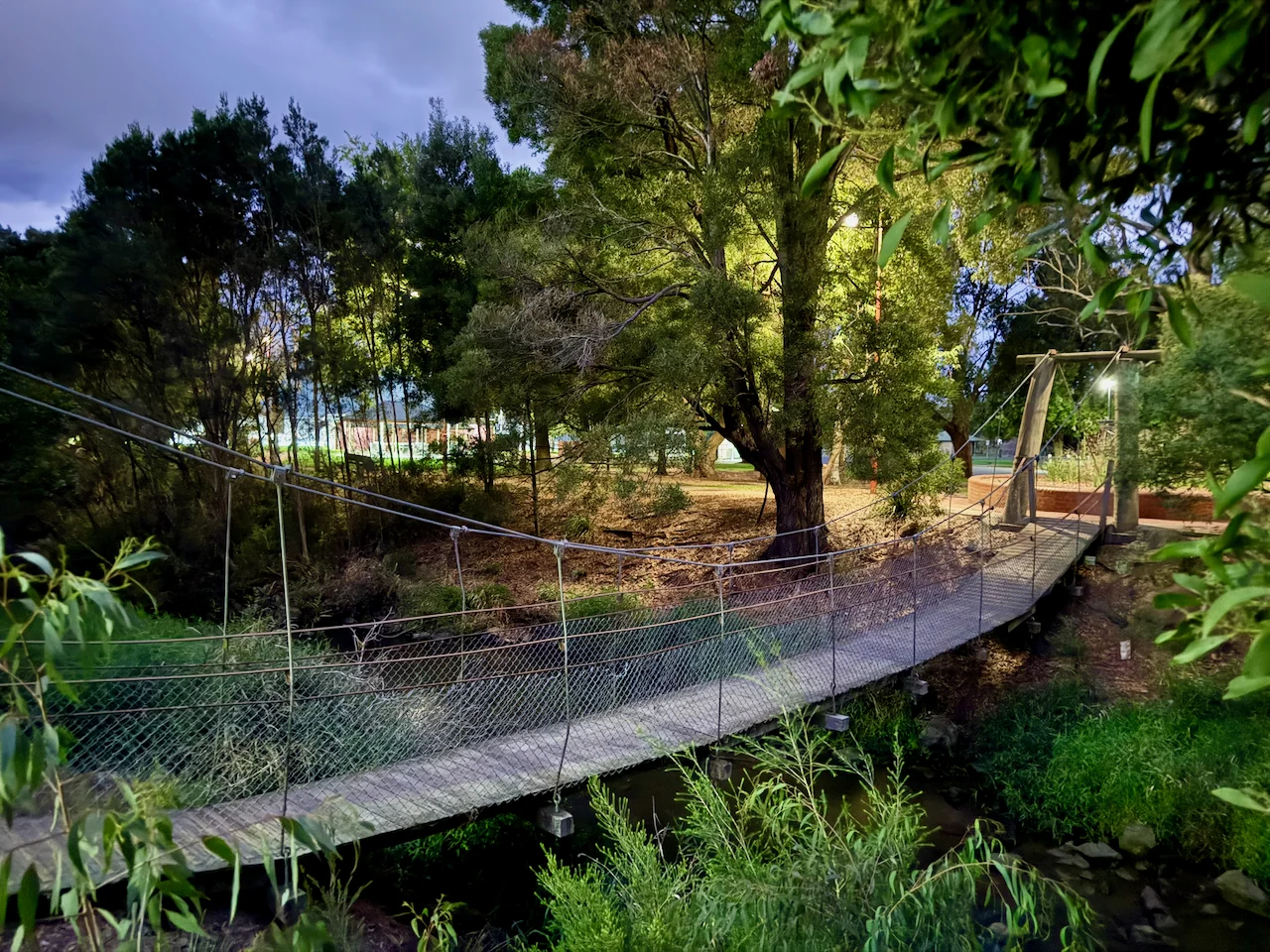
The first documented work at Moe Botanic Garden joined two practical acts: make a way across the creek and make a place where something could grow.
In 1984–85, an Army Field Squadron built a log bridge across Narracan Creek. The first raised garden bed was started. A cubby house donated by Yallourn TAFE College was raffled, raising $1,200 for the Botanic Gardens project.
A bridge, a bed and a raffle formed the beginning of something the Rotary Club of Moe would remember as an ambitious project—large enough to become one of the defining undertakings of its 1980s.
The work had an earlier lead-in. In 1980–81, Rotary and Apex held joint working bees to continue beautification along Narracan Creek. Four years later, the Botanic Gardens project gave that practical civic impulse a larger form. The creek corridor became ground where access, planting and public use could be built together.
The idea became real through successive additions.
In 1986–87, the 5th Field Squadron erected a suspension bridge. Two barbecues were installed, trees were planted and garden beds developed. The following year, footpaths were completed and seats made at TAFE were put in place. More trees and longer paths followed in 1988–89.
Each contribution opened another possibility. A bridge allowed movement across the creek. A path gave that movement direction. A seat made room to pause. Trees and beds changed the character of the ground. Barbecues gave people a reason to stay.
The Garden emerged through a network of useful skills. Rotary organised, fundraised and worked. Apex joined the earlier creek-side effort. Army personnel brought construction capability to the crossings. Yallourn TAFE contributed to fundraising and made seating. The project grew because different parts of the community could bring something practical to the same piece of ground.
That pattern continued after the first decade.
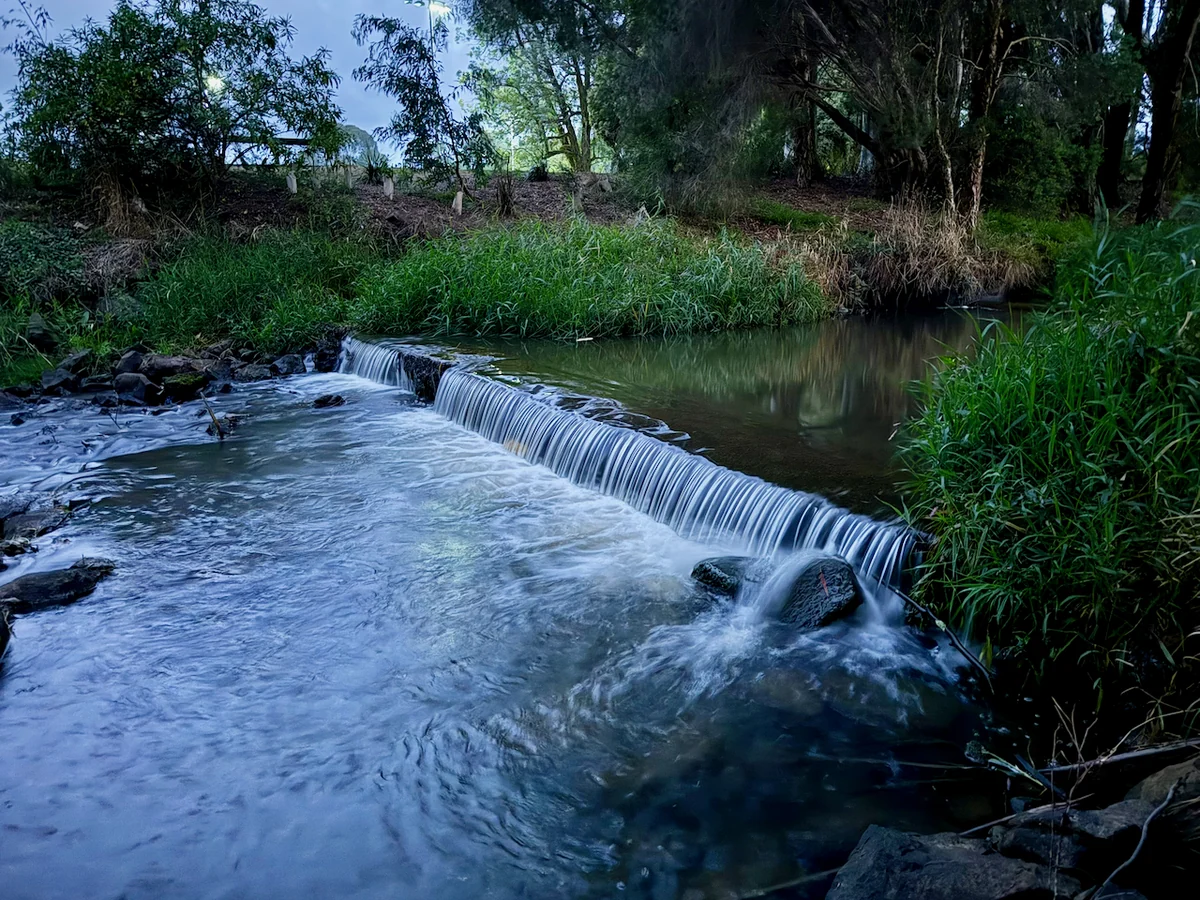
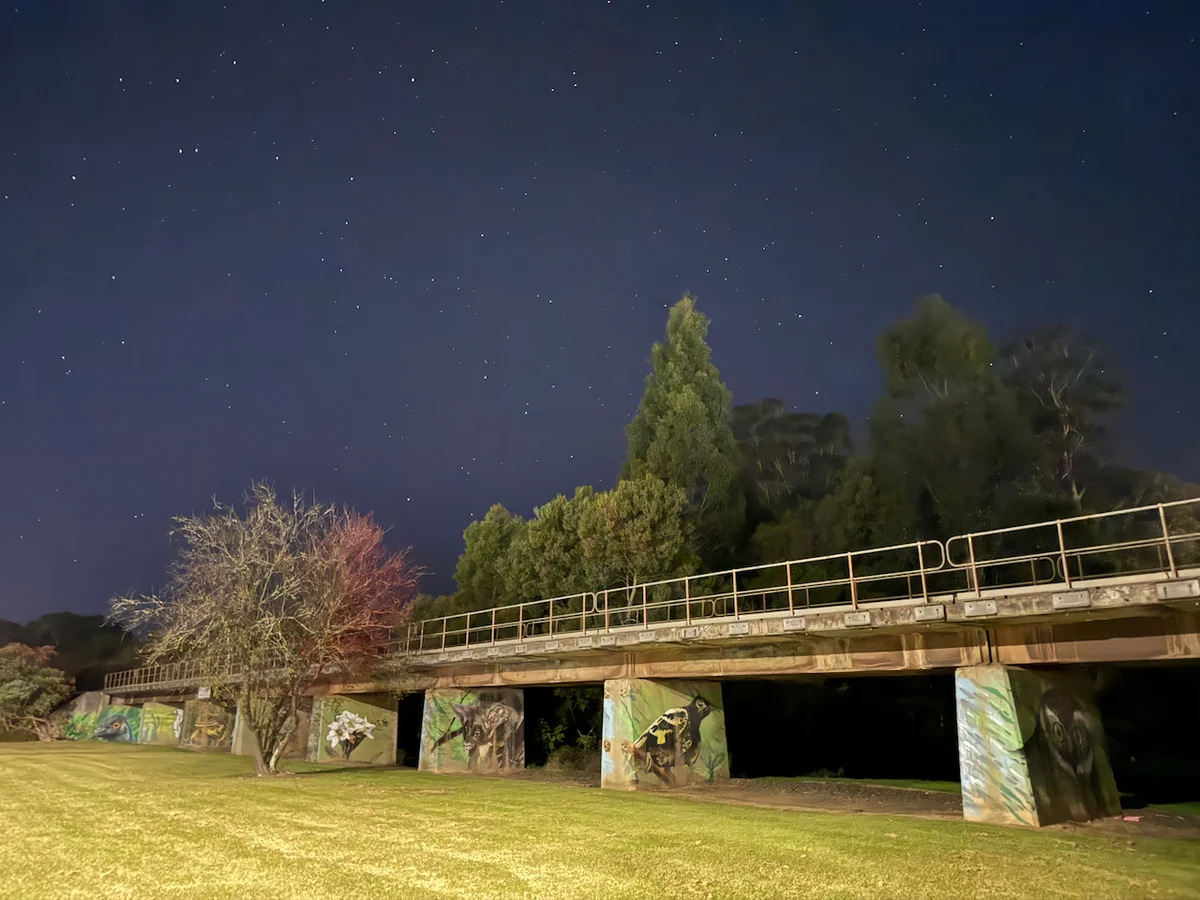
A circular brick garden bed was laid in 1991–92. Access towards the Moe–Yallourn Rail Trail developed in the early 2000s. A rotunda was restored and relocated to the Garden, memorial walls were built, paths were lit and a new barbecue pavilion followed.
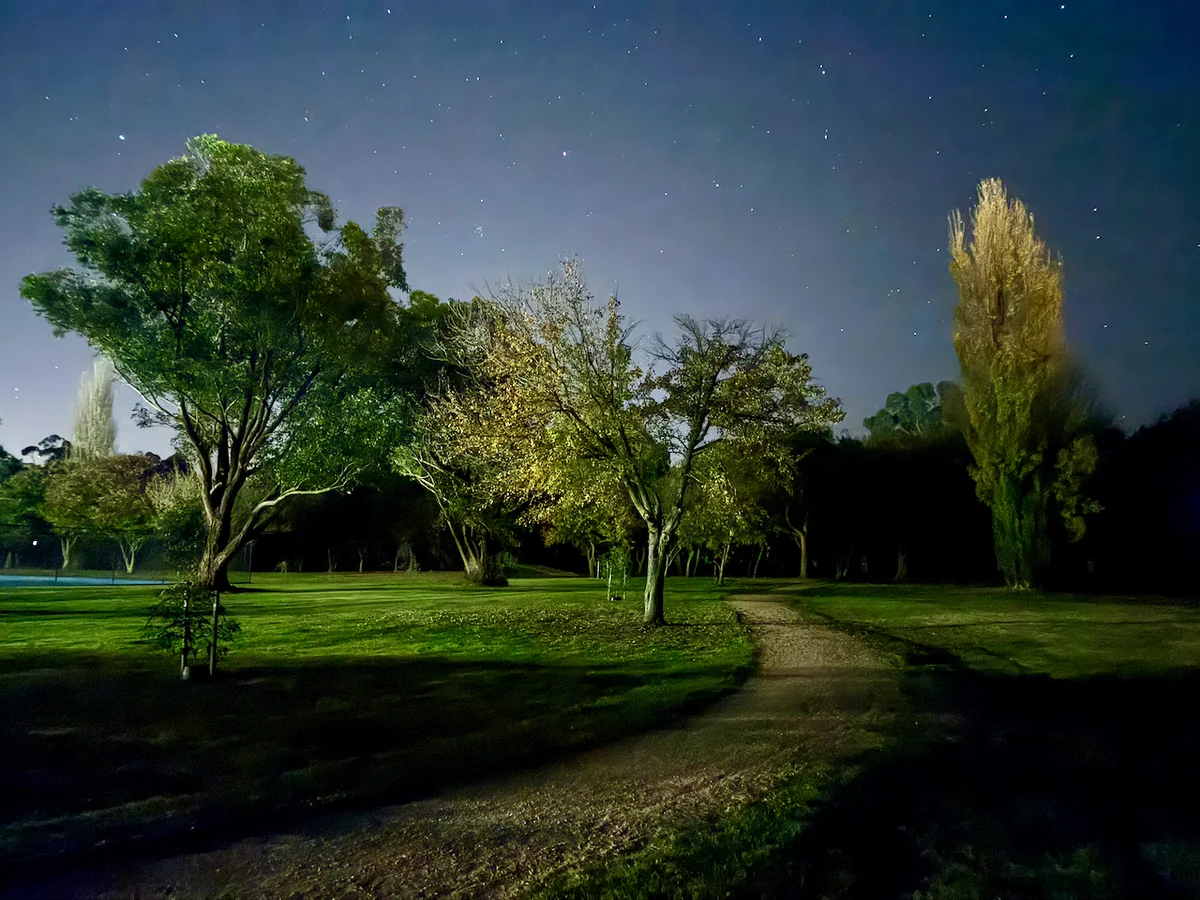
These additions created a place with many ways in. Today, native and exotic trees stand among walking paths, murals, picnic areas and public facilities. The railway-themed playground gives children a train, a flying fox, a nest swing, spinning play and a creek-bed water feature. The Garden also connects with the Moe–Yallourn Rail Trail, carrying a local walk into the wider landscape between Moe and Yallourn.
The playground arrived through another long act of collaboration. Rotary began developing the idea in 2014. Consultation brought Council, the Moe Historical Society, the Moe–Yallourn Rail Trail Committee and other stakeholders into the planning. The playground was completed in 2021, adding another reason for families to return.
The place now holds several generations of decisions. Some are visible as structures. Others live in the arrangement of a path, the position of a tree or the ground beneath a garden bed.
That ground called people back in 2026.
Rotary members began renewing the round garden bed. Around fifteen trailer loads of old soil were removed. Drainage trenches were dug. Weep holes were cleared, then stone screenings and agricultural pipe were laid before new soil arrived. Only after that work could planting begin.
The process carries an echo of 1984–85. The Garden's earliest documented work included a first raised bed. More than forty years later, another group returned to soil, drainage and the conditions a planting needs before its colour can appear.
This is how a public garden keeps being made.
People often meet a shared place when it is ready for them. A path already reaches the bridge. The tree already offers shade. The playground is waiting. The barbecue shelter has a roof. The work that made those experiences possible sits quietly inside them.
Moe Botanic Garden brings that work into view because its history is cumulative. Each generation prepared a useful layer. Later hands repaired it, connected it, extended it or added another reason to return.
The Garden therefore carries a generous local proposition: ordinary acts of care can enter the life of a town. A working bee, a constructed path, a cleared drain or a young tree may begin as a bounded task. Its value grows as people encounter it across years.
_Moe Botanic Gardens: A Green Path Through Town_ follows the Garden's paths into its relationship with the rail trail and the wider region. The history beneath those paths adds another dimension. Before a route can carry somebody onwards, people have to make the ground passable, plantable and welcoming enough to enter.
Power of Colour celebrates the same relationship between visible beauty and the work that sustains it. Two of its Award pathways bring that idea within reach at different scales.
The Biodiversity Garden Award recognises a garden that supports diverse planting, habitat and visible garden life. It draws attention to the living relationships that care can establish and maintain over time.
The Junior Colour Creation Award invites a participant under 16 to make a colourful floral or botanical creation. A young maker can begin with the materials, scale and idea available to them and bring something living into shared view.
One Award looks across a garden. The other begins with a creation held in young hands. Both make room for attention, choice and care to become visible.
The Power of Colour Awards are scheduled for 14–15 November 2026. Current Award and participation information is available through the Power of Colour Awards page.
Moe Botanic Garden began to take shape through people making a crossing, preparing a bed, planting trees and giving others a place to stop. Its story has continued through every later decision to repair, connect, build and grow.
In the renewed round bed, the drainage lies beneath fresh soil. The work will remain largely unseen as the plants establish above it. That is its gift. Ground prepared now becomes colour, shelter and possibility for people still to come.

Power of Colour
Power of Colour Awards 2026
Power of Colour brings gardens, community creativity and professional botanical work into a shared regional programme across 14–15 November 2026.
Explore the Power of Colour Awards