
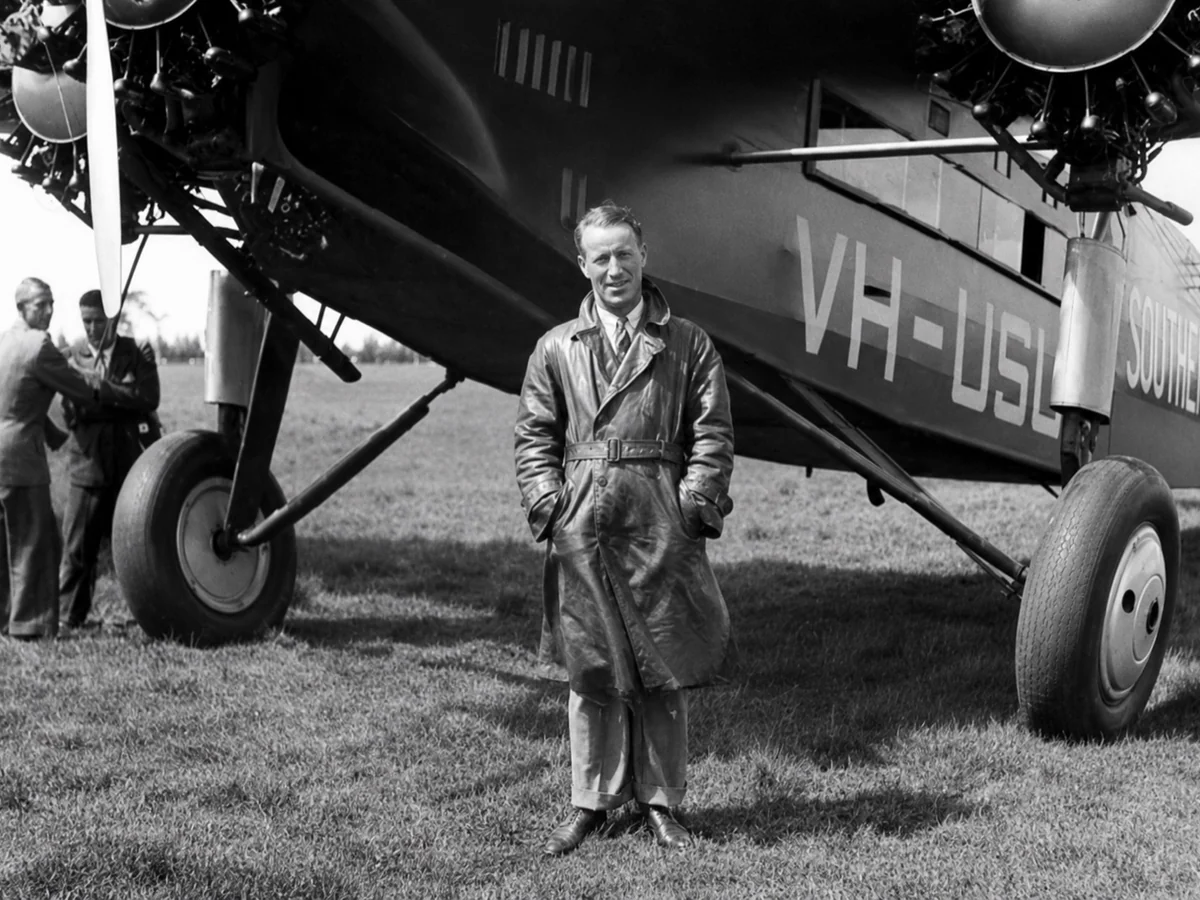
Fine weather finally arrived over Morwell on Saturday 29 October 1932. Weeks of heavy rain remained underfoot in Kleine’s paddock, behind the Presbytery.
W. McRoberts had helped prepare the visit as the local advance agent. His everyday work was at Morwell’s Vacuum Oil depot. On this morning, the arrangements around him involved one of the world’s most famous aviators, a temporary landing ground and a crowd expected to gather around two working aircraft.
The plan appeared settled. Sir Charles Kingsford Smith would arrive in the Southern Cross at eleven. Passenger flights would follow. Admission to the ground was free, and organisers had made arrangements for the safety of onlookers and the comfort of passengers. One warning had already appeared in the newspaper: keep well away while the propellers were revolving.
Shortly after ten, the first aircraft arrived to test the field. O. B. Hall’s small D.H.30 biplane came down safely and began moving across the wet outskirts of the paddock.
Its wheels found a crab hole.
The biplane came close to bogging and had to be assisted out. The aircraft sent ahead to test the landing ground had found the ground’s weakest point. The Southern Cross was due within the hour.
Long before eleven, people were gathering beside the paddock. Eleven o’clock arrived. The sky remained empty. The wait stretched for another quarter of an hour.
At about 11.15, the Southern Cross appeared in the distance.
Hall’s biplane climbed from the paddock, met the larger aircraft and led it towards the landing ground. The Southern Cross followed. Both aircraft made what the Morwell Advertiser described as perfect landings.
Kingsford Smith stepped out looking, in the newspaper’s words, as though he had “just walked out of a cosy room”. A cigarette was found for him. Shire secretary Mr Horsfall and Mr W. Smith introduced him to councillors, returned soldiers and other residents. D. Reid of Traralgon was there too. He and Kingsford Smith had served as motorcycle dispatch riders during the early stages of the Great War, and the famous aviator greeted his old cobber.
Councillor D. J. White welcomed him for the Shire Council. A. Shaw spoke for the returned soldiers. Kingsford Smith answered the speeches with nine words that brought the occasion back to the aircraft beside them: “the same old bus and the same old pilot.”
The crowd continued to grow as people arrived from near and far. The successful landing opened the next stage of the day. The Southern Cross and Hall’s biplane began carrying passengers, and both aircraft remained continuously engaged. Local people looked down on Morwell and the surrounding district for the first time. No mishap occurred.
That evening, the welcome continued at McKay’s Hotel. Kingsford Smith explained that touring towns and carrying passengers allowed him to remain in Australia and meet the costs of his aircraft. Every flight over Morwell helped the Southern Cross fly on.
At about ten on Sunday morning, the Southern Cross lifted from Kleine’s paddock and headed for Leongatha with passengers aboard. The field that had nearly held the advance biplane had carried the larger aircraft through a full day of flying and released it towards the next Gippsland town.