
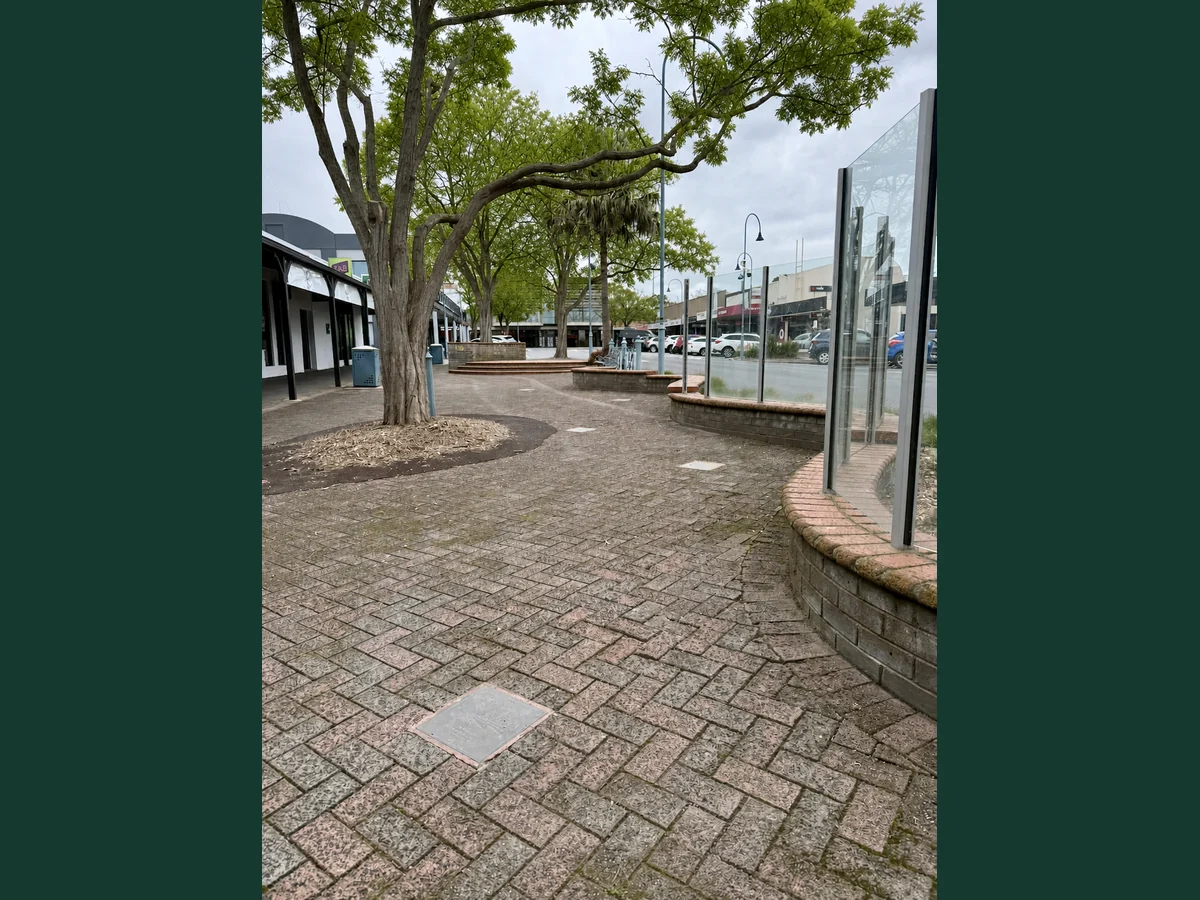
The first thing that catches the eye is a change in texture: pink-edged paving, dark aggregate, then a rectangle of metal scored with lines too deliberate to be ordinary wear.
Bend closer and a cartoon takes shape. Words rise from the scratches and weathering. A newspaper masthead appears. Then a signature.
There are five photographed cartoons in Moe’s Footpath Gallery of Prominent Cartoonists, each carrying the work of an artist whose drawings reached Australian newspaper readers as the day’s events were still unfolding. Bill Mitchell, Sean Leahy, Dean Alston, Peter Nicholson and Jeff Hook drew the country’s political life while it was unfolding. In Moe, their lines have settled into the daily path of the town.
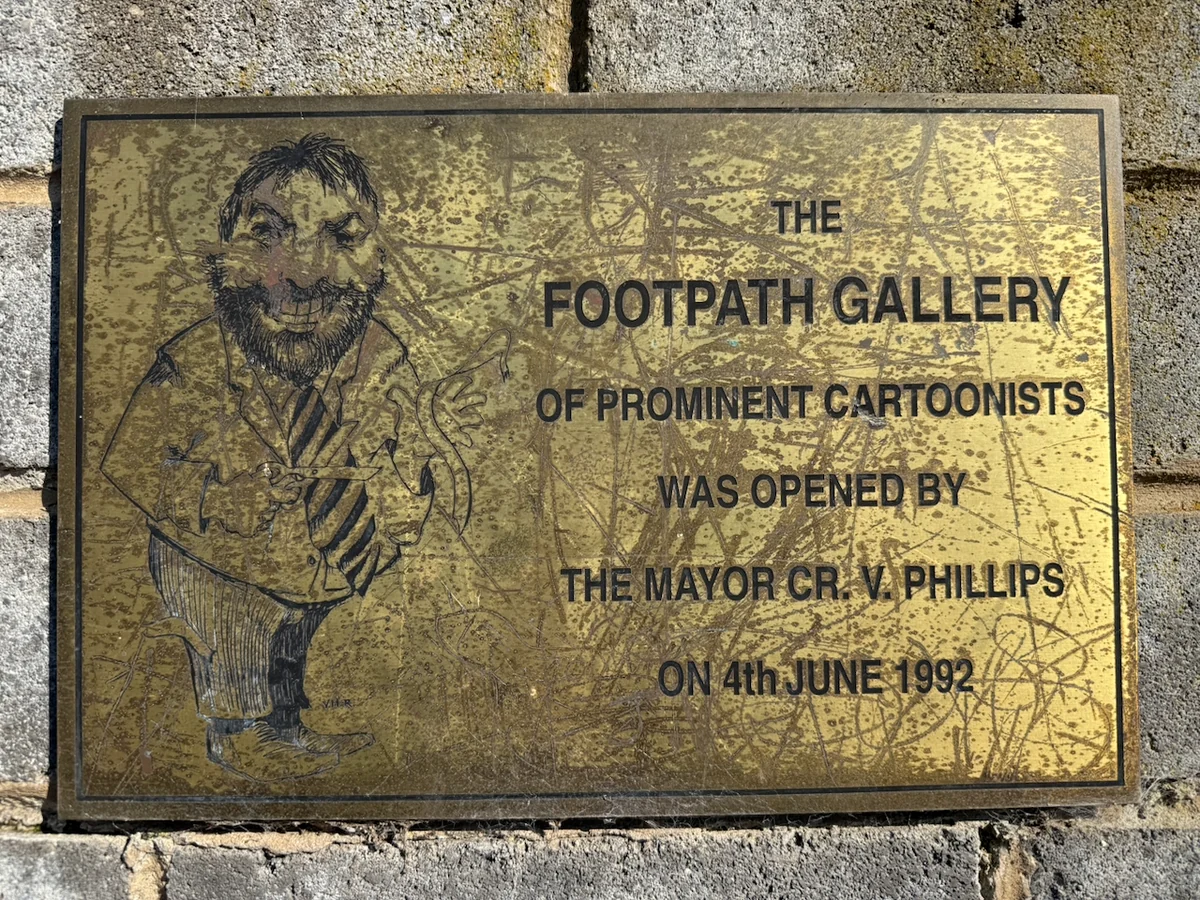
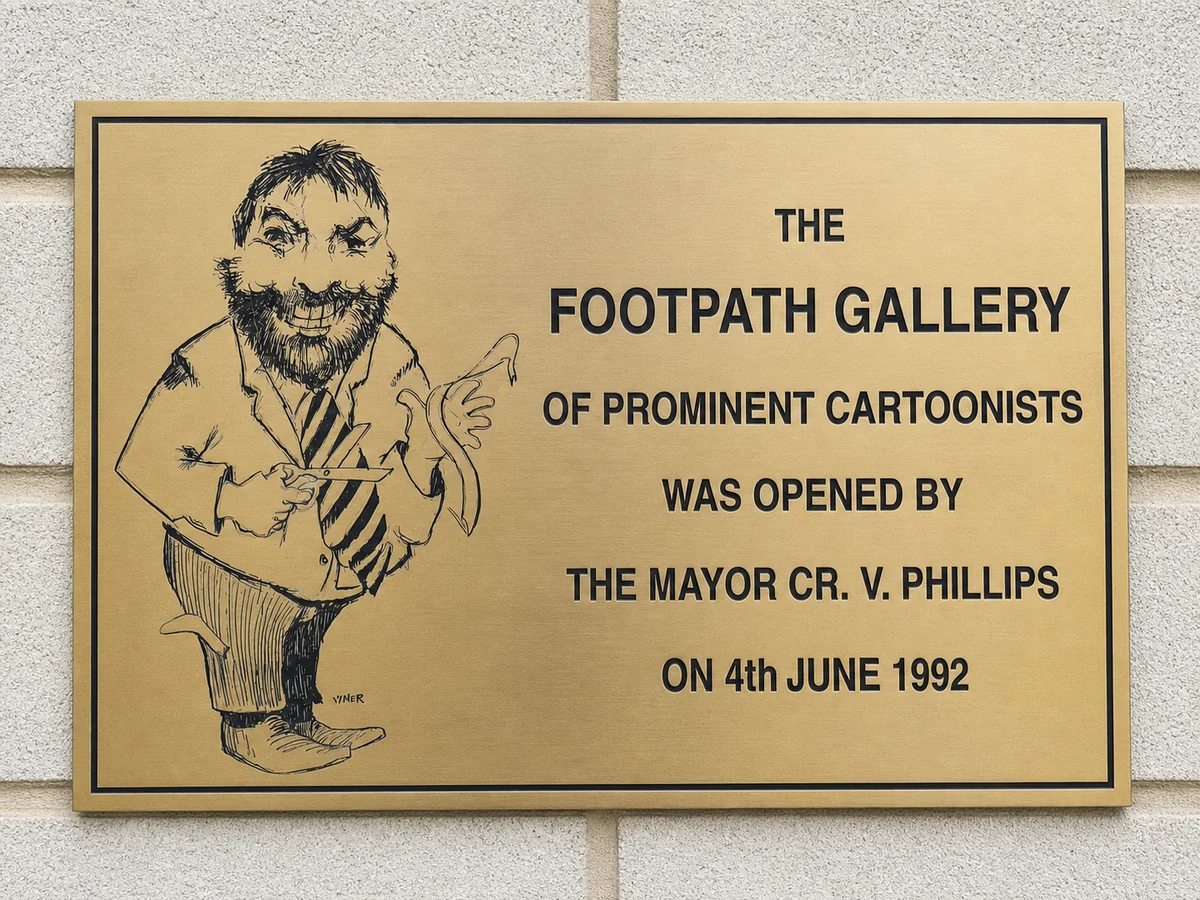
An opening plaque records that Mayor Cr V. Phillips opened the gallery on 4 June 1992. Four of the five photographed cartoons are dated in 1991. Together, they bring back a year of recession, industry policy, opinion polls, parliamentarians’ pay and Australia’s relationship with the United States.
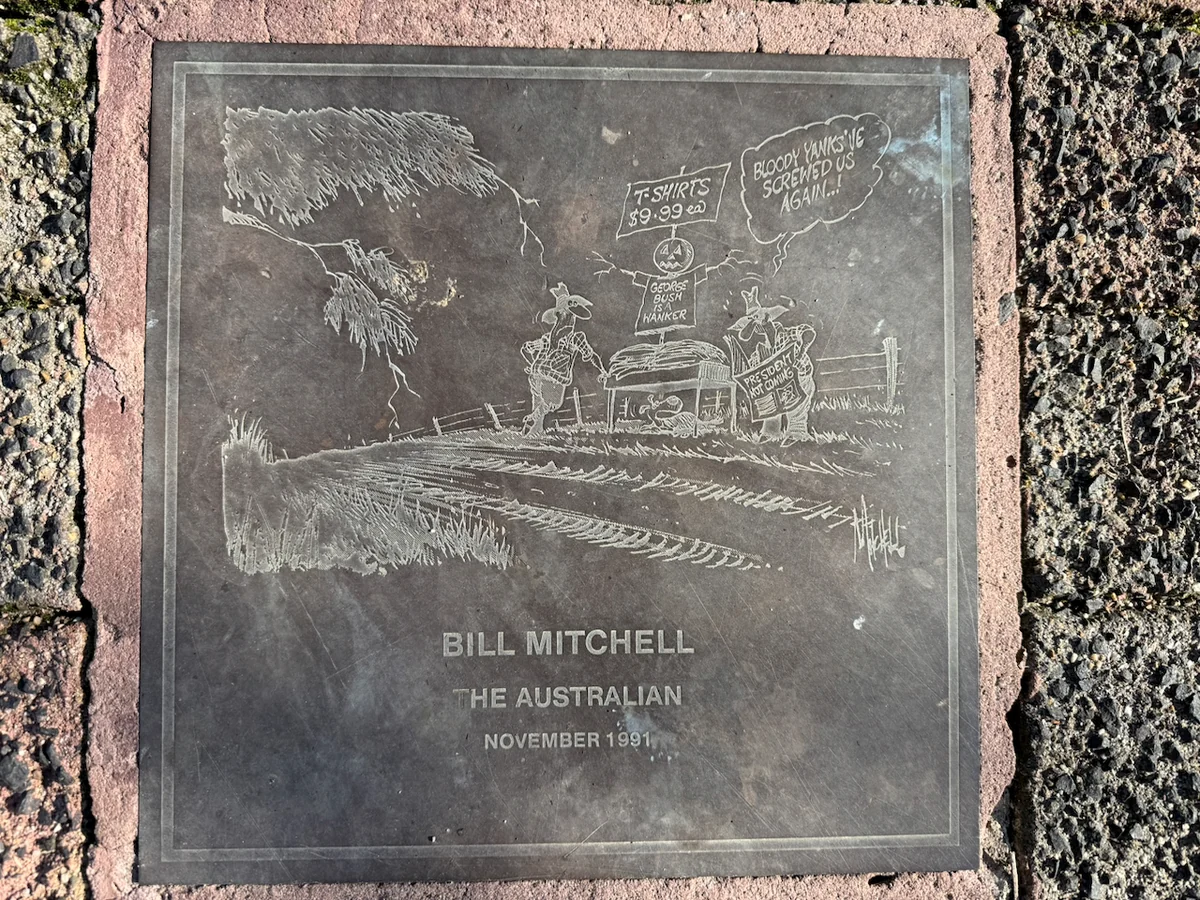
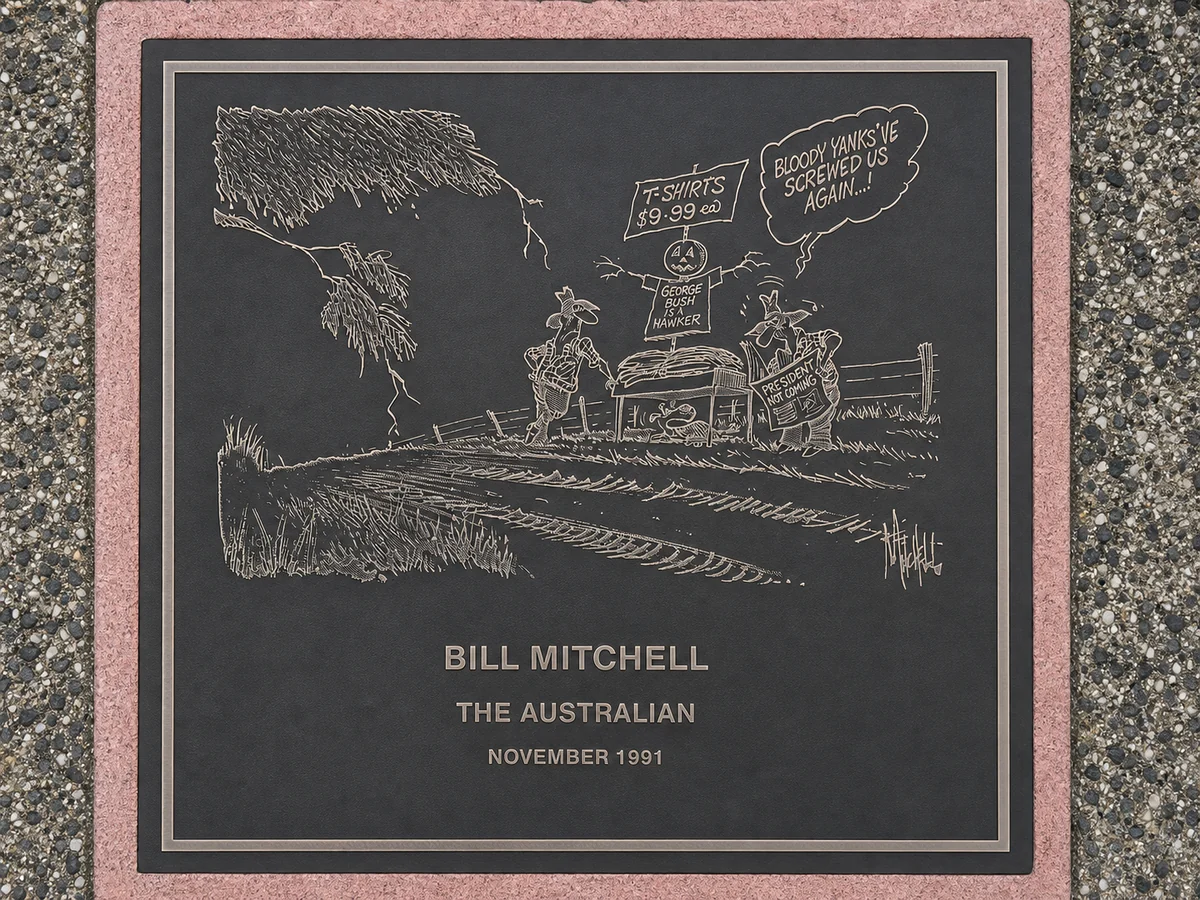
Bill Mitchell makes his point with two kangaroos. His plaque, credited to The Australian and dated November 1991, turns a familiar national figure into a sharp exchange about Australia and America. Mitchell spent his career reducing large political arguments to a few purposeful lines. Three Stanley awards recognised the editorial cartoonist whose work helped shape the character of The Australian.
The metal changes the encounter with his work. A newspaper cartoon usually arrives surrounded by headlines and the urgency of its day. Here the two kangaroos wait at walking pace. The reader supplies the pause.
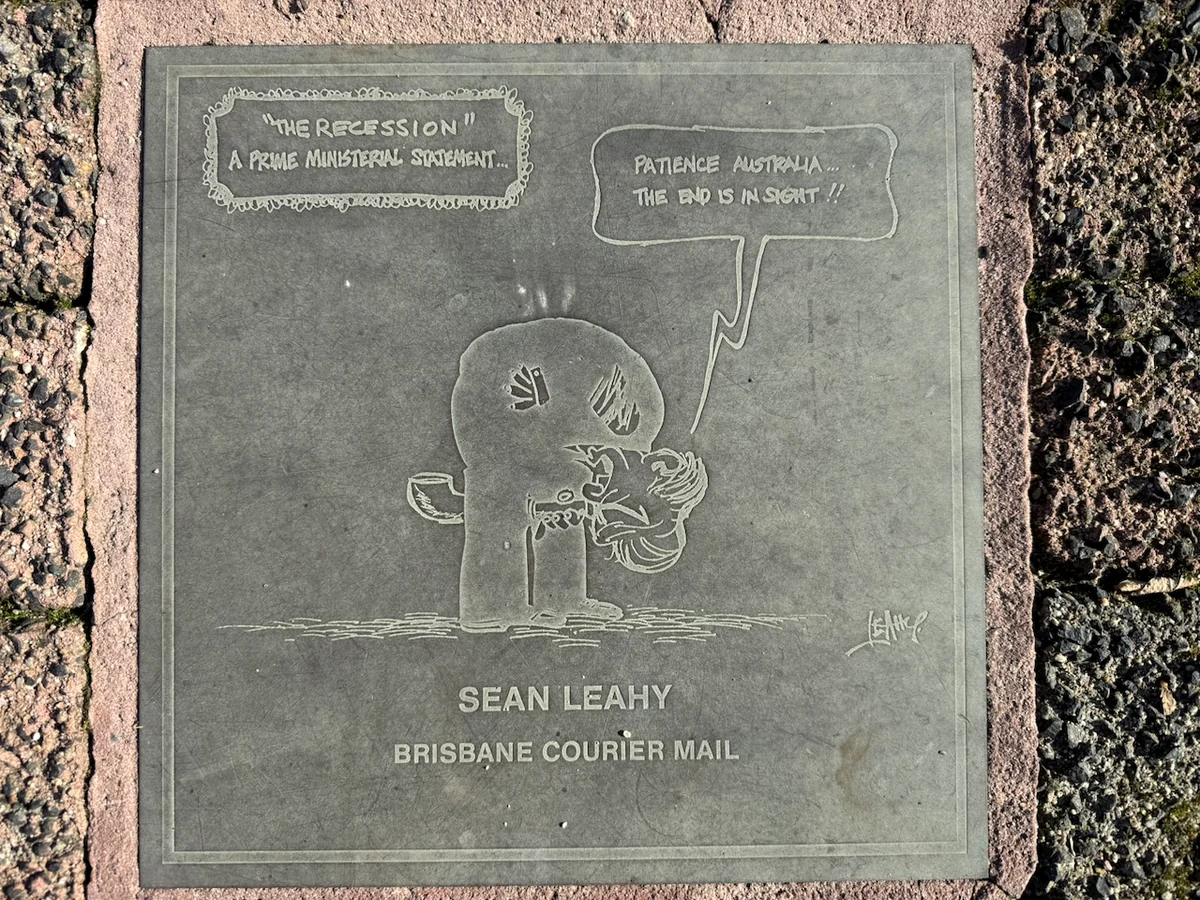
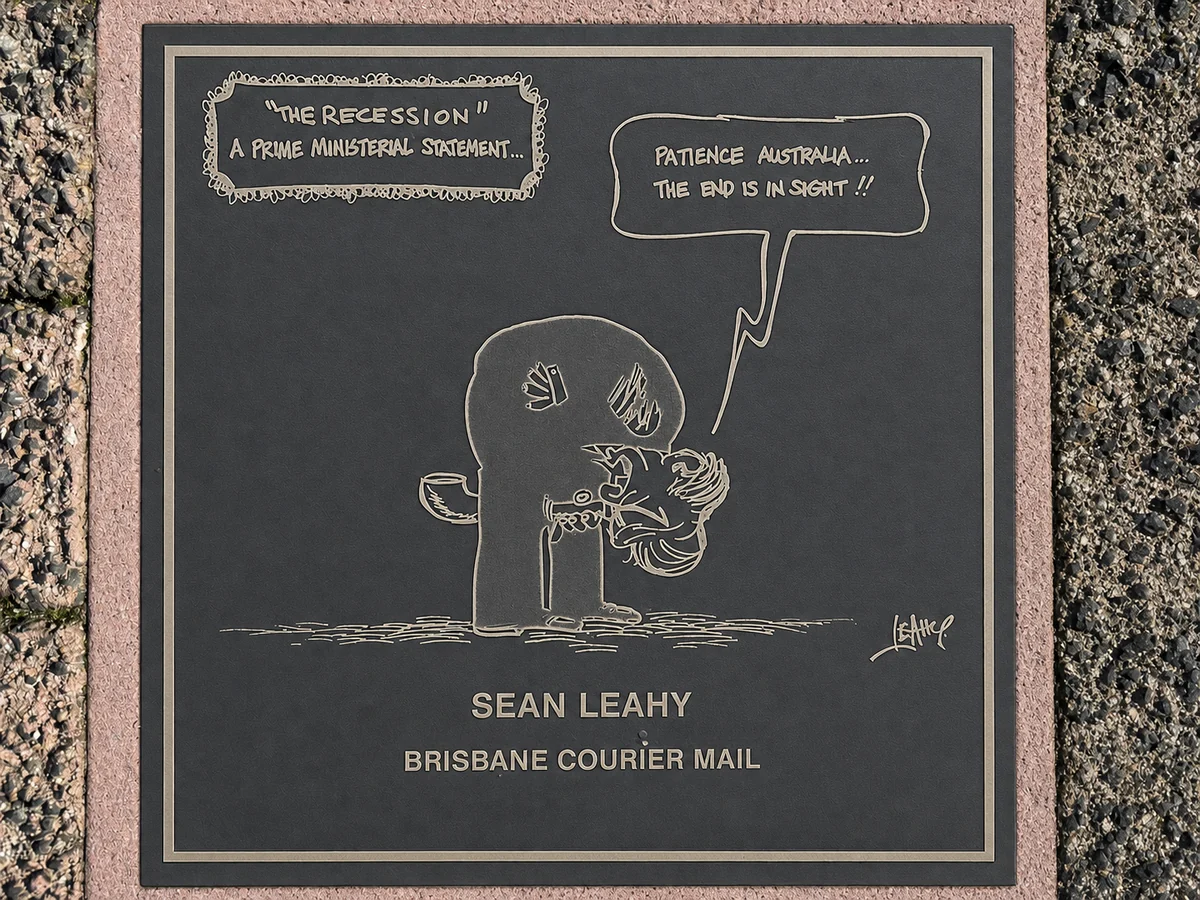
Sean Leahy uses the weight of a body to tell the story. In the plaque credited to the Brisbane Courier Mail, a figure bends beneath “The Recession” while a promise that the end is in sight delivers the sting. The joke comes from the distance between hopeful words and the load the figure is already carrying.
Leahy drew political cartoons for the Courier Mail after newspaper roles in Queensland and Western Australia, and he created the comic strip Beyond the Black Stump. On the Moe plaque, one stooped figure carries the pressure of an economic period.
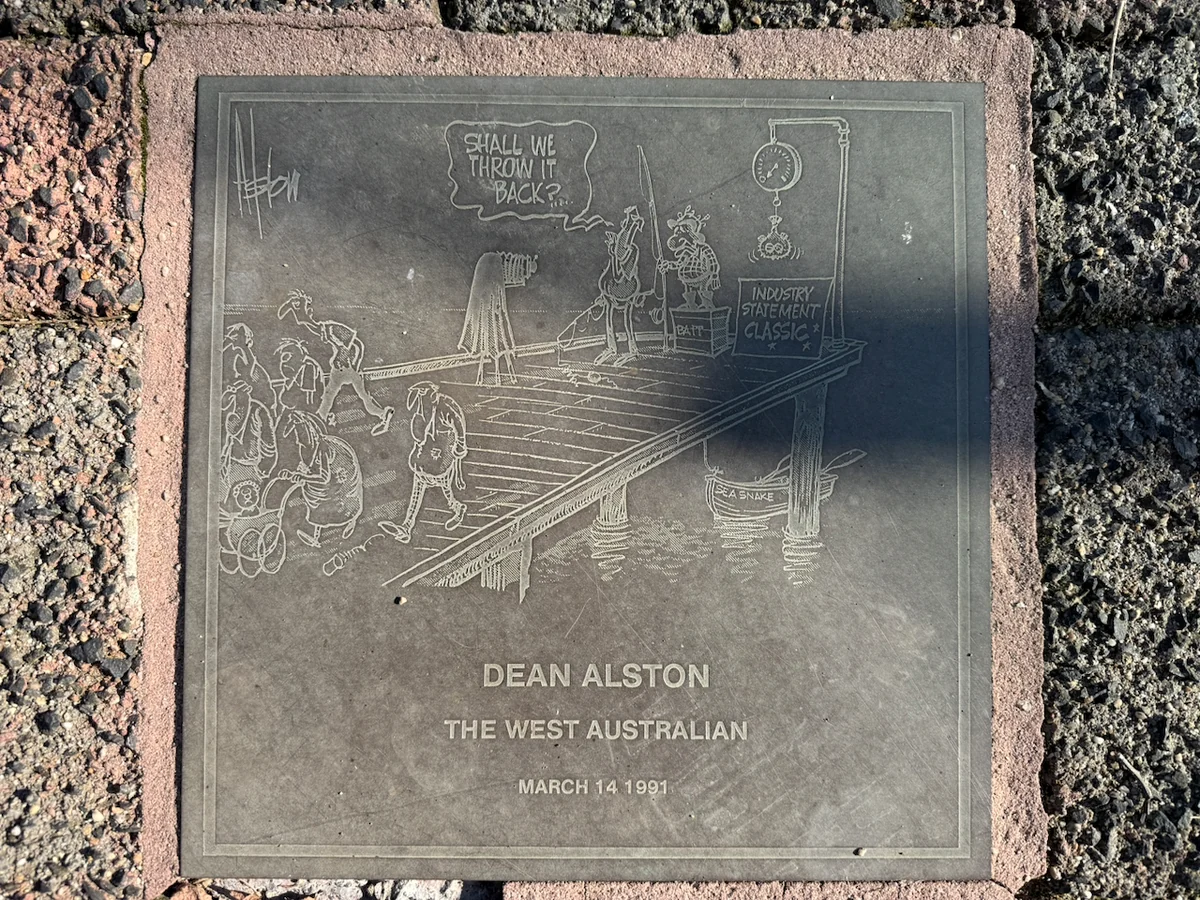
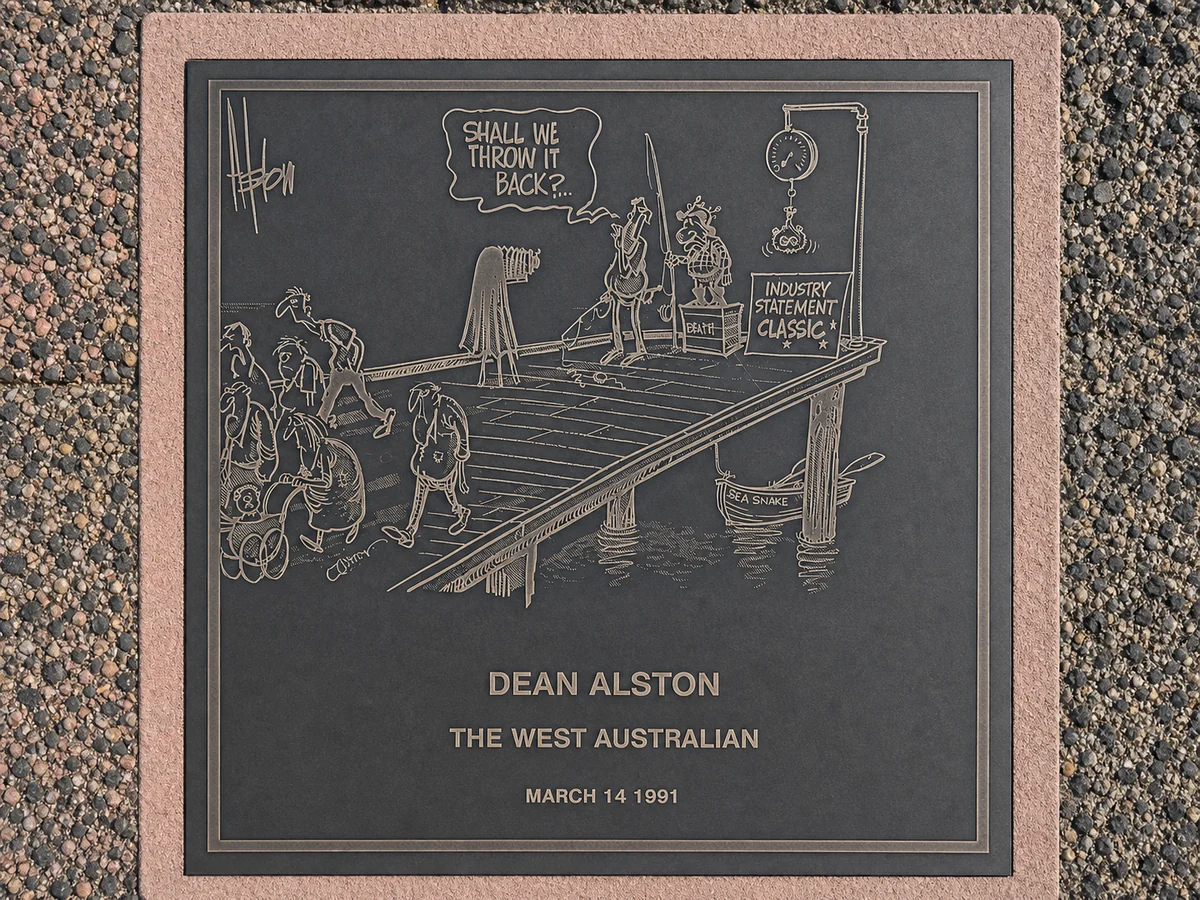
Dean Alston takes a darker line. His plaque for The West Australian, dated 14 March 1991, turns an industry statement into a gallows scene. A crowd moves towards the platform. Policy becomes consequence in a single severe image.
Alston had joined The West Australian in 1986 and began drawing its editorial cartoons the following year. By 1991, the Walkley Awards had named him the winner for Best Cartoon. His Moe work shows the economy that makes editorial cartooning so potent: the drawing gives an abstract public argument a human shape.
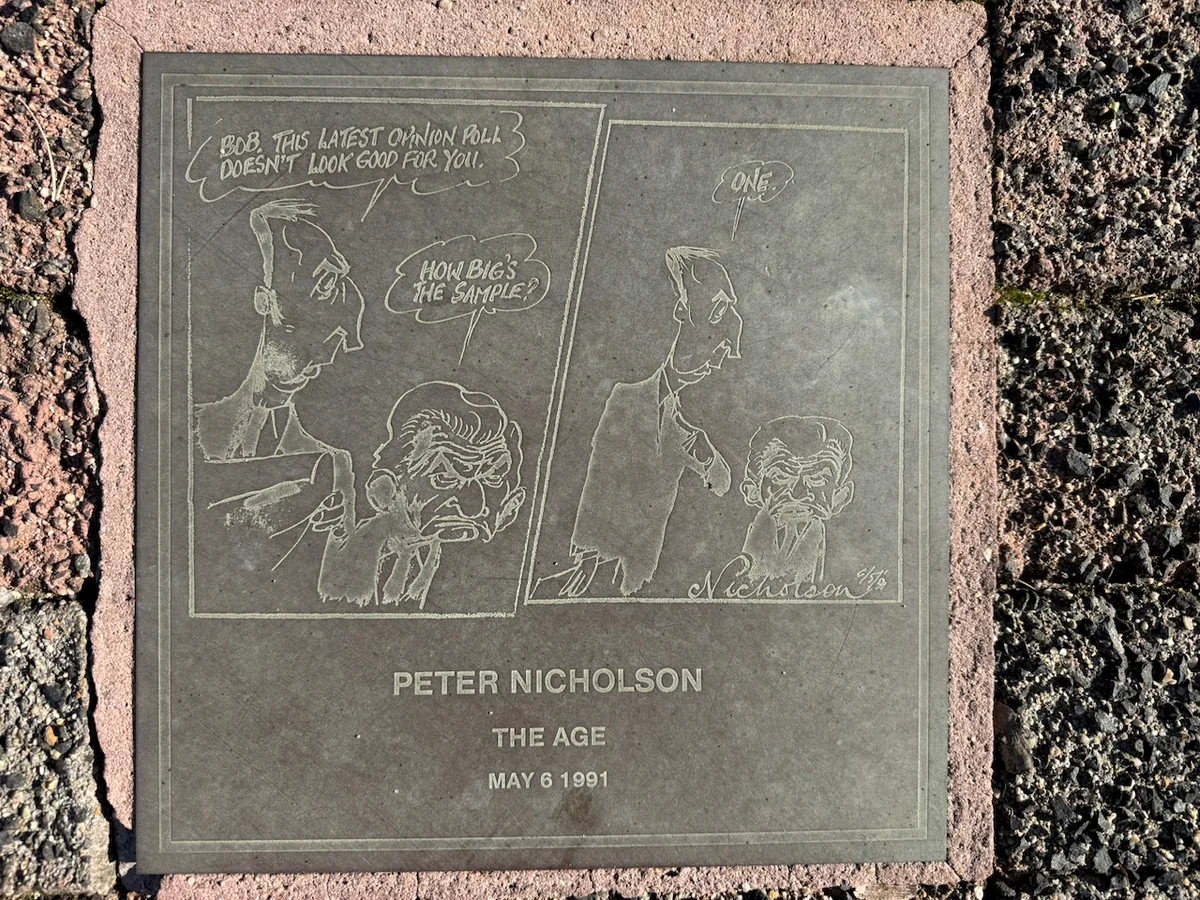
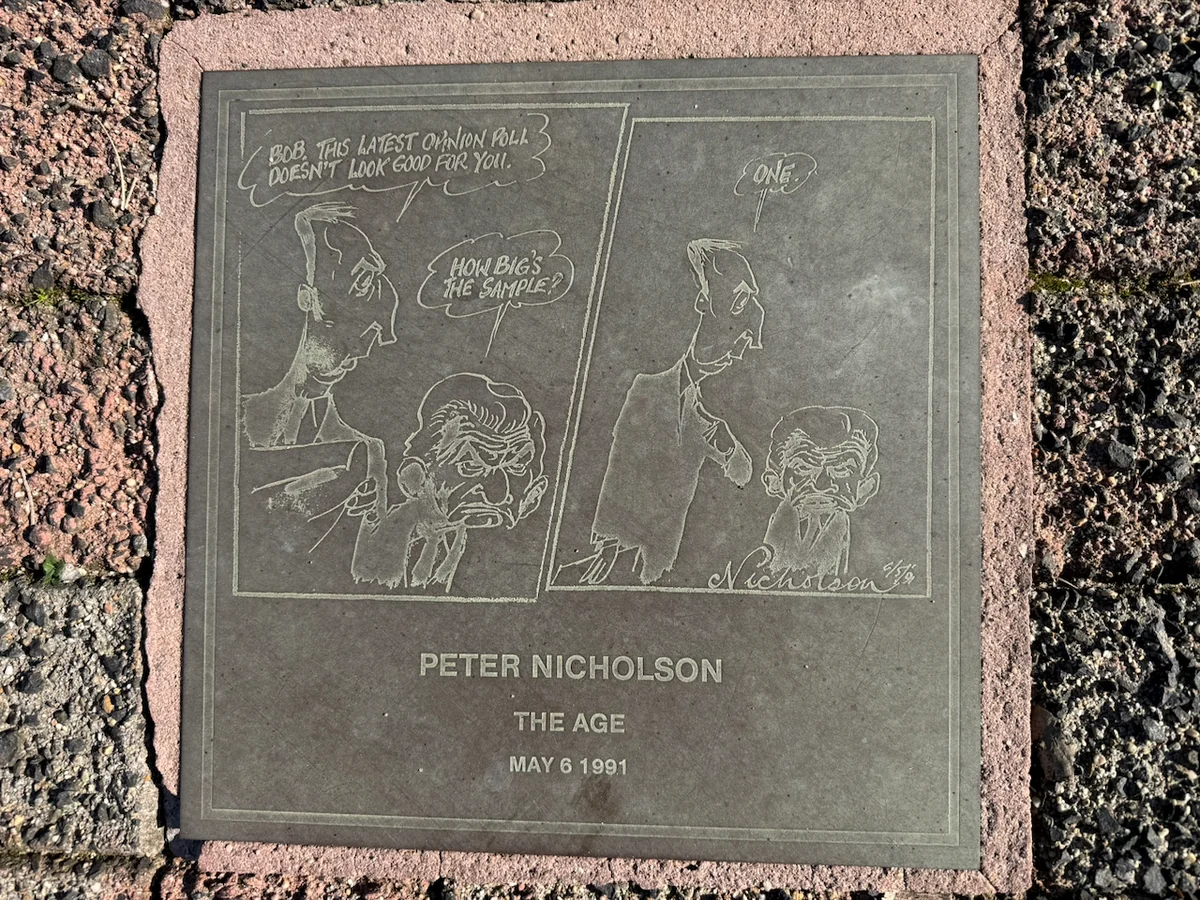
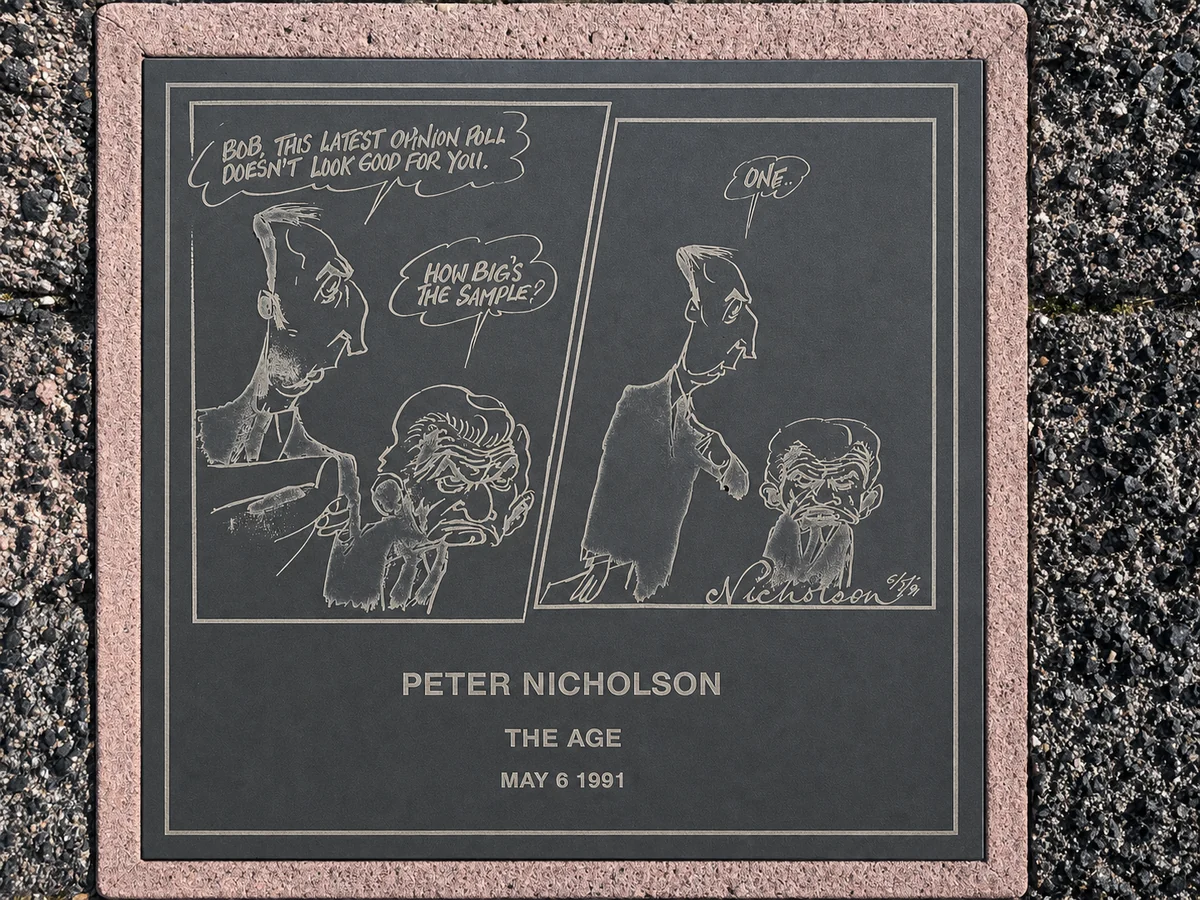
Peter Nicholson brings Bob Hawke into a compact exchange about opinion polling. The plaque, credited to The Age and dated 6 May 1991, catches the peculiar pressure of politics measured through percentages, approval and the next result.
Nicholson spent seventeen years at The Age. He also created Rubbery Figures, carrying his political caricatures from the newspaper page to television. The Walkley Awards named him the 1991 winner for Best Illustration. His work could make a public figure immediately recognisable, then let the conversation reveal the predicament.
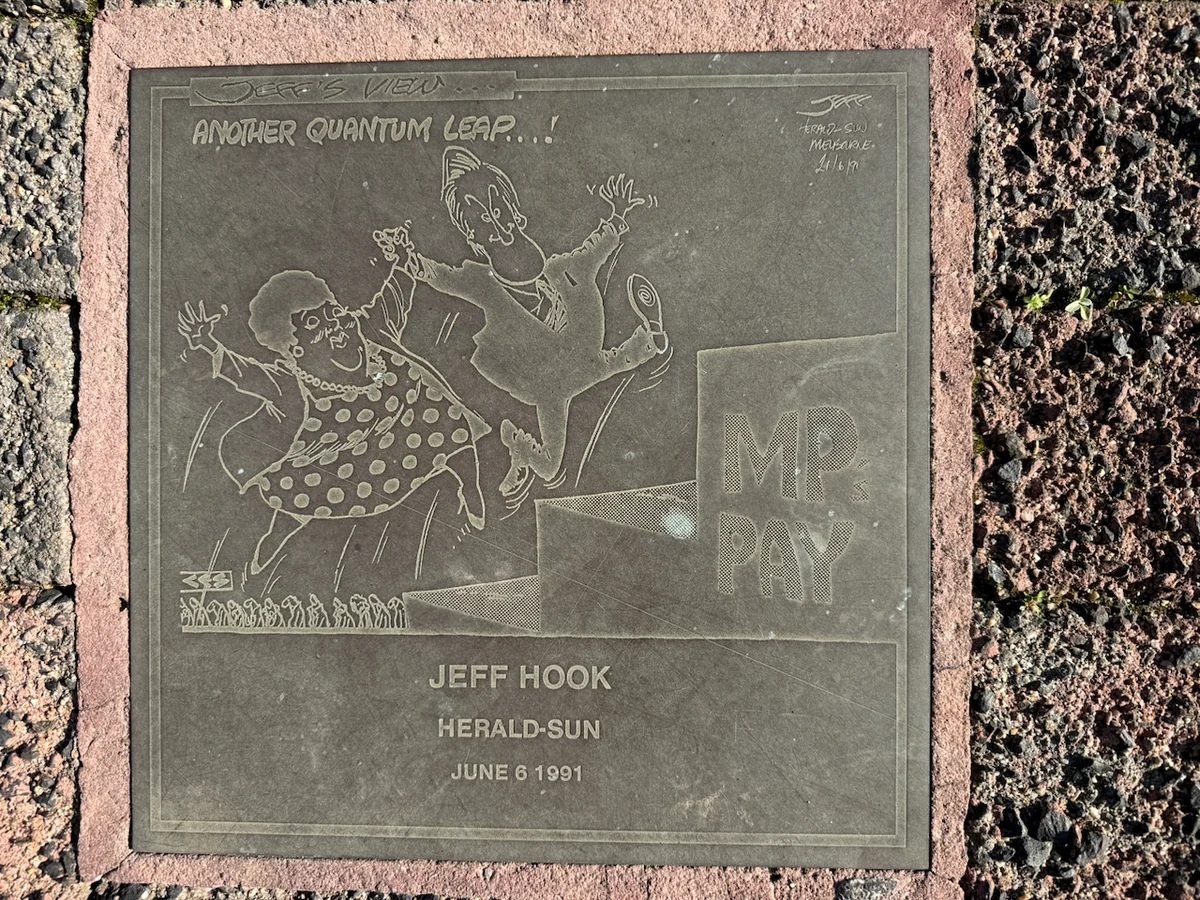
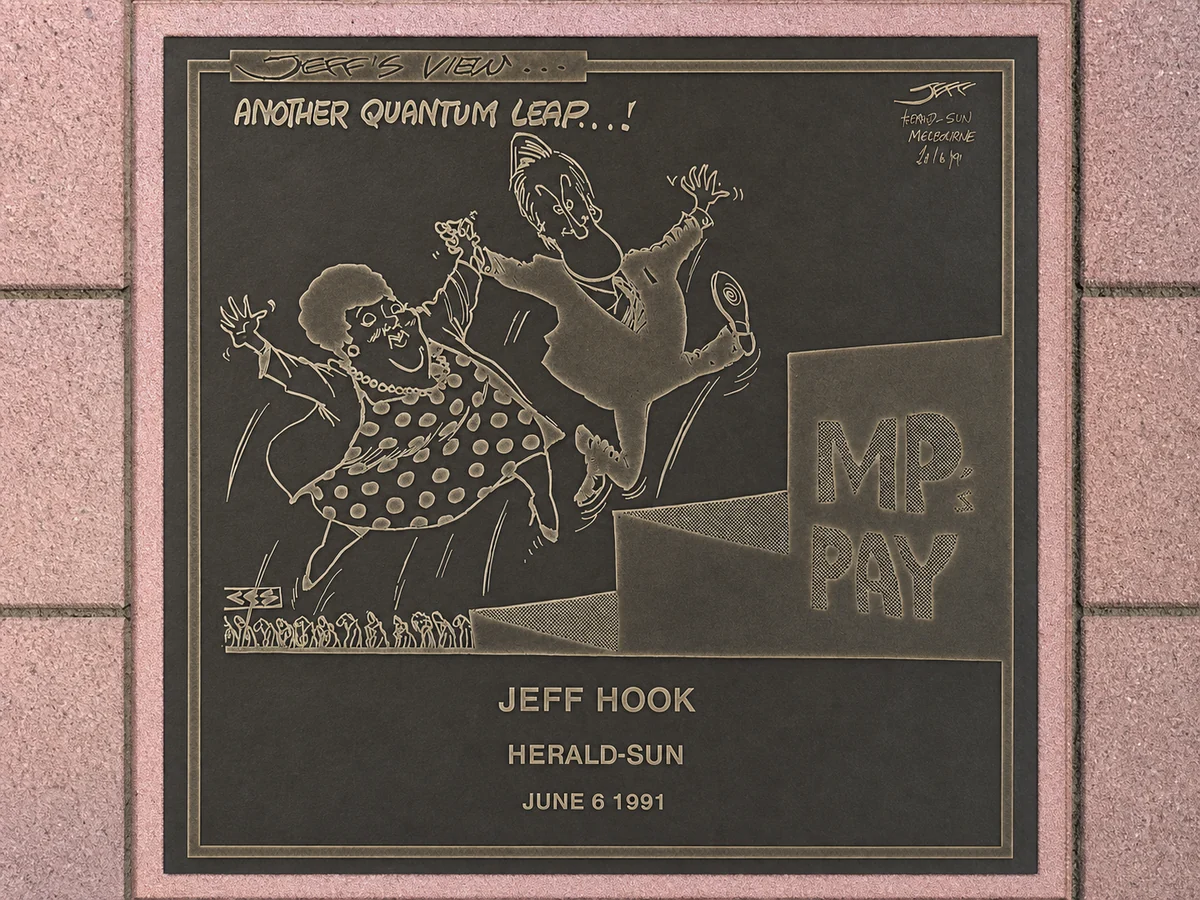
Jeff Hook’s plaque turns to politicians and MPs’ pay. Credited to the Herald-Sun and dated 6 June 1991, it draws its figures beside a set of marked steps. Hook had been drawing for the Sun and Herald-Sun newspaper group since 1964, building a relationship with generations of readers.
He gave those readers another reason to stay with each picture. Somewhere in his cartoons, Hook hid a tiny fishhook.
Finding it changes the pace again. The eye leaves the words and follows the engraved marks, searching through jackets, limbs and the edges of the scene. Hook’s private game with his readers survives inside the public footpath, waiting for the next person willing to crouch down and look.
That same year, Hook received a Best Press Cartoon award at the International Cartoon Festival in Knokke-Heist, Belgium. Alston and Nicholson received their Walkley honours. Mitchell’s Stanley awards and Leahy’s long newspaper career complete a group with deep standing in Australian cartooning.
Their five Moe plaques also preserve the craft they shared. Each artist had only a small space in which to make a reader recognise a person, understand an issue and feel the turn of the joke. A posture could carry a recession. A face could carry the state of national politics. Two kangaroos could carry a debate about Australia’s place in the world.
The news cycle moved on. The engraved lines took on another life beneath Moe’s feet. Weather has softened them, passing shoes have crossed them and the subjects have become history. The act of looking still brings each cartoon back into the present.
One person may stop for Hawke. Another may recognise Mitchell’s kangaroos or Alston’s uncompromising scene. Someone else will search for Hook’s fishhook and feel the small satisfaction of finding it.
Five artists are waiting in on the Moore Street footpath as a gallery each time somebody looks down.
Image 1 of 6
Sources
The story draws on the seven supplied documentary photographs and inspected biographical and award records.
- Australian Media Hall of Fame — Bill Mitchell
- Museum of Australian Democracy — Sean Leahy
- National Museum of Australia — Dean Alston
- National Museum of Australia — Peter Nicholson
- Peter Nicholson — first-party biography
- Walkley Winners Archive
- Jeff Hook — first-party biography
- Jeff Hook — Hanging up the hook
- Design & Art Australia Online — Jeff Hook