

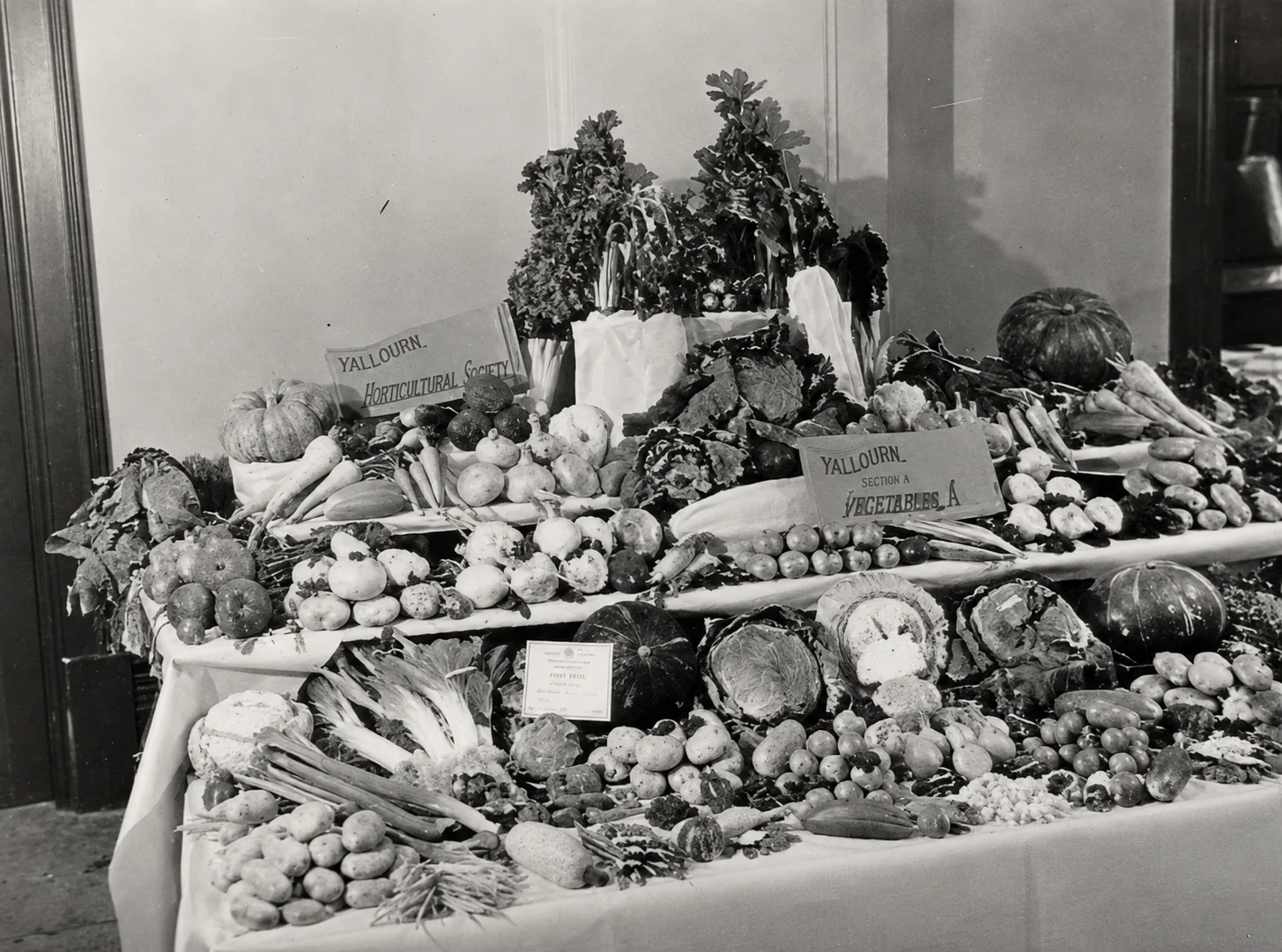
At a Yallourn horticultural show, the gardens arrived indoors one exhibit at a time. Sweet peas, pansies, stocks and irises entered the room beside bowls of roses, mixed arrangements and vegetables. Each contribution had begun in separate ground under the attention of a different gardener.
A Morwell Advertiser report from November 1945, reproduced in the Yallourn Association's history, records that variety. The categories moved between growing and presentation: first the ability to cultivate a plant, then the judgement to arrange colour, form and balance for other people to see.
The Yallourn and District Horticultural Society created the meeting point. Its shows gave residents a structure for comparing results, sharing knowledge and recognising care taking place beyond the Commission's public gardens.
The society also helped gardeners respond to larger needs. During the war years, when households were encouraged to grow vegetables, it obtained lime and fertiliser for members at wholesale prices. A shared organisation gave individual plots practical support and helped domestic cultivation contribute to food production.
Jock Lawson helped sustain this public life. Local accounts credit him with assisting the society's establishment and record life memberships for Jock and Nan Lawson alongside other long-serving members. Their service extended from what they grew into the organisation that kept gardeners connected.
Awards for home gardens carried recognition back outside. Local material records the use of Fawkner Medal recognition, showing that care performed behind a household boundary could become part of how the town understood itself.
Competition gave the activity shape, but the larger movement ran between private effort and shared value. A plant could be raised by one person, carried into a show and placed beside the work of neighbours. Methods travelled with it. Service kept the society operating. Recognition encouraged residents to look again at the gardens around them.
The historical record does not claim universal participation, and the competitions reflected the standards of their time. What survives clearly is a community building structures around cultivation: a society, shows, practical support, service and public acknowledgement.
On the show bench, a bowl of roses stood beside vegetables. For a short time, the gardens of the town occupied one room, and residents could see what their separate work had created together.
The Evidence
- A10-S01Yallourn Association newsletter, January 2016
- A10-S02Virtual Yallourn, Jock Lawson and bowling club
- A10-S03Canonical SJMM Jock Lawson story
- A10-S04PROV Yallourn archive overview
- A10-S05Power of Colour Brand Foundation v1.1 and Development Reference for contemporary relationship