

Archival photographs hold Yallourn at two scales. The open cut, rail lines and power-station structures fill one frame. In another, houses sit behind gardens, trees line streets and people gather at civic or sporting grounds.
Both landscapes grew from the same undertaking.
From the 1920s, the State Electricity Commission developed the Latrobe Valley's brown coal for electricity generation. The work required a stable workforce. Those workers needed homes, and their families needed schools, shops, health care, recreation and places to meet.
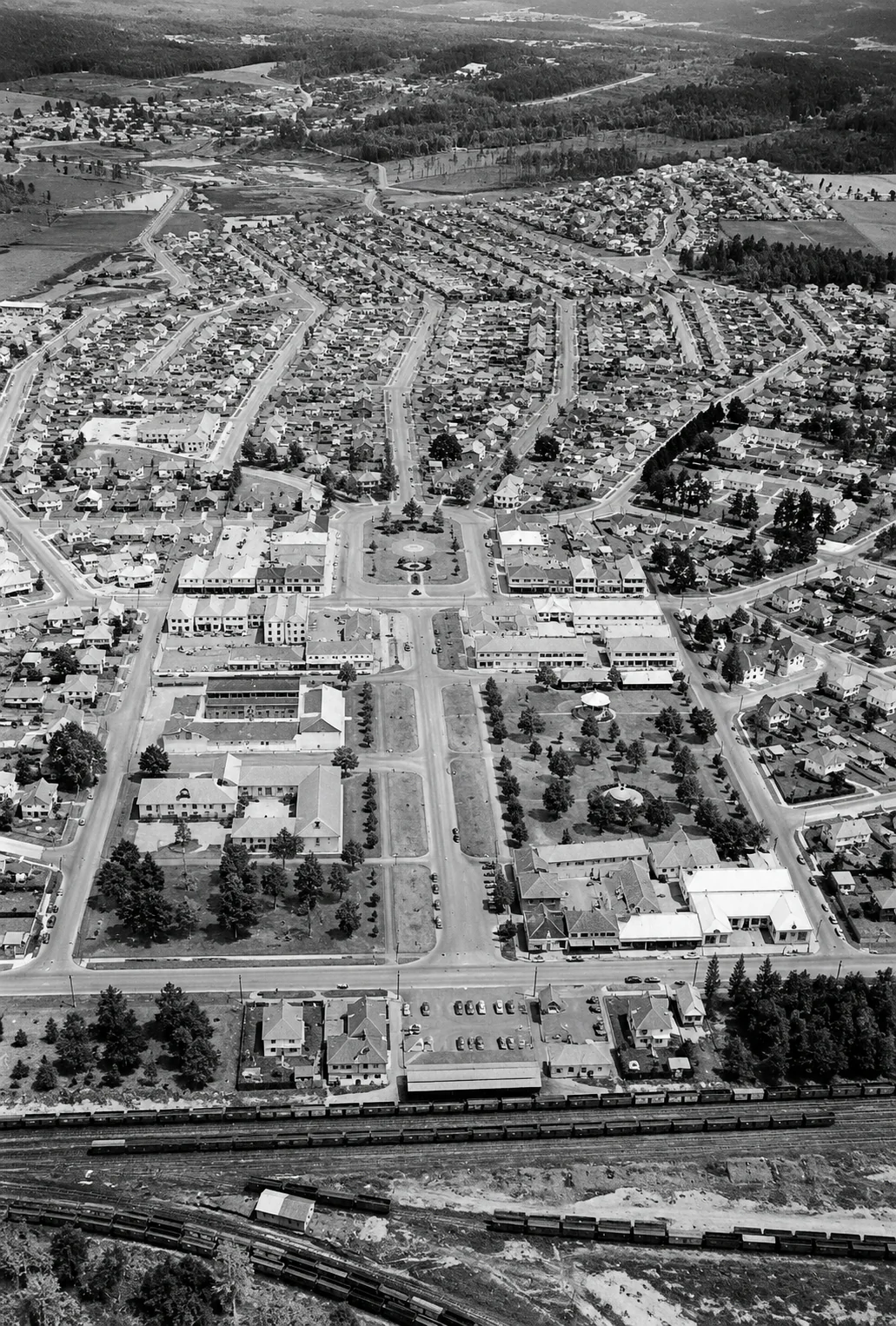
The Commission's 1921 plan placed a town square near the shopping centre and sent streets outward with the topography. Broadway led towards the railway station. Parks, gardens, public planting and a green belt entered the design, while generous home blocks gave households room to grow food and flowers.
A. R. La Gerche shaped the town plan and Hugh Linaker designed its early landscape. Road crews, builders, nursery workers and gardeners turned their intentions into streets and living ground. Residents then added their own labour behind front fences and their own routines to public facilities.
The two systems kept different time. Coal had to move and equipment had to operate as soon as it entered service. Trees needed years to establish. Hedges thickened through repeated cutting. Soil and sporting turf improved because people returned to them.
John “Jock” Lawson and Yallourn's gardening teams carried much of that long work. Their program reached civic gardens, schools, streets, reserves and sporting grounds. The nursery supplied plants for new work, seasonal renewal and replacement. Firebreaks connected horticultural knowledge with the safety of a town beside brown-coal workings.
Yallourn became known through electricity and presentation, but the gardens grew within a complicated civic structure. The Commission employed much of the population while owning most land and buildings and administering the town. It invested in workers' surroundings and concentrated authority in the same institution.
Residents still made lives that exceeded the plan. They formed clubs and societies, played sport, entered horticultural shows and turned houses into homes. Repetition made particular streets, gardens and routes familiar.
Coal eventually reversed the relationship. Mining expansion led the Commission to close and remove Yallourn. Houses moved or were demolished, streets disappeared and public landscapes lost the community for which they had been grown.
Former residents carried photographs, objects, relocated houses and memories into other towns. Their stories preserve the human scale beside the industrial one: the shade on a route to school, the work behind a sporting surface, the garden seen from a front door. Those surroundings became part of what powering Victoria meant to the people who lived beside the machinery.
The Evidence
- A05-S01PROV, “The town that was — Yallourn”
- A05-S02Latrobe City Heritage Study
- A05-S03Victorian DTP, Latrobe Valley Social History
- A05-S04EnergyAustralia, “History — Yallourn Power Station”
- A05-S05Power of Colour Brand Foundation v1.1, internal approved source