

The Public Record Office Victoria holds pages and plans prepared before Yallourn had mature streets, a civic square or gardens. In 1921, the State Electricity Commission was still deciding how a new town should take shape beside the Latrobe Valley's brown-coal undertaking.
The industrial need was immediate. Mines, power stations, railways and workshops required a permanent workforce. Workers brought families, and family life required homes, schools, shops, health care, recreation and places to meet. The Commission had to decide what kind of town would surround the work.
Its planners inherited an international answer. Ebenezer Howard had published his garden-city proposal in England in 1898. Letchworth began five years later, followed by Welwyn Garden City in 1920. Books, diagrams, professional discussion and built examples carried a model that connected housing, employment, green space, civic facilities and transport.
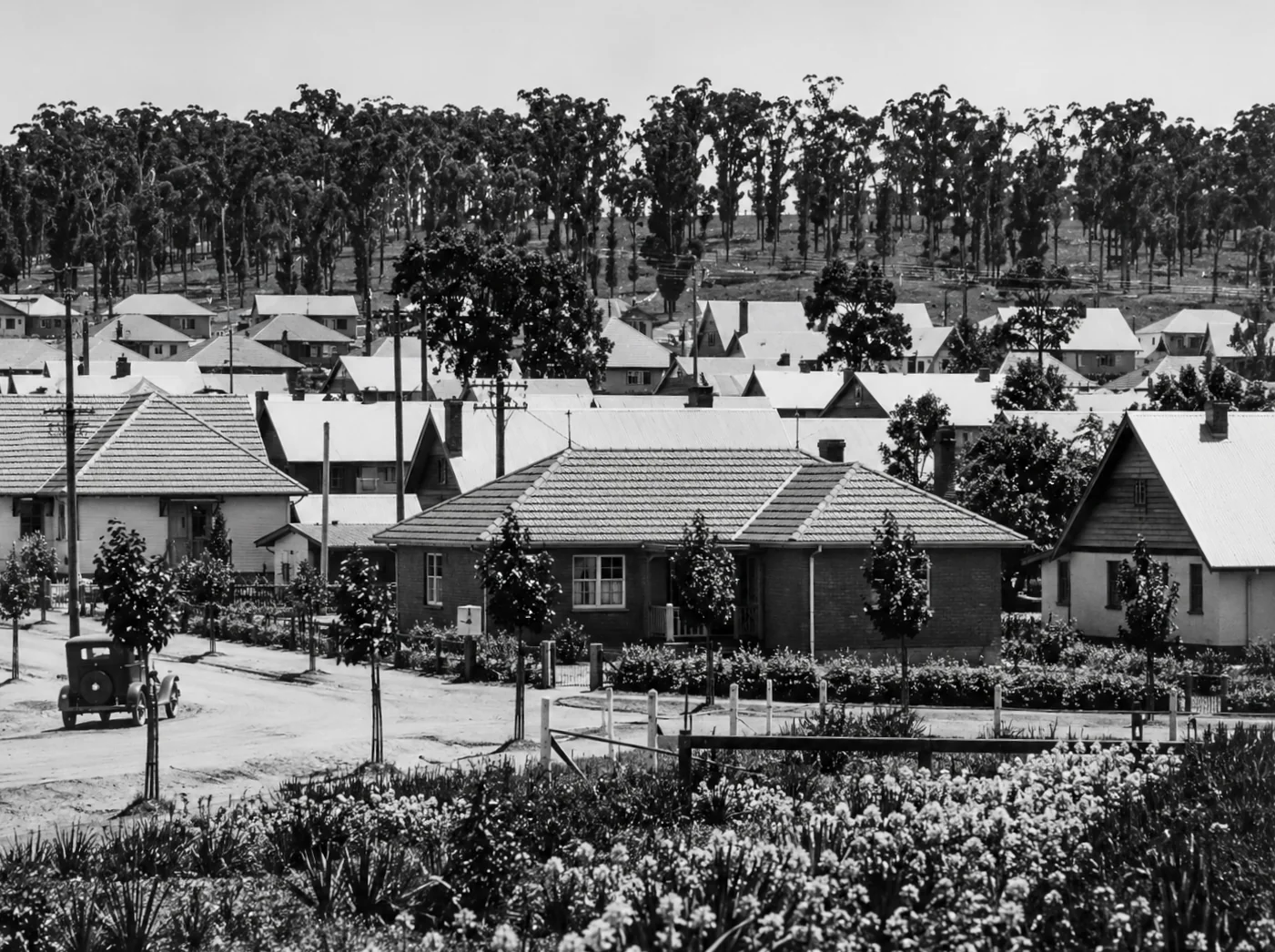
State Electricity Commission architect A. R. La Gerche is credited with Yallourn's 1921 plan. He placed a town square at the centre and sent streets outward with the topography. Published planning accounts describe Broadway linking the shopping centre and railway station, while domestic blocks gave households room for gardens and food growing.
Landscape gardener Hugh Linaker designed parks, gardens and extensive street planting. His work made green space and recreation part of the town's structure from the beginning. La Gerche organised movement and civic relationships; Linaker gave those relationships a living form that would develop across years.
Their plans then passed into other hands. Road crews and builders formed streets and houses. Nursery workers and gardeners established trees, beds and reserves. Residents planted domestic ground, used sporting facilities and created associations within the spaces first described on paper.
Yallourn carried selected garden-city principles into an industrial landscape. Its ownership followed the logic of the electricity undertaking: the Commission owned and administered the town and employed much of its population. Howard's community stewardship model gave way to concentrated public authority.
Howard therefore belongs to Yallourn's story as an influence on the movement. La Gerche, Linaker, Commission staff, construction workers, gardeners and residents belong to it as the people who created the local place.
The 1921 report captured relationships before anyone could live inside them. Years of construction, planting, maintenance and ordinary use tested those relationships on the ground. That is how the idea reached Latrobe—not intact, but translated through local decisions into a town built for power and daily life.
The Evidence
- A04-S01Public Record Office Victoria, “The town that was — Yallourn”
- A04-S02Latrobe City Council, Latrobe City Heritage Study 2008
- A04-S03Historic England, English Garden Cities
- A04-S04Ronald Freestone, “The garden city idea in Australia” (1982)
- A04-S05Virtual Yallourn, “Yallourn — A Planned Town — The 1920s Part 1”
Sources reviewed 15 August 2026.