

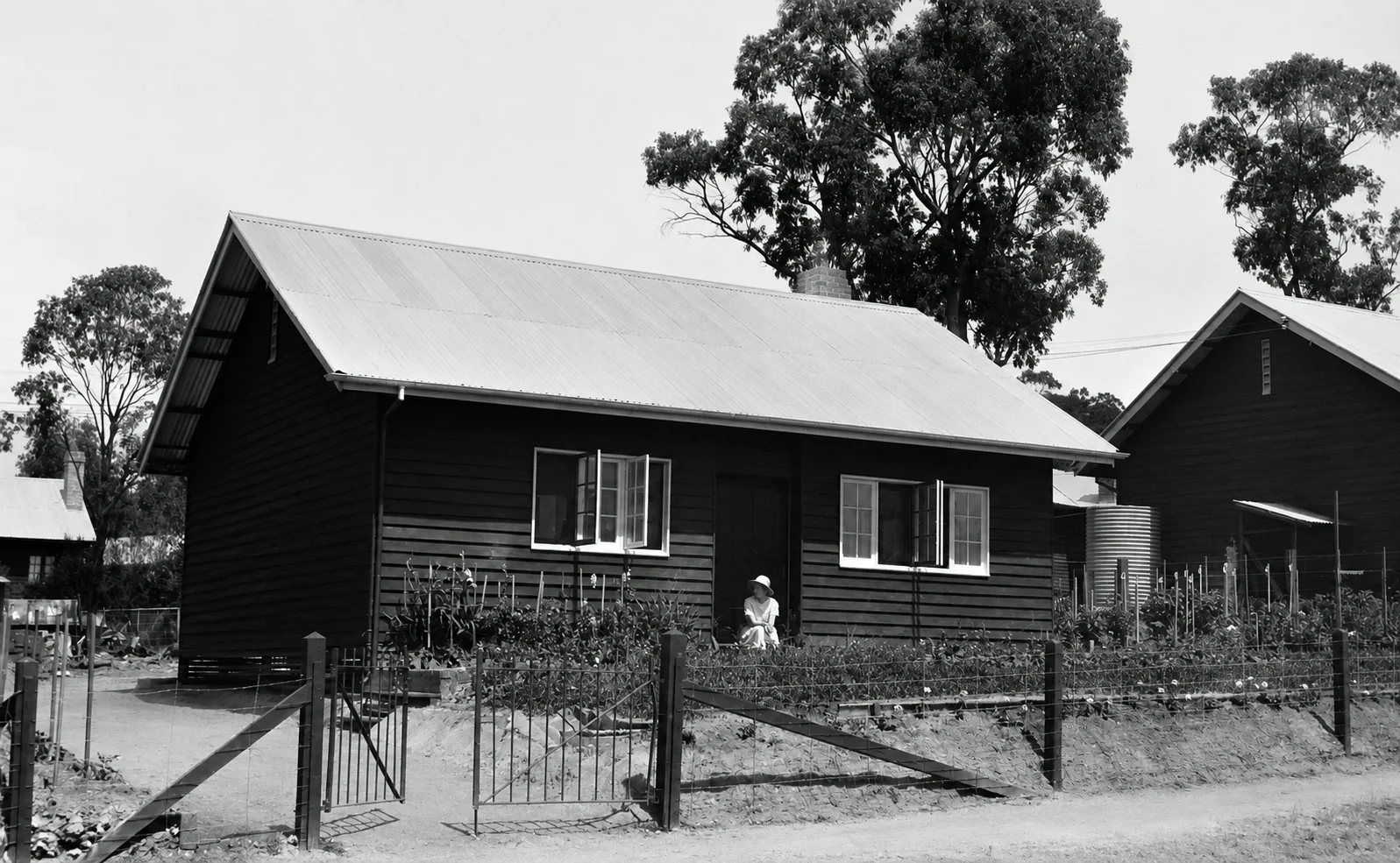
The State Electricity Commission left open ground around Yallourn's houses. Its 1921 planning provided room for vegetable growing at each home, while General Sir John Monash's brief is remembered more broadly as a block large enough for a tenant to keep a horse and a garden.
The scale mattered because it carried the garden-city idea across the front boundary. Public trees and planting gave continuity to streets of houses with recognisable forms and locally made terracotta tiles. Inside each block, residents decided what the garden would become.
One household could grow food; another could favour flowers. The public nursery supplied the town and was intended to support home gardens as well as civic planting. Residents could share plants, learn what suited local conditions and make choices that differed from the formal landscapes nearby.
During the Second World War, this domestic capacity acquired greater urgency. Local histories record that between 1940 and 1944 residents were encouraged to turn gardens towards vegetables. The Yallourn and District Horticultural Society helped members obtain lime and fertiliser at wholesale prices, connecting separate household plots through practical support.
Flowers remained part of the same culture. Horticultural shows placed sweet peas, pansies, roses, irises and mixed arrangements beside vegetables. Food and beauty came from the same domestic ground and from residents responding to the same seasons in different ways.
These gardens gave people agency within a centrally planned company town. La Gerche's streets and the Commission's housing program created the capacity; households supplied cultivation. They prepared soil, selected plants and decided how the garden would meet paths, kitchens and the street.
The opportunity was real, but household circumstances varied. The Commission remained employer, landlord and administrator. Residents had different amounts of time, interest, money and physical ability. Open ground allowed action without producing one uniform garden at every door.
That variation was the point at which design became lived experience. Public parks and avenues expressed planning at civic scale. Home gardens brought weather, work, family need and personal taste into the same regional idea.
The house provided shelter. The ground around it provided room to act. At the kitchen door, Yallourn's planned landscape passed into the hands of the people who lived there.
The Evidence
- A09-S01PROV, “The town that was — Yallourn”
- A09-S02EnergyAustralia, Yallourn history
- A09-S03Virtual Yallourn, planned town
- A09-S04R. C. Spaull, A Brief History About the Homes of Yallourn
- A09-S05Yallourn Association newsletter, January 2016
- A09-S06Victorian Government Library Service, Our House bibliography/house histories